

The Moment Everyone Skips
Strike a match. Run a current through a neon tube. Drop a pinch of sodium into a flame and watch it burn orange. Light comes out of atoms constantly, and every textbook explains it in the same two sentences: an electron absorbs energy and jumps to a higher energy level; later it falls back down, and as it falls it emits a photon.
Read that again slowly, because an enormous amount is hidden inside those two verbs.
What jumped? An electron is supposed to be a point — no size, no parts, no interior. How does a point move from one orbit to another without crossing the space in between? And when it comes back down, where was the photon stored? Was it tucked inside the electron, waiting? Was it inside the atom? If the electron has no parts, there is nothing in it to let go of. So the photon must be made at the instant of emission, out of nothing, by something.
Ask a physicist and the answer is that the photon is created by an excitation of the electromagnetic field. That is a sentence about bookkeeping, not about matter. It tells you which number goes up and which goes down. It does not tell you what physically left the atom, what it was made of, or where it was a moment earlier.
The four universal motions answer those questions directly — and the answer starts by throwing out the idea that an electron is one particle.
An Electron Is Not One Thing
In this model, the electron is not a particle. It is a quanta — a population of enormously smaller particles that the atom holds around its nucleus. These are G1 particles: the same particles that make up gravity, light, magnetism, and electric current. They are not charged. There is no such thing as charge here. There is only motion.
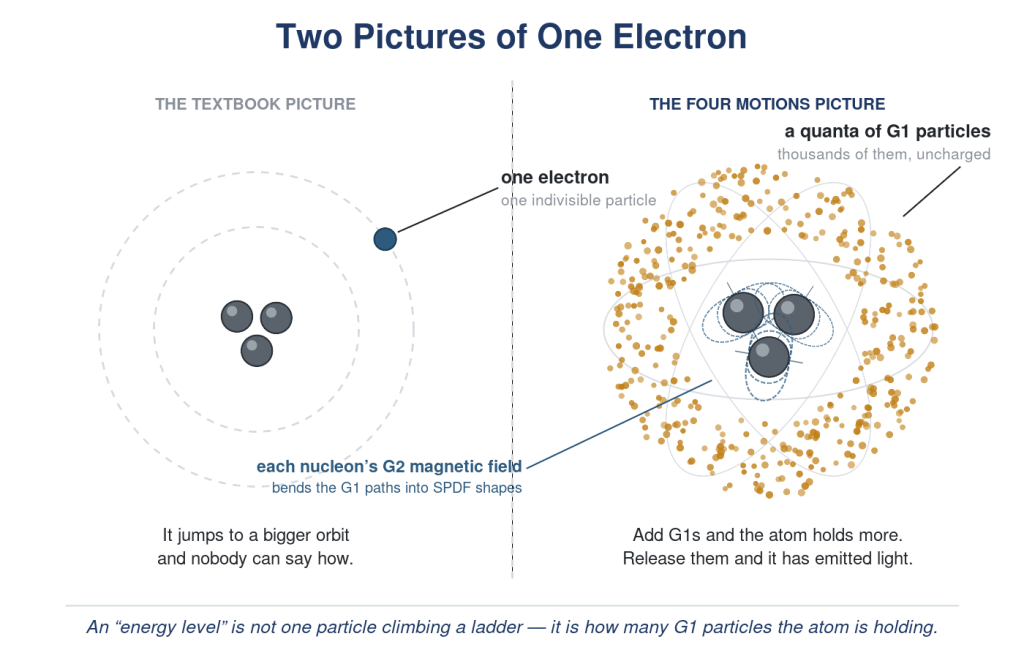
Once you make that one change, the whole mystery of emission dissolves. A point particle has nothing inside it to release, so a photon has to be conjured. But a population of particles can grow and shrink. It can take some on. It can let some go. Nothing has to be created, and nothing has to be destroyed — things only have to move.
What Holds the Cloud in Shape
If the G1 particles are not charged, what keeps them from flying off? Two motions, both operating one level down from the gravity and magnetism we see in the sky.
The first is G2 gravitic motion. What Coulomb wrote as an attraction between charges is really gravitation at the atomic level, carried by particles far smaller and faster than the ones that hold planets to stars. This is why Coulomb’s equation and Newton’s equation have exactly the same form — they are the same kind of motion at two different scales. The nucleus holds the G1 cloud the way a star holds its planets, with no charge required.
The second is G2 magnetic motion, and this is the part that does the real work. Gravity alone would give you circles and ellipses. Atoms do not have circles and ellipses — they have the lobed, dumbbell, and clover-shaped regions that chemistry calls the S, P, D, and F orbitals. Those shapes come from magnetism, and the key point is where that magnetism lives: every nucleon has its own magnetic field, in exactly the way the Earth has one. Not one field belonging to the nucleus as a whole — one field per nucleon, each with its own poles, each tilted its own way.
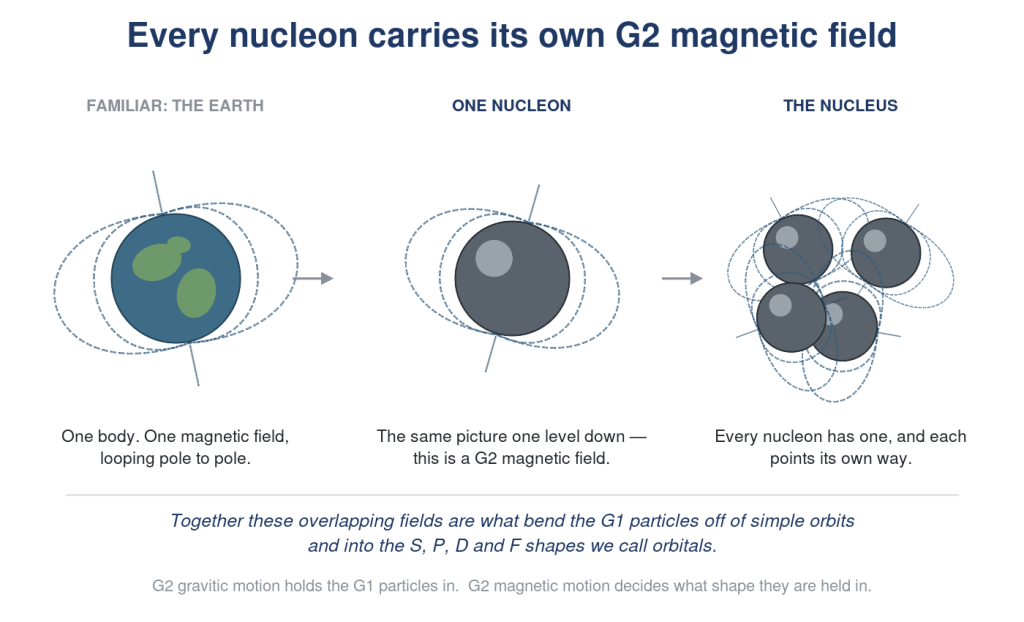
Those overlapping fields attract, repel, and settle into balance through the Dinu Effect of magnetic motion, and in doing so they push and pull the G1 particles off of simple orbits and into the stable, complicated paths we actually measure. The orbital shapes in every chemistry book are not probability clouds standing in for our ignorance. They are the shape of the traffic pattern.

So the atom is a container. Not a box with walls, but a region of motion that can hold a certain population of G1 particles in a certain arrangement. Keep that word — hold. Everything else follows from it.
Absorbing Light Is Taking On More G1 Particles
Here is the piece that makes the whole model click: the light arriving at the atom is already made of G1 particles. Light, in the four motions, is luminic motion — groups of similar particles traveling in the same direction at the same speed. Not a wave in a mysterious medium. Not a lonely point carrying a frequency. Real particles, flying in formation.
When that formation reaches an atom, some of those particles are captured by the atom’s G2 gravitic motion and swept into the cloud it already holds.
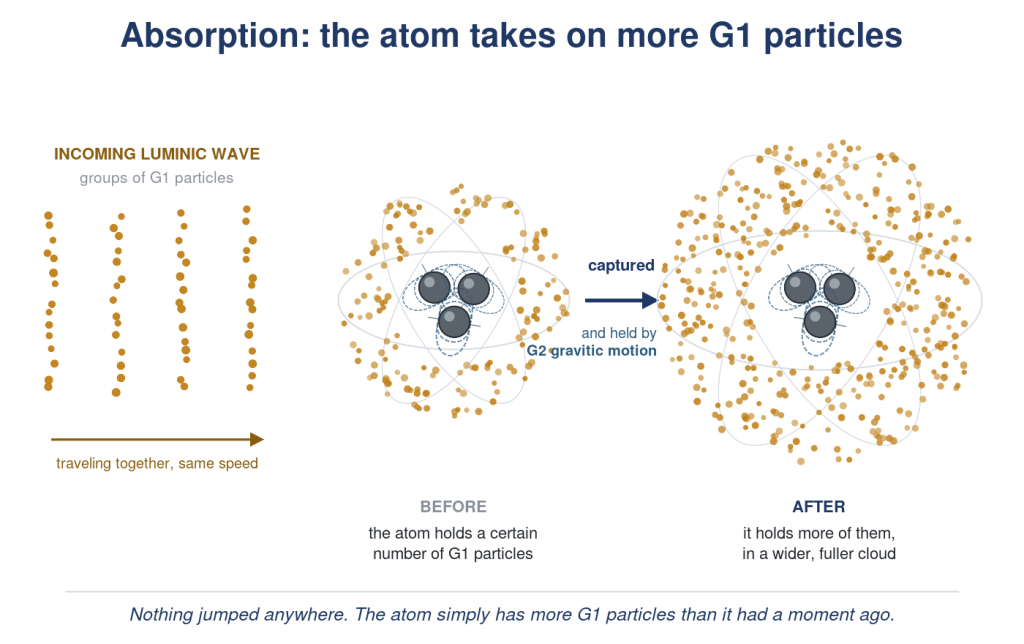
Nothing jumped. Nothing teleported between orbits. The atom is holding more G1 particles than it was holding a moment ago, and a fuller cloud sits in a wider, differently shaped arrangement because that is what the G2 fields can support with that many particles in them.
That is what an “excited state” is. Not a particle on a higher rung of an invisible ladder. A larger population.
Emitting Light Is Letting Them Go
An atom holding extra G1 particles is holding more than its stable arrangement wants. Sooner or later — jostled by a collision, or simply because that population cannot be sustained — it sheds the surplus.
And it does not shed them as a shapeless spray. They leave the way the G2 magnetic motion was already moving them: together, in step, group after group, all in the same direction at the same speed.
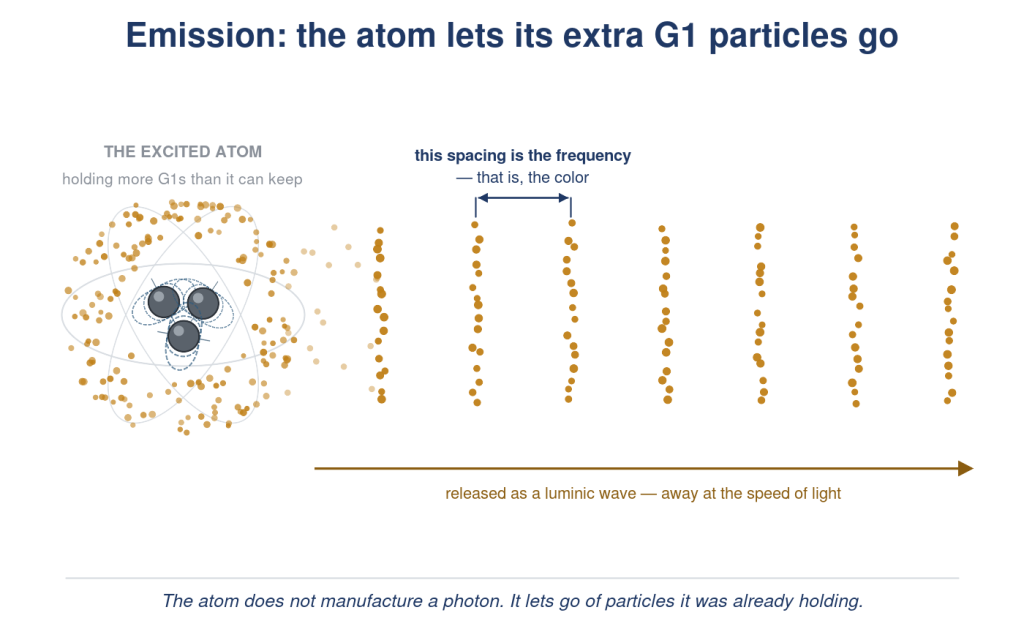
Groups of similar particles traveling together at the same speed is light. That is the definition of luminic motion. So the moment those G1 particles leave in formation, the atom has emitted light — not because anything was created, but because particles that were orbiting are now streaming.
The atom never manufactures a photon. It releases particles it was already holding.
Follow the particles through the whole cycle and the books balance without a single act of creation. G1 particles arrive in a stream. They are captured and held. They are released. They stream away. What the atom emits is made of exactly the same stuff as what it absorbed, because it is the same stuff.
Where the Color Comes From
A single particle cannot have a frequency, for the same reason a single bus passing your house cannot have a schedule — frequency is a property of a repeating series, not of one object. (That argument is laid out in full in The Impossible Photon.) So the color of emitted light cannot live inside any one G1 particle. It has to live in the formation.
And it does. The color is the spacing between the groups as they fly away. A large release packs the groups tightly together, and we see blue and violet. A smaller release spreads them out, and we see red.
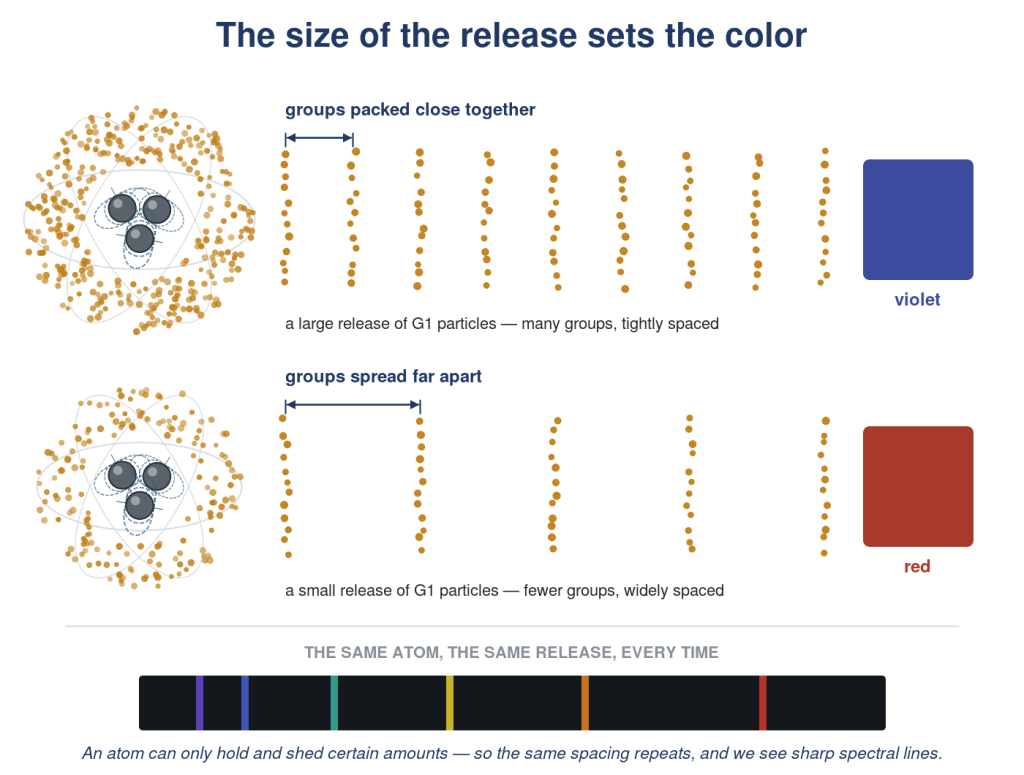

Notice what this buys you. The wave is not a metaphor laid over a particle, and the particle is not a mysterious smear of a wave. The particles are real and the wave is real, because the wave is simply the pattern the particles are flying in. Wave-particle duality was never a paradox of nature. It was the shadow cast by insisting that a single object had to carry a property only a procession can have.
Why the Spectral Lines Are Sharp
Heat hydrogen and it does not glow in every color. It glows in a few precise ones, the same ones every time, anywhere in the universe. This is the observation that forced quantization into physics in the first place, and it is usually presented as a brute fact: energy levels are discrete because they are.
In the four motions, the discreteness is structural. An atom’s G2 gravitic and magnetic fields form a specific geometry, and that geometry can only hold G1 particles in certain stable arrangements — the same reason a given room can hold certain seating arrangements and not others. Going from one stable arrangement to the next always means shedding the same quantity of G1 particles, in the same formation, with the same spacing. Same spacing, same color. Every time, in every hydrogen atom that has ever existed.
Change the element and you change the nucleus, which changes the G2 field geometry, which changes the stable arrangements and therefore the spacings that can be released. That is why every element has its own fingerprint of lines, and why we can read the composition of a star from its light.
It also explains the dark lines. Shine white light — a stream of every spacing at once — through a cool gas, and the atoms capture the formations that match what they are able to hold. Those groups are taken out of the stream and the color they carried goes missing. The dark line in the spectrum is not a shadow of something destroyed. It is the record of particles that stopped and stayed.
What We Have Not Done Yet
The configuration of the G2 fields is still unmodelled. Everything said above about what this atom can hold, and what it lets go of, rests on arrangements of G2 fields we cannot yet write down. That gap — what is settled, what is not, and how to close it — is set out in full in The Configuration of the Atom.
What the Model Actually Gives You
None of this requires new mathematics. The spectra were always right, the energies were always right, and nothing in this model asks you to discard a measurement. What it replaces is the story underneath the measurement — and the replacement is made of things that move.
- Nothing is created at the moment of emission. The particles that leave were already there.
- Nothing teleports. There is no leap between orbits, because the “orbit” is a population, not a rung.
- No charge is required. G2 gravitic motion does what Coulomb’s law was describing, and G2 magnetic motion does the rest.
- Color has a physical cause: the spacing of real groups of real particles.
- Wave-particle duality disappears, because the wave is the formation and the formation is made of particles.
An atom emitting light is not performing an act of creation. It is a container that took on more than it could hold, and let the surplus go — in formation, at the speed of light, in groups spaced closely enough or widely enough that an eye three feet away or three thousand light years away reads that spacing as a color.
That is how an atom emits light when you insist on a physical model instead of a mathematical placeholder.
