

Nobody Has Ever Said What a Field Is
Look at a weather map. There are the isobars, curving across the country, bunched where it is windy and spread where it is calm. You can point at them. You can predict the storm from them. And nobody has ever once suggested that the isobar is pushing the air. The lines are a drawing of what the air is doing. The air is the thing that exists.
Now ask what an electric field is, and the same kind of drawing gets handed back to you as the answer. A field, you are told, is a quantity defined at every point in space — a number, or an arrow, assigned to each location, telling you the force a test object would feel if it were there. That is a map. It is an extraordinarily good map. But at some point in the last century the map stopped being a description of something and became the something, and now the field is said to carry energy, carry momentum, push on charges, and propagate through empty space — all without anyone ever saying what it is made of.
Ask directly and you will get one of two answers. Either the field is “a fundamental entity,” which means we have stopped asking, or it is “an excitation of the vacuum,” which pushes the question down a level and leaves it there. Neither tells you what is in the room with you.
Something is in the room. It is just not a field.
Faraday Drew a Map and We Promoted It
The word came from Michael Faraday, and he was being careful when he used it. He sprinkled iron filings on paper over a magnet, watched them arrange themselves into those familiar arcs, and called what he was seeing lines of force. He meant: here is a record of which way a small magnet would turn at each spot. A map of behavior.
Maxwell then wrote that map as equations, and the equations worked so well that the lines were quietly upgraded from a record of what happens into the cause of what happens.
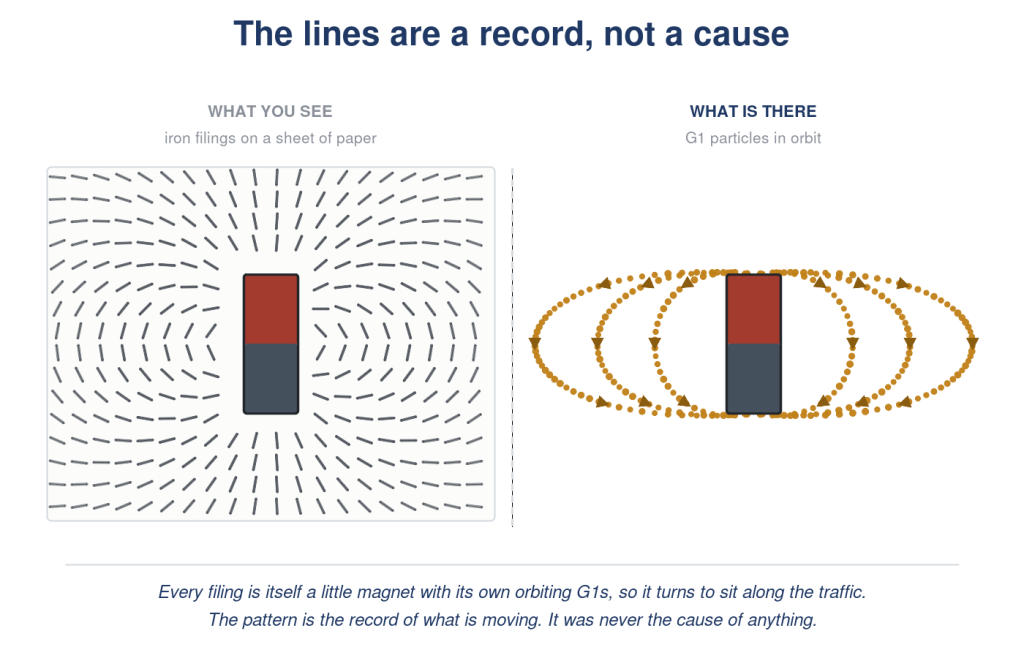
Notice what the filings experiment actually demonstrates. Iron filings are not inert markers revealing an invisible geometry. Each one is a tiny magnet in its own right — a body with its own orbiting G1 particles — and it swings around until it is lying along the traffic going past it. The experiment does not show you a field. It shows you several thousand small objects reacting to something physically streaming through the space they are sitting in.
The Two Fields Are Two Different Populations
Here is the claim that organizes everything else on this page. The electric field and the magnetic field are not two aspects of one underlying thing. They are two different populations of particles, operating one level of the universe apart.
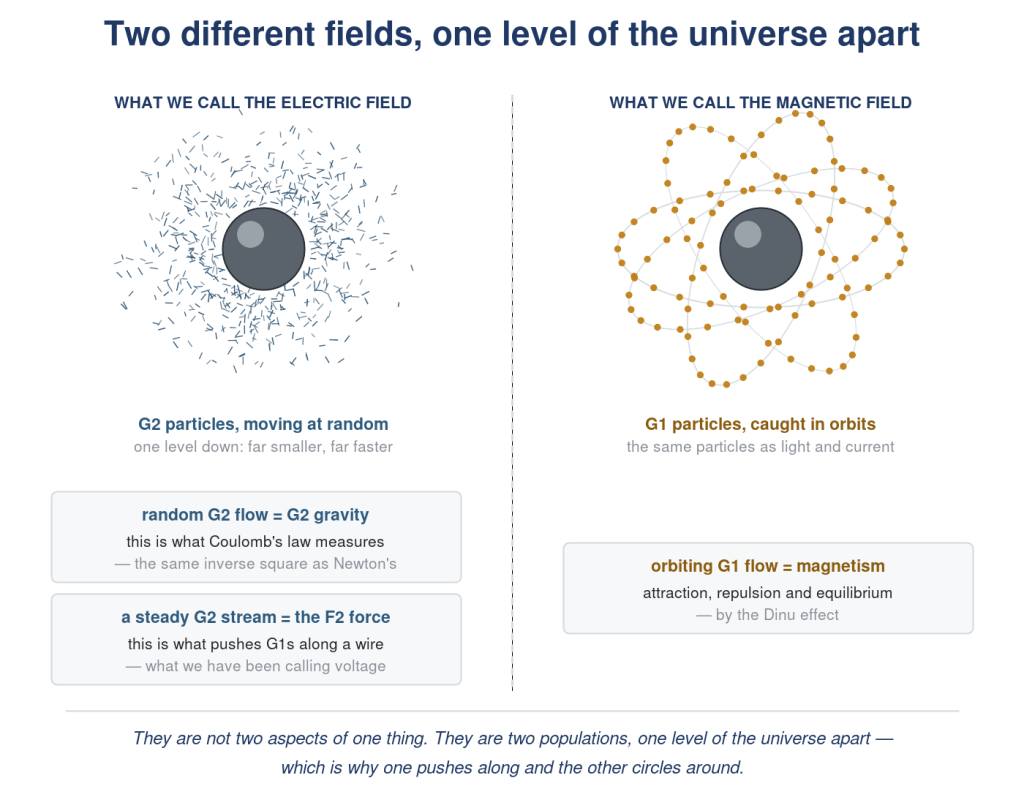
What we call the magnetic field is G1 particles caught in orbits. That is all magnetic motion ever is, as set out on Magnetic Motion — the same G1 particles that make up light, electric current and Newtonian gravity, here going round instead of going straight. Attraction, repulsion and equilibrium are what happens when two of these orbiting populations meet, by the Dinu effect.
Those orbits come in two sizes, and the difference is worth being exact about. The small ones belong to a single atom: the G1 particles already in orbit around its nucleons. When two atoms sit side by side, those orbiting populations pass each other, and that passing is what atomic polarity is — the thing chemistry handles by handing atoms partial charges. The rotations run opposite ways, so the two streams travel together in the gap, which is attraction by the same Dinu rule that governs two magnets. Nothing extra is strung between the atoms. There is nothing that would make loops there, and no need for them. The large ones belong to no single atom at all. They run right around groups of atoms in a lattice, thousands at a time. Those are the ones we are used to: the arcs in the iron filings, the field around a bar magnet, the pull on the fridge door.
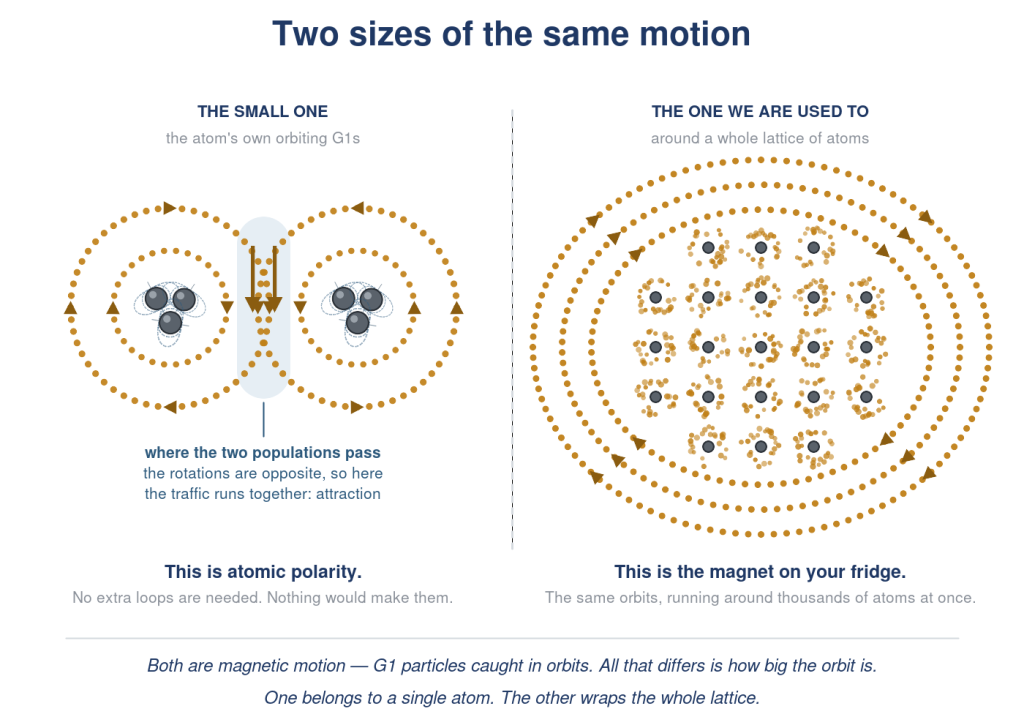
One further distinction, because the word “magnetic” is used at two levels across this site. The G1 magnetic fields described here are at our level — around single atoms, and around lattices. The G2 magnetic fields described in Atoms and How an Atom Emits Light are one level further down: each nucleon carries its own, the way the Earth does, and they are what bend the G1 orbitals into their S, P, D and F shapes. Same motion, different level, different particles.
What we call the electric field is G2 motion — one level down. G2 particles are vastly smaller and faster than G1s, fast enough to bend a G1 particle’s path, and they do two jobs that physics gave to one word:
- Random G2 flow is G2 gravity — the pull that holds a G1 cloud around a nucleus. This is the thing Coulomb’s law actually measures.
- A steady G2 stream is the F2 force — the push that drives G1 particles along a wire. This is what we have been calling voltage, and it is already used in exactly this way on the diode and transistor pages.
Say it that way and a long-standing oddity stops being odd. The electric field pushes along the line between two objects. The magnetic field circles around. In the textbook these are two faces of one entity which nevertheless have completely different geometry, related to each other by a cross product that is simply asserted. Here the difference needs no explaining: a stream pushes along because it is a stream, and an orbit circles around because it is an orbit. They look different because they are different.
The Coincidence That Was Never a Coincidence
Coulomb’s law and Newton’s law of gravitation have the same shape. Two quantities multiplied, divided by the square of the distance, scaled by a constant. Every student notices it. Nobody is ever told why.

They have the same form because they are the same motion at two scales. Newtonian gravity is random G1 flow; what Coulomb wrote down is random G2 flow. Same mechanism, smaller and faster particles, a different level of the universe. An inverse square is simply what you get when something is streaming outward in every direction from a region — it is a fact about geometry, and it shows up twice because the same kind of thing is happening twice.
Which Means Charge Was a Placeholder
If the electric field is G2 gravitic motion, then charge — the property the field is supposed to act on — has nothing left to do. And it never had a physical description anyway. Ask what charge is and you get a list of things it does.
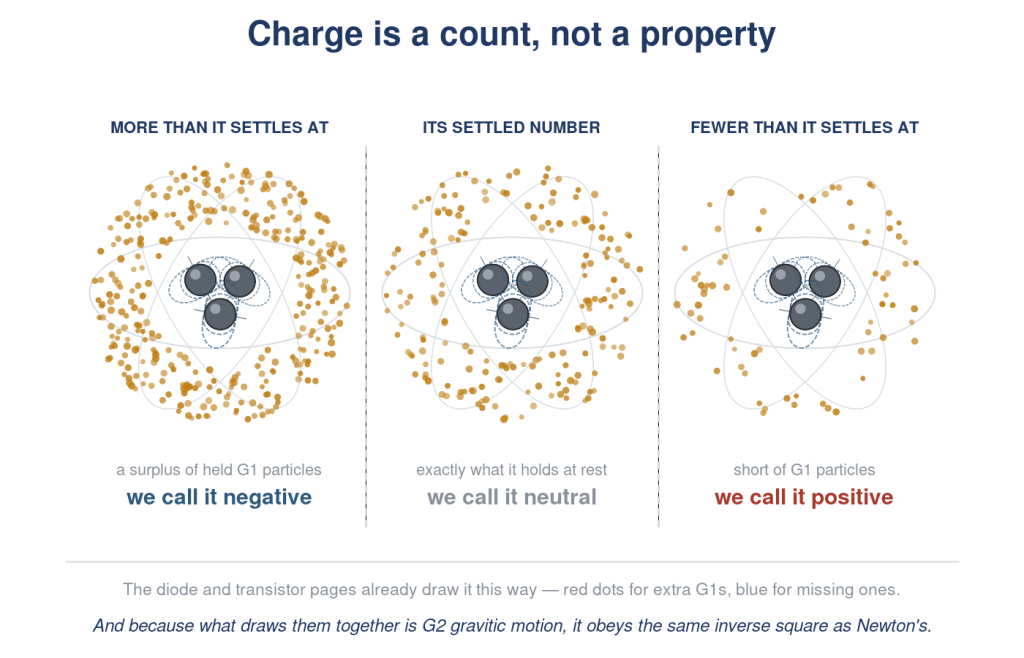
In the four motions, charge is a count. An object holding more G1 particles than its settled number is what we have been calling negative; one holding fewer is what we have been calling positive; one sitting at its number is neutral. This is not a new convention invented for this page — it is exactly how the diode and transistor articles already draw doping, with red dots for atoms carrying extra G1s and blue for atoms missing one.
Two counts differing is enough to get a flow going, because a difference in population is what the F2 force relieves. There is no need for a mysterious quality that comes in two flavors and makes objects reach for each other.
A field is not a thing that is there. The particles are what is there, and the field is our drawing of what they are doing.
Why the Two Always Turn Up Together
If they are genuinely two different populations, why can you never find one without the other? Run a current and a magnetic field appears around the wire. Change a magnetic field and a current appears. They are welded together in practice, which is the whole reason the word electromagnetic exists.
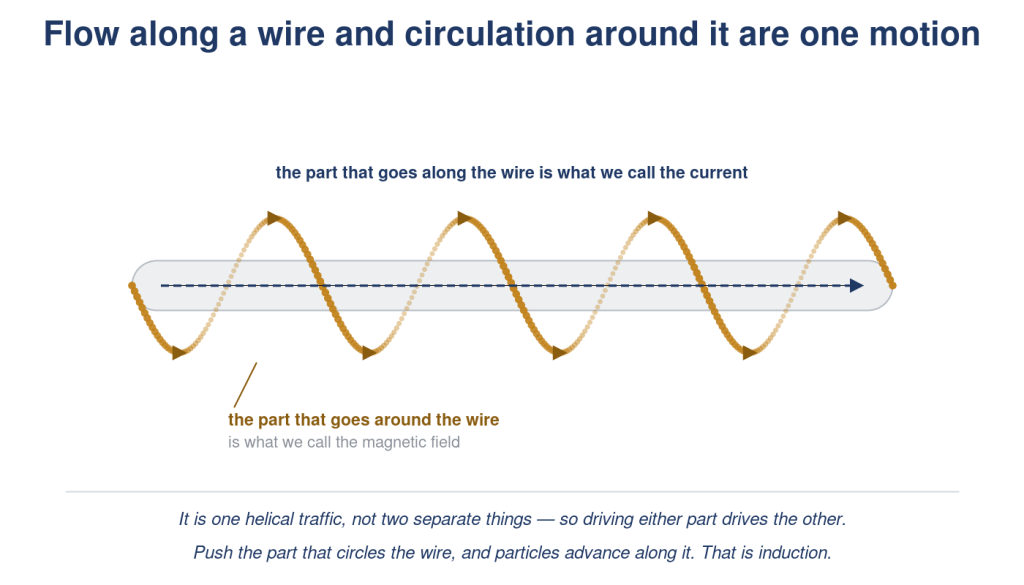
The answer is that the pairing is not between the two fields at all. It is inside the G1 traffic. When an F2 push drives G1 particles through a conductor, they do not travel in a straight line — some are guided along inside the metal and some spiral around the outside, as described in Electromagnetic Waves. One helical motion. We named the forward part “current” and the circling part “the magnetic field,” and then spent a great deal of effort explaining why those two always accompany each other.
They accompany each other because they are the same particles on the same path. And because they are, driving either part drives the other — which is what Induction is built on.
What the Picture Fixes
- Why fields carry energy and momentum. Because they are made of moving particles, and moving particles carry energy and momentum. Nothing abstract has to be granted mass-like properties by decree.
- Why changes propagate at the speed of light. Because the things that have to arrive are travelling at the speed of light. The delay is transit time, not a property of empty space.
- Why countless fields share a room without interfering. Light from every lamp and star is crossing the space in front of you from every direction at once. As rigid overlapping planes of force this is a disaster; as particles in motion it is traffic, and traffic shares a volume easily.
- Why a field has a direction at every point. Because at every point there is something going past, and it is going some particular way.
- Why shielding works the way it does. A mu-metal box does not block a field. It offers the orbiting G1s a better route and they take it, going around the box instead of through it.
- Why there is no magnetic monopole. You cannot have one end of an orbit. An orbit is a closed path, so its traffic always returns — which is exactly what “field lines have no ends” has been telling us for a century and a half.
What We Have Not Done Yet
The honest edges, the same ones that show up on Atoms, How an Atom Emits Light and Induction.
The configuration of the G2 fields is still unmodelled. This page identifies the electric field as G2 motion and can say what that motion does, but the right-hand half of the diagram above is drawn from life and the left-hand half from a job description. That gap — what is settled, what is not, and how to close it — is set out in full in The Configuration of the Atom.
Like repelling like needs to be worked all the way through. Random flow produces attraction by shadowing — that is how gravitic motion works, and it gives you unlike counts coming together. Two objects with the same surplus pushing apart has to come from their orbiting G1 populations meeting in the same sense, by the Dinu effect. That is a consistent story, but it is a story until somebody shows the collisions producing it.
And none of this is quantitative yet. Coulomb’s constant, the permittivity and permeability of free space, and the fact that those two combine to give the speed of light are all numbers this picture should eventually account for. At present it explains the form of the equations and not their values.
The way to close all three is the same as everywhere else on this site: physical model simulations in which particles are the model, not force equations fitted to measurements. Put G1 and G2 populations in a box with nothing but motion and collisions, and see whether an inverse square falls out of the random flow, whether orbits sort themselves by the Dinu rule, and whether two surpluses push apart. Those are things a simulation can refuse to do.
What Changes
- A field stops being a condition of space and becomes a population of particles in motion.
- Field lines go back to being what Faraday meant: a record of what is moving, not the cause of the movement.
- The electric field is G2 motion — random flow for the Coulomb pull, a steady stream for the F2 push we call voltage.
- The magnetic field is G1 particles in orbits, and nothing else.
- Charge becomes a count of held particles rather than an unexplained property with two flavors.
- The “coupling” of the two fields becomes one helical path with two names.
None of this touches the equations. Maxwell’s relationships stay exactly as accurate tomorrow as they were yesterday, and so do Coulomb’s and Faraday’s. What changes is the answer to the question the equations never took: when you stand in a room with a magnet and a wire, what is actually in the room with you.
Not a field. Particles, going past.
