

Capacitor Construction
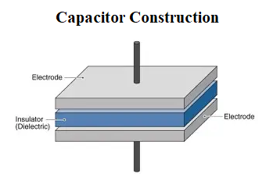
The capacitor is made from two parallel conducting plates separated by a dielectric insulator. A capacitor can be charged with a voltage, and it can hold this charge for a long time.
Charging a capacitor involves connecting it to a voltage source, causing its voltage to rise exponentially until it matches the source voltage while current gradually decreases.
How a Capacitor Charges
A capacitor is a device that stores energy in the electric field between its plates. When an uncharged capacitor is connected to a battery through a resistor, electrons move from one plate to the other, creating a voltage across the capacitor that opposes the battery voltage. Initially, the capacitor behaves like a short circuit, so the current is at its maximum, determined by the source voltage and the series resistance (I₀ = V/R). As charge accumulates, the voltage across the capacitor increases, reducing the current over as voltage increases.
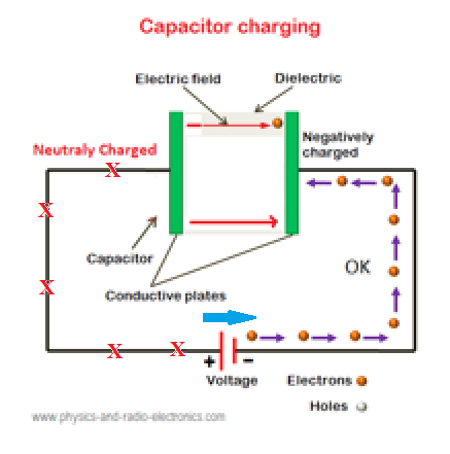
Figure 2 shows the battery moving electrons to the right. There is no force pushing electrons out the positive side of the battery.
When enough electrons accumulate on the negative terminal of the battery, the electrons stop moving. This occurs because the F2 force of the capacitor matches the F2 force of the battery. See Figure 3.
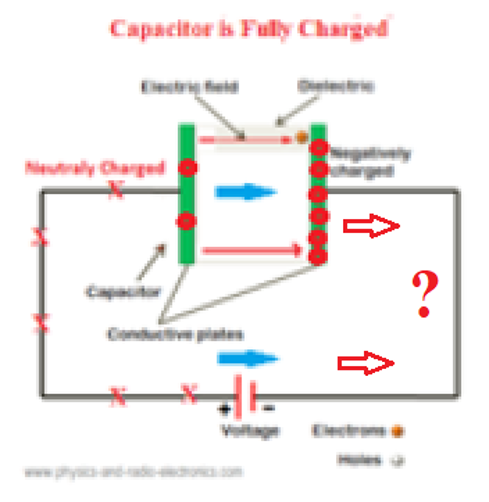
There is no force keeping the electrons from moving out of the battery or capacitor. So. if the capacitor has the same voltage as the battery, then they each push out equal number of electrons. Measuring current would give a zero result even though electrons are flowing.
RC Circuit
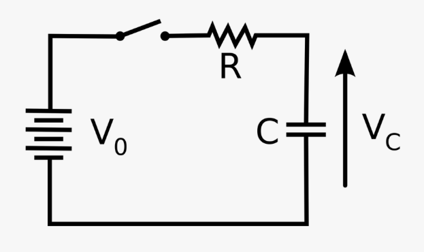
When the switch is closed, electrons flow from the negative terminal of the battery to the lower plate of the capacitor. The current through the resistor is zero. When the capacitor has enough electrons on the negative plate to have a voltage that matches the battery, current flow stops.
Basic Resistor-Capacitor Charging Circuit
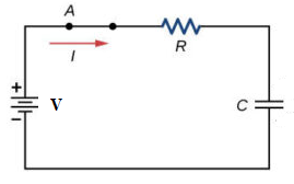
Figure 5 is a commonly used diagram showing how current charges a capacitor. The problem is that current is the flow of zeros, not the flow of electrons. Figure 6 is a better circuit that shows electrons flowing to the negative side of the capacitor.
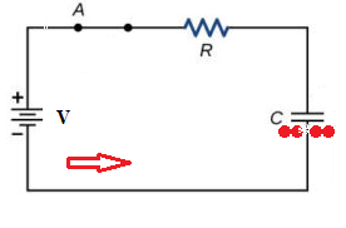
As the electrons on the capacitor increase, the capacitor starts to push them back out. At the beginning of this process, the battery has more charge than the capacitor, so the battery wins out. It pushes more electrons to the capacitor than the capacitor can push back. So, the capacitor voltage builds up towards the battery voltage.
As the charge on the capacitor gets closer to the charge on the battery, the capacitor starts pushing more electrons out of its negative terminal. But the battery is still winning. It will continue to put electrons on the negative terminal of the capacitor until the capacitor voltage matches the battery voltage.
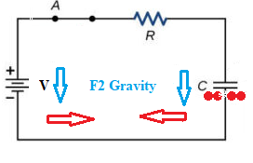
Question: Is there current in Figure 7?
Yes, there is current, because there is electron flow. But it may not be detectible.
