
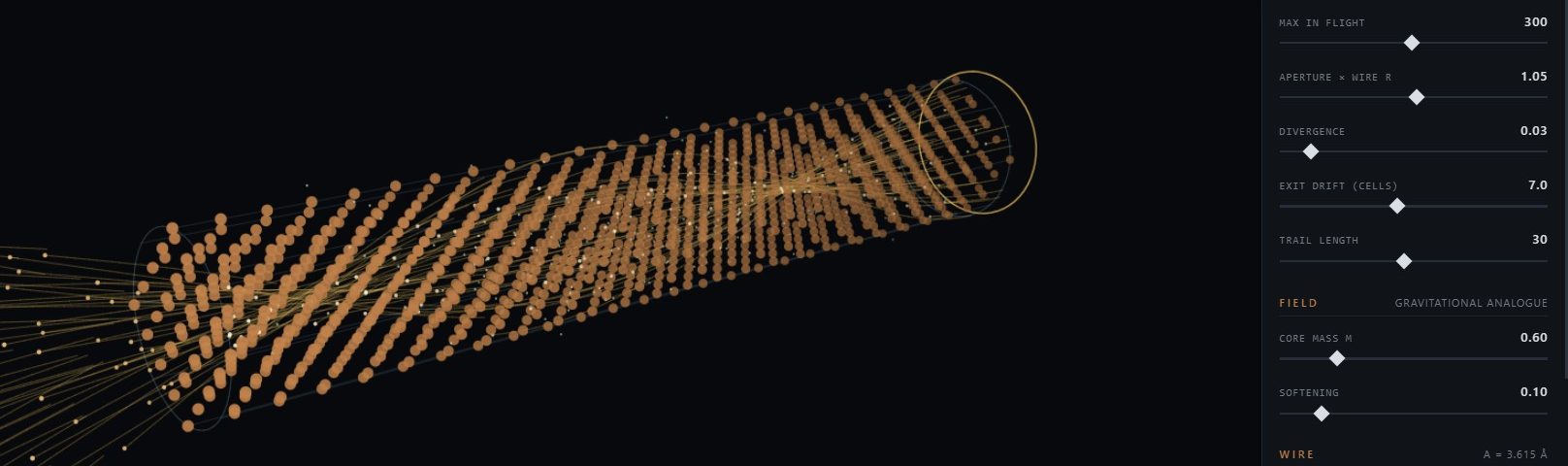
Electric motion is the flow of bodies along a gravitic path that is not an orbit. This motion is not circling a central mass but is guided by many masses lined up in a structured path. These masses create a gravitic tube through which bodies are guided. This could be the nucleus of atoms in a copper wire guiding electricity or molecules in the air that guide lightning.
Electric motion is made up of bodies with the following characteristics:
- travel in a non-orbital path
- are guided by a path of bodies that form a gravitic tube
- do not have charge
- are similar in size and mass
- can have an overall similar speed
- are significantly smaller than the bodies that are guiding them
- occurs at all macro or micro levels of the universe
Guided by Atomic Structure
Electricity is guided by atomic structures. It also creates magnetic fields as they travel down wires and spiral by the nature of how copper atoms are arranged in a lattice and their G1 orbital flows.
Live Animation
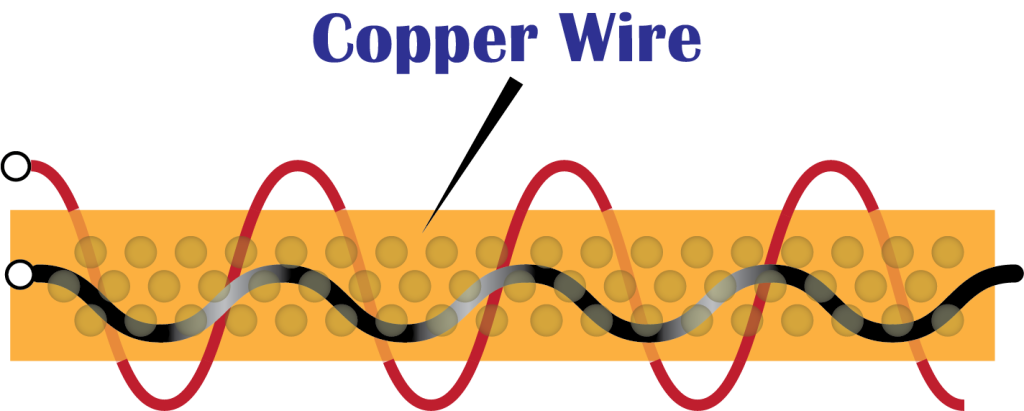
This animation renders a short segment of copper wire down to the atomic scale, showing 1,200-plus copper nuclei arranged in their true face-centered cubic lattice — the same crystal structure, and the same 2.556 Å spacing between neighboring atoms, as real copper. Rather than tracking electrons as discrete charges bouncing between atoms, this model treats each G1 particle as a comet under gravity, pulled toward every nucleus in the lattice by the same inverse-square law that governs planetary orbits — no artificial cutoff or shortcut, every particle feels the pull of the entire wire at every instant. A bound cloud of these G1s (shown in teal) drifts continuously through the lattice, threading between atoms rather than orbiting any single one, while a second stream (shown in white and amber) is injected from a circular aperture at the right edge and steered leftward through the wire by the gravity wells of the atoms it passes. Where the particle stream aligns with the open channels between rows of atoms, it threads through with little disturbance; where it doesn’t, it scatters. After exiting the far end, the particles continue coasting into open space for a distance, so their trajectories — bent or straight — remain visible as a record of what happened to them inside the lattice.
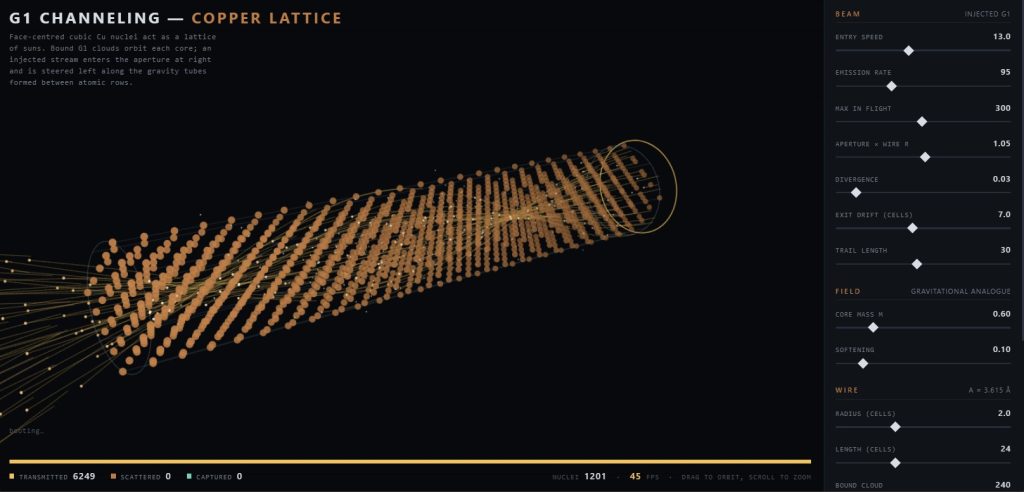
The panel on the right lets you adjust both the injected stream and the field it’s moving through. Under Beam, “Entry speed” sets how fast particles enter — raise it high enough and they escape the wire’s pull entirely, lower it and they get recaptured; “Emission rate” and “Max in flight” control how many particles stream through at once; “Aperture × wire r” sets the radius of the entry circle relative to the wire itself, so you can inject a narrow, focused beam or a wide one that overshoots the atoms entirely; and “Exit drift” and “Trail length” control how far past the wire, and how much of their path, you can see once particles leave. Under Field, “Core mass μ” is the strength of each atom’s pull — turning it up makes the channeling more dramatic, but also traps more particles inside; “Softening” prevents the force from spiking to infinity on a direct hit. Under Wire, “Radius” and “Length” resize the lattice itself, and “Bound cloud” sets how many resident G1 particles fill it. The View toggles let you hide trails or nuclei, cut away half the lattice to see inside, spin the view automatically, or pause and reset the run — and you can always click into the animation and drag to orbit the camera or scroll to zoom.
Electric Circuit
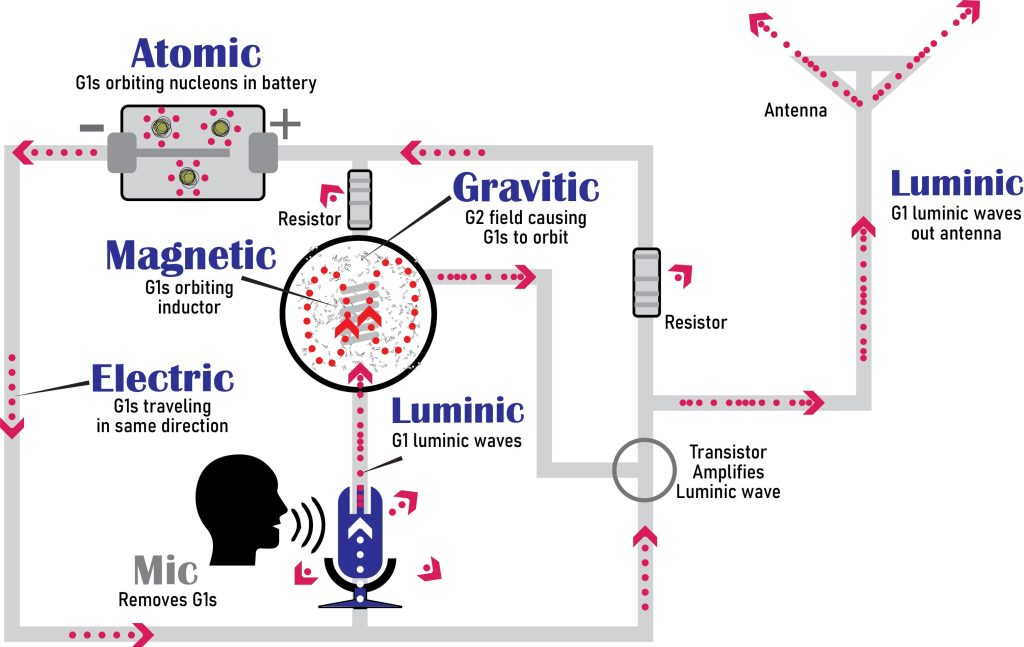
Here is a diagram about how G1 particles flowing in circuit create electric current, magnetic fields, and electromagnetic waves. They are all G1 particles.
Read About the Four Universal Motions
