
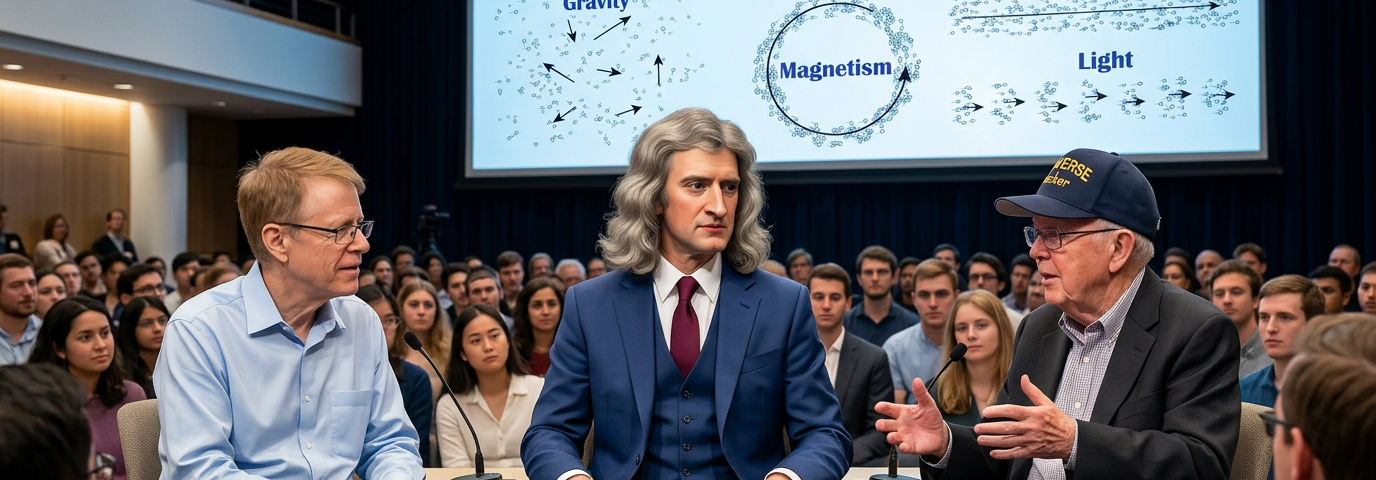
A Dialogue on the Four Universal Motions
A staged conversation. ROBERT DE HILSTER and DAVID DE HILSTER sit on a centered stage along with SIR ISAAC NEWTON, a man pulled three centuries out of his own time and visibly delighted to be here. The house lights are turned up. The audience is full and surrounds the three men.
DAVID: Good evening, everyone. My father and I have spent a good portion of our lives building something we call the Four Universal Motions. And tonight we have, let’s say, an unusual guest to put it to. Sir Isaac, thank you for joining us.
NEWTON: I confess I do not entirely understand the machinery that brought me here, and that is a rare and uncomfortable sensation for me. But I am told you have been busy with my universe. So. Let us be busy together.
ROBERT: That’s exactly the spirit we hoped for. I want to start by saying something plainly, because it matters to us. Everything we are going to tell you tonight is Newtonian. Not Newtonian in flavor. Newtonian in substance. Particles with mass, moving through space, pushing on one another by contact. No fields with minds of their own. No mathematics standing in for things we refuse to name. Just bodies in motion.
NEWTON: (settling back, pleased) Then you and I are already friends. I spent my life resisting the temptation to dress ignorance in elegant clothing. Tell me where you begin.
I. Gravity as Random Motion
DAVID: We begin where you began. Gravity. But we ask a question you left open. You gave the world a law — every mass attracts every other, falling off as the square of the distance. The most successful equation ever written. But you never said why. You never said what gravity physically is.
NEWTON: (a flicker of old irritation) No. I did not. And I was attacked for it. “Hypotheses non fingo” — I feign no hypotheses. I could measure the attraction. I could predict the planets. But the cause of it, the mechanism by which one body reaches across empty space to pull another — that I could not honestly claim to know. I left it for posterity. I gather posterity has not been kind.
ROBERT: Posterity invented curved spacetime and called it solved. We think you’d have found that unsatisfying.
NEWTON: Space that bends? Without anything doing the bending? (shakes head) Tell me your answer instead.
ROBERT: Our answer is that there is no pull at all. There is only push. Space is not empty. It is filled — saturated — with tiny particles moving in every direction at once, at enormous speed. A constant, random rain coming at you from all sides. Above, below, left, right, all of it, all the time.
NEWTON: Random in every direction.
ROBERT: Completely. And because it comes from everywhere equally, on a single body it cancels. You feel nothing. But put two bodies near each other, and each one blocks some of the rain coming toward the other. Each one casts a shadow.
NEWTON: (very still now) So the side of one body facing the other is struck less.
DAVID: Less. And so it gets pushed toward the other body — not pulled. The shielding makes the near side calmer than the far side, and the imbalance shoves them together. What you called attraction is bodies being pushed into each other’s shadows.
NEWTON: (slowly) By God. That is a pressure differential. That is — that is hydrostatics, almost. The apple does not reach for the Earth. The Earth shields the apple from the rain above, and the rain below drives it down.
DAVID: That’s it exactly.
NEWTON: And the inverse square — (he is already working it) — of course. A shadow spreads. The shielding from a body diminishes with the square of the distance because the solid angle it subtends diminishes with the square of the distance. The geometry demands an inverse square. I did not have to assume it. It would fall out of the picture on its own.
ROBERT: (quietly, to David) I told you he’d get there before we finished the sentence.
NEWTON: (almost to himself) Others proposed this. Fatio. Le Sage, after my time, I’m told. Push, not pull. It was dismissed.
DAVID: It was. For two reasons. They said the particles would slow the planets down through drag, and they said the bombardment would heat everything to nothing. But both objections assumed slow, heavy particles. Ours move at the speed of light, and they are unimaginably small. The version that was refuted is not the version we are proposing. The fast version is a different animal entirely.
NEWTON: (nodding) You rescued a discarded truth by changing its speed. That is a respectable kind of work. (beat) I will accept this readily. It offends nothing in me. It answers something in me. Go on. This was the easy part, I suspect.
II. The Second Gravity
DAVID: It was the easy part. Here’s where it gets interesting. We said gravity is a rain of particles. Now — what holds an atom together?
NEWTON: Ah. The subatomic world. Of which I knew nothing. Tell me.
ROBERT: Mainstream physics says there’s a separate force down there — the electric force, governed by Coulomb’s law. Like charges repel, opposite charges attract. And the equation for it is —
NEWTON: (cutting in) Let me guess. An inverse square.
ROBERT: (grinning) Force proportional to the product of the two charges, divided by the square of the distance between them.
NEWTON: (sitting bolt upright) But — but that is my equation. That is the form of my equation. Two quantities multiplied, divided by distance squared. You are telling me the law that governs the very small has the same shape as the law that governs the heavens?
DAVID: Identical shape. The only difference is what you put in place of the masses, and the value of the constant out front.
NEWTON: (intensely) When two equations have the same form, Mr. de Hilster, it is one of two things. Either it is a coincidence — and I have never in my life trusted a coincidence in mathematics — or it is a clue. The form is the same because the thing is the same.
ROBERT: That is exactly our argument. And we don’t think you trust the coincidence either.
NEWTON: I do not. Nature is not so wasteful as to invent the same equation twice for two unrelated reasons. If Coulomb’s law and my law of gravitation wear the same face, they are kin. So what is your claim — that the force inside the atom is also gravity?
DAVID: It’s gravity. But a second gravity. We call it G2. The first gravity — the rain we just described — is made of particles we call G1. They organize the world at our scale. But G1 particles are themselves made of something smaller and faster. Those are the G2 particles. And down inside the atom, it is a rain of G2 particles doing the shielding, the pushing, the holding-together.
NEWTON: A smaller rain. A faster rain. A finer rain. (working it) And the constant is different in Coulomb’s law because the particles are different — smaller, faster, at a different scale — but the mechanism is the same. Shadowing. Pushing. Shielding.
ROBERT: The same mechanism, one level down.
NEWTON: (leaning back, exhaling) So gravity is not one thing operating at one scale. It is the same trick, played again with smaller pieces, at the next level down. (a long pause) I like this enormously. It is economical. One mechanism, repeated. I always believed that Nature was pleased with simplicity, and affects not the pomp of superfluous causes. You are showing me a Nature that found one good idea and used it twice.
DAVID: Not twice, Sir Isaac. That’s the next part.
III. The Infinite Universe — No Partless Parts
NEWTON: (narrowing his eyes) Not twice. Then how many times?
ROBERT: This is where we owe a debt to a man named Glenn Borchardt, who developed something called Infinite Universe Theory. And his central principle is one I think will either thrill you or trouble you. He says: there are no partless parts.
NEWTON: No partless parts. Meaning — nothing is fundamental. Nothing is the final, indivisible brick.
DAVID: Nothing. Every particle, no matter how small, is made of smaller particles still. Your G1 graviton is built of G2. The G2 is built of G3. And it never stops. There is no bottom.
NEWTON: (very quietly) And no top, I should think, if you are consistent. Our world sits inside a larger one, which sits inside a larger one, forever.
ROBERT: Infinitely up and infinitely down. And the four motions — gravity, magnetism, light, electricity — occur at every level. The same dance, all the way up, all the way down, with no first step and no last.
NEWTON: (He stands. He cannot help himself. He paces.) You must understand what this does to a man like me. I was haunted by the infinitely small. The calculus — my fluxions — I built it by letting quantities shrink toward nothing, and the philosophers savaged me for it. “Ghosts of departed quantities,” Berkeley called them. I never had a physical picture of what it meant to divide and divide and divide without end.
DAVID: And now?
NEWTON: And now you hand me a universe that is actually like that. Where the dividing never bottoms out because the world never bottoms out. My mathematics of the infinitely small was not a trick after all. It was a description of the architecture. (he sits, somewhat overcome) That is a strange comfort to receive three hundred years late.
ROBERT: We thought it might land that way.
NEWTON: It is a vertiginous idea. A turtle standing on a turtle, and so on without end — and yet you’ve made the turtles do work. Each level holds the one above together. (a dry smile) I shall need a moment with that one. But continue. You mentioned magnetism. That, I never cracked.
IV. Magnetism — Orbiting Particles
DAVID: Few people know you worked on it at all.
NEWTON: I worked on everything. (a flash of the old pride) Magnetism defeated me honestly. The lodestone attracts iron, and it also repels — and attraction-and-repulsion from the same stone resisted every model I could build. Gravity only ever attracts. Magnetism does both, and it has poles, and the poles cannot be separated. I set it aside. It is one of my few open defeats. So. Tell me. What is a magnet?
ROBERT: Here we lean on the work of a researcher named Ionel Dinu, who did something beautifully simple. He did experiments underwater — with vortices, with swirling water — to model what magnetism might physically be. And what he found pointed to this: magnetism is orbital motion. Particles going in circles.
NEWTON: Orbits. (immediately engaged) Now that is a word I own. Tell me how orbiting particles make a magnet.
DAVID: Picture the particles around a magnet not raining randomly — like in gravity — but circling. Going around and around a center, all in formation. That orbital motion structures the space around the magnet. It lays down a pattern of circulation.
NEWTON: And the two poles?
DAVID: The two directions of circulation. One way around is one pole. The other way around is the other pole. That’s why you can never separate them — they’re not two things, they’re two senses of the same rotation. Cut the magnet in half and each half still has a clockwise end and a counterclockwise end.
NEWTON: (softly) Of course it does. You cannot have a whirlpool with only one direction of spin. (beat) And attraction versus repulsion?
ROBERT: Bring two magnets together. If their particles are orbiting in the same direction — in sync, turning the same way where they meet — they repel. They’re fighting each other’s flow, like two gears spinning the same way grinding at the point they touch. But if they’re orbiting in opposite directions — out of phase, so where they meet the motion runs together —
NEWTON: — they mesh. Like gears turning the proper opposite ways. They attract. (he claps once, sharply) The interlocking of two rotations! Same spin repels because the surfaces oppose; opposite spin attracts because the surfaces cooperate. That is mechanical. That is something I can hold in my hand.
DAVID: And all of it — every orbiting particle — is just G1 particles caught in circular paths instead of random ones. Magnetism isn’t a new substance. It’s the same particles as gravity, moving in circles instead of moving at random. All guided of course by our second gravity the G2 particle.
NEWTON: (marveling) So you have not added anything to the world. You have only made the same rain go around in a circle. Random motion gives me gravity. Circular motion gives me magnetism. (he looks at his own hands) The lodestone that defeated me was only ever a vortex I could not see. (a pause, then quietly) I should have liked to have known that. It cost me sleep.
DAVID: And what makes it go in a circle or orbit are the nucleus of the atoms. Like lots of suns lined up in a grid, they can guide G1 particles into long eliptical orbits outside a loadstone and those loops are guided again by our second G2 gravity.
NEWTON: (fascinated) Even though the subatomic world is not known to me, I can picture in my mind’s eye the scenario given I can picture and have an intuitive feel for gravity. After all, your magnetic motion is caused again by what you call the fundemental motion in the universe: random moving particles.
V. Light — Waves of Birds
DAVID: Now we come to the one you’ll have the strongest opinions about. Light.
NEWTON: (immediately combative, but delighted to be so) Light is mine. I split the sunbeam with a prism and found the colors hiding inside the white. I built the reflecting telescope. And I argued — against Hooke, against Huygens, against the whole quarrelsome lot — that light is corpuscular. Particles. Little bodies, fired in straight lines. That is why light casts sharp shadows and travels in beams.
ROBERT: And you were attacked for it, because light also does things that only waves seem able to do. It bends around edges. It produces those bands of light and dark when two beams overlap.
NEWTON: (grudgingly) Interference. Yes. Hooke and Huygens had the better of me there, and history sided with the wave. And then — I am told — physics later decided light is somehow both, particle and wave at once, and simply declared the contradiction a deep truth and stopped asking. (witheringly) “Wave-particle duality.” A confession dressed as a discovery. You do not resolve a paradox by naming it.
ROBERT: (quietly) No. You don’t. And this is the piece I’m proudest of, Sir Isaac, so let me give it to you carefully. You were right that light is particles. Your only mistake — and it was the natural mistake — was thinking each particle had to carry the wave inside itself. You tried to assign sizes to the corpuscles to make them wave. You tried to make one particle do the whole job.
NEWTON: (leaning in) And it could not. A single body cannot be a wave. I felt the failure but could not name it.
ROBERT: Because a wave is not a property of one particle. A wave is a property of many particles — a whole line of them, side by side, traveling together. Don’t put the wave inside the corpuscle. The wave is the line of corpuscles.
NEWTON: (absolutely motionless) Say that again.
ROBERT: Picture a flock of birds — but a very particular kind of flock. A single straight line of birds, wingtip to wingtip, all flying forward together. That line is one wave. Now picture another line just like it following behind, and another behind that, and another — line after line after line, each separated from the next by a gap. That whole procession, flying at the speed of light, is a beam of light. Each line is a wave. The gap between the lines is what gives the beam its frequency.
NEWTON: (stunned) So there is no single body rising and falling. There is no — bobbing.
ROBERT: None. Nothing moves up and down. That was never needed. The “wave” is not a wiggle. The wave is a rank of particles flying abreast. The waviness you see in the diagrams is just the succession of these ranks arriving one after another — line, gap, line, gap, line, gap.
DAVID: We call it waves of birds. Each bird is a particle — solid, real, locatable. You could point to any one of them. A single line of birds, all abreast, is one wave. And light is line after line of them, sweeping forward in formation with regular gaps between the lines. There is no contradiction in it whatsoever — and no particle ever has to “be” a wave, because the wave was always the group.
NEWTON: (he sits back as if struck) The wave is the rank. The beam is the column of ranks. The particle is the single soldier in the line. And of course a single soldier cannot be a marching column — that was my error stated in one sentence. (he is quiet for a long moment) I was so close. I had the particle. I had it in my hand. I only needed to stop demanding that each particle carry the whole wave on its own back. I needed more particles, drawn up in lines. The answer to my failure was not a different idea. It was more of my own idea.
DAVID: And here’s the part you’ll like, Sir Isaac, because you were a man who trusted what the eye reports. When that beam reaches your eye, it doesn’t arrive as one smooth thing. It arrives as a drumbeat. Line strikes — gap — line strikes — gap — line strikes. Wave after wave of particles hitting the back of your eye, with a regular spacing between the blows. That rhythm of strikes — how close together the blows land — is the frequency.
NEWTON: (slowly) A frequency of impacts. Not a vibration carried by one thing, but a count of arrivals. The eye is struck, and struck, and struck again, evenly. (a flicker of delight) That I can measure. That I can feel the sense of. It is a hammer falling at regular intervals, and the speed of the falling is the frequency.
DAVID: Exactly that.
NEWTON: (eagerly) Then color — color must follow from the spacing of the blows. I see where you are going. Tell me I am right.
ROBERT: You’re right. Color is the spacing between the lines. Tight spacing — the lines packed close, the blows landing in quick succession — that’s blue. Wide spacing — the lines far apart, the blows landing slowly — that’s red. The color isn’t a property of any single particle. No particle is “blue.” Color is how closely packed the ranks are. Run the beam through a prism, sort the ranks by their spacing, and the rainbow falls out.
NEWTON: (very softly) So the colors I found hiding in the white light were never colors in the particles. They were spacings — the closeness of one rank to the next. The prism sorts the columns by how tightly they are drawn up. (he shakes his head slowly) It is more elegant than what I had. I do not say that easily. (beat) Why did I not think of it? It was sitting there. I had the corpuscle. I had the prism. I had the colors. I had every piece but the one that mattered — that the wave belongs to the line, not to the bird.
ROBERT: You were a giant standing on the one spot from which you couldn’t see your own feet. It happens to giants.
NEWTON: (a rueful laugh) Flattery. But I shall allow it tonight.
DAVID: There’s one more thing about the prism, Sir Isaac — and it’s where you came closest of all.
NEWTON: (leaning forward) Go on. I am listening like a student now.
DAVID: You explained the rainbow by size. You thought white light was a mixture of corpuscles of different sizes, and that the prism bent each size by a different amount — the small ones most, the large ones least — fanning them out into the spectrum. The mixture idea was right. The sorting idea was right. Only the thing being sorted was wrong.
NEWTON: Not size, then. What?
ROBERT: White light is a jumble of waves at every spacing at once. Lines packed tight, lines spread wide, every spacing mixed together with no order to them. That jumble is why it looks white — every spacing arriving at once averages out to no color at all.
NEWTON: And the prism un-mixes them.
ROBERT: The prism un-mixes them — but not by size. By gravity. A triangular prism is thick at the base and thin at the top, so the G2 gravitic field inside it varies across the glass. It is not uniform. As the waves enter, they cross a gradient — a changing gravitic field — and that gradient bends them. The lines entering where the field is steepest curve the most; the lines entering where it is gentlest curve the least.
NEWTON: (slowly) So the bending is greatest at one part of the prism and least at another — and the varying field does the fanning.
DAVID: That’s it. More curve at the beginning of the wedge, less at the end. The varying G2 field sorts the waves by their spacing — and what enters as jumbled white light leaves as an ordered rainbow. The prism didn’t sort your corpuscles by size. It sorted waves by how a changing gravitic field bends them.
NEWTON: (sitting back, quietly) But the shape of my answer was right. A mixture goes in. The medium sorts it. An ordered spectrum comes out. I had the structure of the explanation in my hand three hundred years ago. I simply reached for size because size was the only property I had given my corpuscles. I had no gravity inside the glass to reach for. (a long pause) You did not overturn me here. You finished me. You took the one property I lacked and put it exactly where my instinct already pointed.
ROBERT: You were closer on the prism than on almost anything else. The rest of physics walked away from your corpuscles entirely. We think you had the right picture and the wrong cause — and the right picture is the harder half to get.
NEWTON: (a small, satisfied nod) I will take that. To be wrong in the cause but right in the form — that is the most forgivable kind of error a natural philosopher can make. It means you were thinking correctly and merely lacked a piece. (he almost smiles) Give a man the missing piece and he forgives you everything.
VI. Electric Motion
DAVID: The fourth motion we’ll go through more gently, Sir Isaac, because it’s the one furthest from anything you worked on. Electricity barely existed as a science in your day.
NEWTON: It did not. We had amber that crackled and lodestones that pulled, and we lumped them together in ignorance. Lightning we thought was the wrath of God, or the friction of clouds. So here, I am content to be a student. Teach me.
ROBERT: Then here it is, simply. If random motion gives you gravity, and circular motion gives you magnetism, electric motion is the flow. The same G1 particles — not raining randomly, not orbiting in circles, but flowing in a directed stream along a path.
NEWTON: A flow of the same particles. But what makes the path? A river needs its banks. What holds these particles to their course rather than letting them scatter back into the random rain?
DAVID: The atoms do — the same little suns we keep returning to. In a copper wire, the nuclei sit in an orderly lattice, a grid of them running the length of the wire. And that lattice of nuclei lays down channels through itself — we call them gravity tubes. The G1 particles flow down these tubes, guided by the atoms, streaming along the wire at nearly the speed of light.
NEWTON: (slowly) So the wire is not merely a vessel the particles happen to pass through. The wire’s own atoms carve the channel. The lattice makes the riverbed, and the gravity tube is the river. (a nod) That is consistent with everything else you have told me — the atoms organizing the random rain into something directed. Go on. And the two kinds of electricity — your positive and negative?
ROBERT: Directions. Exactly as with magnetism. We told you a magnet’s two poles were only the two senses of the same rotation — one way around, the other way around. Positive and negative are the same idea, but for a flow instead of a spin. Which way the stream runs down the tube. That’s all “positive” and “negative” ever were — a direction, not two different substances.
NEWTON: (satisfied) Good. That pleases me more than the river did. Magnetism gave me two senses of one rotation; electricity gives me two senses of one flow. The same economy. No new substance, only a direction. (he begins to sit back, then stops, struck by something) But wait. Wait. There is a thing here I want to chase.
DAVID: Please.
NEWTON: You have a flow of particles inside the wire. But particles in a stream do not all stay perfectly in the channel, do they? Not if they are the same particles that, in a magnet, were so eager to fall into orbits. (intently) Tell me — what happens at the surface of the wire? At the edge of the flow?
ROBERT: (to David) He’s about to solve it himself.
DAVID: Some of the flowing G1s spill into orbits, Sir Isaac. The stream runs straight down the gravity tubes inside the wire — but at the wire’s surface, the particles can wrap around it, spiraling in circles outside the wire even as the main current drives forward.
NEWTON: (rising from the chair) Circles. Outside the wire. (the realization breaking over him) But you told me, an hour ago, what circular motion of these particles is. Circular motion is — is magnetism. So a flow of particles down the wire must, of necessity, throw off circles around the wire — and those circles are a magnetic field. The electricity does not merely accompany the magnetism. The electricity produces it. The very same particles, flowing straight within and orbiting without.
ROBERT: That’s exactly it. A current in a wire creates a magnetic field around the wire. It was discovered long after your time, Sir Isaac, and to this day mainstream physics describes it precisely but never says why a flow of charge should conjure a ring of magnetism out of empty space. They write the law. They do not give the cause.
NEWTON: (quietly, almost reverent) And you give the cause in a single breath. It is one particle. Flowing, it is electric. The portion that curls at the edge is orbiting — and orbiting is magnetic. Of course the one makes the other. They were never two phenomena. They were one particle doing two of its four dances at once, in the same place, at the same moment. (he shakes his head) I did not even know there was a riddle here. You have answered a question I was never alive to ask.
DAVID: And the reverse runs too — move a magnet near a wire, set those circles moving, and you can start a flow down the tube. Turn circles into a stream. The two motions trade back and forth, because underneath, they are the same particle.
NEWTON: (sitting slowly back down) One substance. Change its motion, and you change its name. (a long pause) I came into this evening thinking electricity the part where I had the least to offer. It may be the part that convinced me most. The same particles, now made to flow — and where they cannot help but curl, magnetism falls out for free.
VII. One Particle, Four Motions
NEWTON: (after a pause, gathering himself — and now he takes command of the conversation) Let me see if the old man has kept up. You will tell me if I stumble. You have given me four phenomena that the world thinks are four different things. Gravity. Magnetism. Light. Electricity. And you have told me they are not four things. They are —
DAVID: Go on. You tell us.
NEWTON: They are one thing, moving in four ways. The same particle throughout. When it moves randomly — (counting on his fingers) — I get gravity. When it moves in circles — magnetism. When it moves in lines, rank after rank — light. When it moves in a flow — electricity. One actor. Four dances. The particle is the noun; the motion is the verb.
ROBERT: (genuinely moved) That’s better than we say it in the book. We may steal it.
NEWTON: (waving this off, intent) But you have a further argument. I can feel it sitting under the table. You have told me what the four motions are. You have not yet told me why I should believe the particle is truly the same in all four — and not merely four similar particles that happen to behave alike.
DAVID: That’s the right question to press on. And here is the fact that settles it — a fact you could not have had, Sir Isaac, because the measurement did not exist in your century. We can now measure how fast each of these four things travels. Gravity. Magnetism. Light. Electricity.
NEWTON: (very still) And?
DAVID: They all travel at the same speed. The speed of light. Not close to one another — the same. Gravity propagates at the speed of light. A change in a magnetic field propagates at the speed of light. An electric signal propagates at the speed of light. And light, of course, is the speed of light.
NEWTON: (rising slowly from the chair) The same speed. All four. To the limit of your instruments.
ROBERT: To the limit of our instruments.
NEWTON: (intent now, working it aloud) Then a careful man is left with exactly two conclusions, and no third. (he holds up one finger) The first: there are four different particles — or four different things — and yet some further law, some hidden hand, has been arranged so as to drive all four to travel at precisely one speed. A conspiracy of equality. Four travelers, four natures, and a separate rule imposed on top to make them all run at the same pace. (he holds up a second finger) Or the second: there are not four travelers at all. There is one. And it always moves at one speed because it is one kind of thing, and one kind of thing has one nature.
DAVID: Those are the only two. Which would you take?
NEWTON: (without hesitation) The second. Always the second. (a flash of the old fire) The first conclusion asks me to believe in four particles and an extra law to discipline them — five things to explain one fact. The second asks me to believe in one particle, and the fact explains itself. A speed is a property of the traveler. If the speed is identical, the traveler is identical. I would no more posit four particles secretly synchronized than I would posit four separate causes for the falling of four separate apples. Nature is sparing. She does not multiply causes without need, and here there is no need.
ROBERT: That’s the whole argument, Sir Isaac. The shared speed is the fingerprint. One fingerprint, one particle.
NEWTON: (quietly, almost to himself) And if it is one particle, then the four phenomena cannot differ in their substance — for the substance is the same in all of them. They can differ only in one thing. (he looks up) In how it moves. Randomly, in circles, in ranks, in a flow. The difference between gravity and light, between magnetism and electricity, is not a difference of what. It is a difference of motion. (a long pause) You have not given me four forces. You have given me one particle and a choice of four dances. And the speedometer is your proof, laid plain. You did not even have to argue it. You only had to point at the dial and let me draw the cheaper conclusion myself.
ROBERT: (to the audience) And that, ladies and gentlemen, is why we wanted him in the chair.
VIII. The Organizing Motion
NEWTON: One thing remains unsettled in me. You have four motions. But you keep returning to the first one — the random rain — as though it were the parent of the others. Why? Why is gravity first among equals?
DAVID: Because the other three are made out of it. Gravitic motion — the random rain of G1 particles — is the raw material. It’s the simplest motion: just particles going every which way in straight lines. And when that random rain meets the structure of matter, it gets organized into the other three. Here is the key, Sir Isaac, and it is the heart of the whole framework: the particles at one level are organized by the gravity of the level below.
NEWTON: The level below. Say what you mean by it.
DAVID: The atoms. Every atom has a nucleus, and the nuclei sit in matter like a vast grid of little suns. The G1 particles — our random rain — are the planets streaming past them. And just as your real Sun bends a comet’s straight path into an orbit, these atomic “suns” bend the straight-line paths of the G1 particles into curves. But the force doing the bending isn’t G1’s own gravity. It’s the gravity one level down — the G2 rain — acting on the G1 particles the very same way G1 acts on apples and moons. Random straight lines go in; organized motion comes out, because a finer gravity beneath is doing the steering.
NEWTON: (leaning in) Then show me each of the three.
DAVID: Let the atoms bend the random rain around a center, and you get the circles of magnetism — G1 particles caught in orbits, held there by the G2 gravity below. Let those little suns release their planets into a coordinated front, line after line moving one way, and you get the ranks of light. And let the atoms channel the particles along a lattice — gravity tubes laid down through the grid of nuclei — and the random rain becomes a directed stream, and you get the flow of electricity. The random motion is the seed. The other three are what it grows into when it meets the physical structure of the world. And in every case, what turns G1’s straight lines into curves, circles, ranks, and streams is the G2 gravity rain one level down.
NEWTON: (very slowly, and this clearly delights him most of all) So the simplest motion — mere randomness, mere chaos — is the organizing one. Order does not come down from above and impose itself on chaos. Order emerges from chaos meeting structure. The random rain, falling on the shapes of the world — on those little suns — sorts itself into circles and ranks and flows. And the hand that does the sorting reaches up from the level beneath.
DAVID: That’s the whole picture.
NEWTON: (quietly) That is almost theological. The least ordered thing is the wellspring of all order. (he is silent a moment) I spent my life believing that God set the world in motion and prescribed its laws from on high. And here you show me a world that generates its own laws from below — from the bottom that has no bottom — out of nothing but particles and their endless, mindless motion. (he looks up) I do not know whether to be unsettled or exalted. Perhaps both. The best ideas have always made me feel both.
IX. Closing
ROBERT: Sir Isaac, we’ll let you go soon. But I have to ask the question everyone here is thinking. We’ve taken your physics, kept every particle, kept every push, kept the inverse square, and used it to rebuild gravity, magnetism, light, and electricity from one particle and four motions. After all that — what’s your verdict?
NEWTON: (He rises. He takes his time. The room is silent.) My verdict is that you have done to me the kindest and the cruelest thing one natural philosopher can do to another. You have shown me that I was right — and that I stopped too soon.
NEWTON: I was right that gravity needed no pull, only I never found the push. You found it. I was right that light was particles, only I tried to make one particle carry the wave, when I needed a multitude. I was right to distrust action at a distance, right to want mechanism, right to believe Nature is sparing and does not multiply causes without need. Every instinct I had, you have vindicated. You simply had three more centuries, and a few good friends I never met — your Borchardt, your Dinu — and the courage to keep asking why after the equations already worked.
NEWTON: (he turns to the audience) They will tell you these two men stand outside the mainstream of physics. Dissident, is the word, I’m told. (a thin smile) I was a dissident. Hooke thought me one. The Cartesians thought me one. The mainstream of my day held that the planets were swept along by great whirlpools of invisible fluid, and I stood against the whole of fashionable opinion and said: no — particles, forces, mathematics, and let us not pretend to know causes we cannot demonstrate. Being outside the crowd is not evidence that you are wrong. Sometimes it is merely evidence that you arrived early.
NEWTON: (he turns back to Robert and David) Whether you are right, gentlemen — that, I cannot certify from a single evening in a chair. That is for experiment, and for the patient cruelty of time, which spares no theory it does not love. But I can tell you this. You have done physics the way I would have wished it done. You refused to hide behind the equation. You demanded a picture. You asked what is actually there, and how does it actually move — and you did not flinch when the answer was strange.
NEWTON: (beat) That is not dissident science. That is just science, practiced by people stubborn enough to still be doing it.
NEWTON: (he extends his hand to each of them) Carry on. And when you find the bottom of it — (a wry look) — though I gather there is no bottom — send word back. I shall be curious.
DAVID: (taking his hand) Thank you, Sir Isaac.
ROBERT: (taking his hand) It was the honor of our lives.
NEWTON: (to the audience, as the lights begin to dim) One particle. Four motions. Infinitely up, infinitely down. (he shakes his head, smiling) I built a clockwork. These men built a living thing — and made it out of my own gears.
Good night. (Blackout.)
