

What are magnetic fields and how do they form? Magnetic fields are made up of the same particles that make up light and gravity and electricity – all which travel in and around the speed of light. We call these particles G1 particles. Magnetic motion is when G1 particles are caught in orbits.
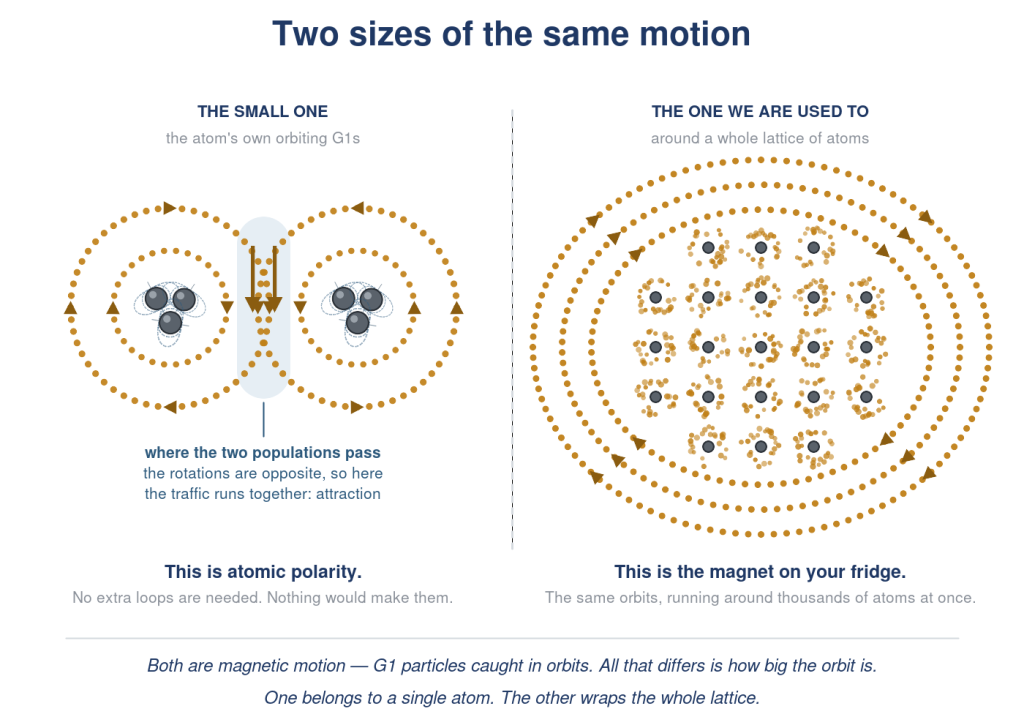
Those orbits come in two sizes, and it is worth being exact about which is which. The small ones belong to a single atom: the G1 particles already orbiting its nucleons. Where two atoms sit side by side, those populations pass each other, and that is what atomic polarity is — what holds the atoms together with no need for charge. The two rotations run opposite ways, so in the gap between the atoms the streams travel together, and by the rule set out below that is attraction. There are no extra loops strung between the atoms; nothing would generate them, and nothing requires them. The large ones belong to no single atom at all. They loop around whole groups of atoms in a lattice, thousands at a time, taking them well beyond the atomic structures that cause them to orbit.
It is the large loops that give us the magnetic fields we are accustomed to: the arcs that iron filings lie along, and the pull you can feel through a fridge door. A magnet is simply a piece of metal whose lattice holds those loops lined up, instead of letting them point every which way. The animation further down shows G1 particles in exactly such an orbit, running around a lattice of atoms.
Magnetic Motion Defined
An orbiting body is a magnetic motion and constitutes a magnetic field. Magnetic attraction, repulsion, and equilibrium occurs when distinct orbiting systems come close or in contact to one another.
Magnetic fields are made up of moving bodies with the following characteristics:
- travel in orbits
- are guided by a gravitic field around a central body or bodies
- cause attraction when two opposite magnetic motions near each other
- cause repulsion when two like magnetic motions near each other
- are similar in size and mass
- can vary in speed in accordance with the shape of the orbit
- occur at all macro or micro levels of the universe
Second Gravity
What makes G1 particles orbit is a second gravitic field made up of G2 particles – G2 meaning down one level in the universe. If you think of atomic nuclei as suns and G1 particles as comets, you can visualize how atoms can guide G1 particles into orbit. The channels that a line of nuclei lays down in this way are what we call gravity tubes, and that is what guides G1s into orbits around a magnet. It is worth being exact about ownership here: the tube belongs to the lattice of nuclei, which is what shapes it. The G2 field is the means by which those nuclei do the guiding, not the tube itself.
When looking purely at orbits and how these orbits behave when they approach one another, we get the familiar repulsion and attraction. Abstracting, we have these two ideal scenarios.
Pure Magnetic Motion
Any orbiting body in a gravitic field is considered to be magnetic motion.
Opposite Directions: Attraction
When two magnetic motions approach each other in opposite directions, they reinforce each other causing the system to move towards each other.
Same Direction: Repulsion
When two magnetic motions which are rotating in the same direction come together, it creates a disturbance and forces the flows apart.
Two magnetic motions in the same direction cause repulsion.
The Same Rule, Said Two Ways
Those last two sections state the rule by rotation: same way round repels, opposite ways round attract. It can equally be stated by traffic — which way the particles are actually running at the place where the two circulations meet. Both are true, and they are the same statement, but they sound like opposites, so it is worth setting them side by side once and for all.
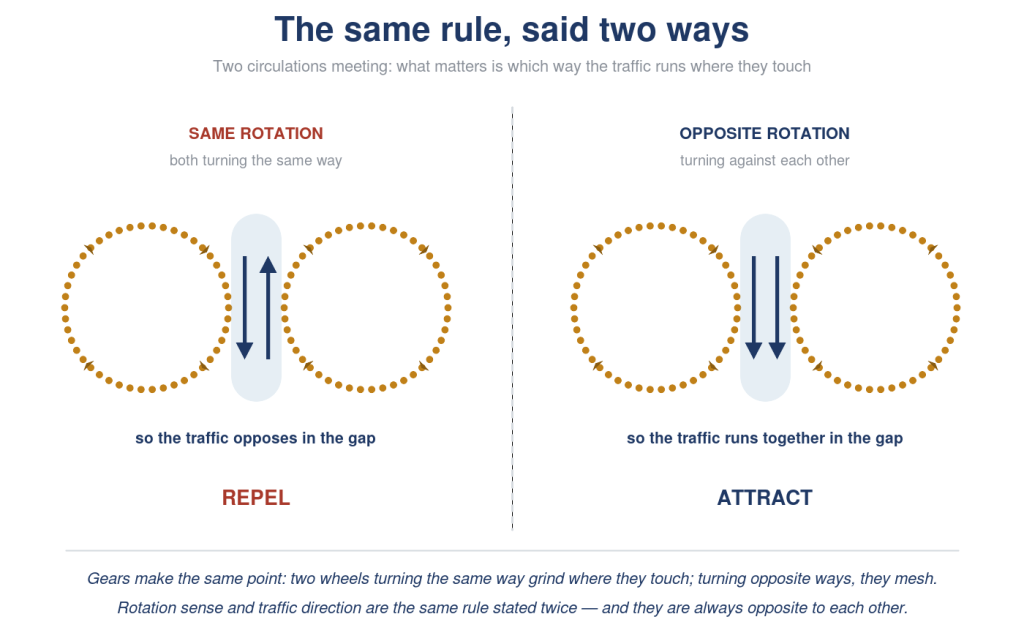
Take two wheels side by side. If both turn the same way, then at the point where they face each other one surface is going up while the other is going down: the traffic opposes, and they grind. If they turn opposite ways, the two surfaces at that point are going the same way: the traffic runs together, and they mesh. Gears work on exactly this principle, which is why a gear train alternates direction down the line.
- Same rotation = traffic opposes in the gap = repulsion.
- Opposite rotation = traffic runs together in the gap = attraction.
So if you ever find yourself reading a diagram and wondering whether “opposite” means the rotations or the arrows in the gap, the answer is that it does not matter which you check — as long as you check only one of them. They are always opposite to each other.
The Dinu Effect
The second of the four universal motions in physics is inspired by the Romanian scientist Ionel Dinu and his underwater experiments. We call this the “Dinu Effect”.
A second experiment with two cylinders rotating under water show how they react identically to magnetism.

Here is a video of this experiment.
Read About the Four Universal Motions
