

This is the companion to Diffraction. That article attacks the two-slit experiment, which the four universal motions have not yet fully solved. This one takes the same apparatus with one hole instead of two — and here the model is on much firmer ground, which is exactly why it is worth setting side by side.
The Oldest Camera There Is
Take a sealed box. Make a small hole in one wall. On the opposite wall, upside down and surprisingly sharp, you get a picture of whatever is outside.
No lens. No glass of any kind. No focusing, no adjustment, nothing to align. Mozi described it in China in the fifth century BC, Alhazen studied it carefully around 1020, and Renaissance painters traced from it. It is the plainest optical instrument that exists, and that is precisely what makes it useful here: whatever light is, the pinhole camera is light doing its job with nothing in the way.
So it is a good test. A model of light that cannot explain a hole in a box is not a model of light.
What the Standard Account Says, and Where It Stops
Conventional optics handles the pinhole with ray diagrams: light travels in straight lines, the hole admits one ray from each point of the scene, the rays cross at the hole, the image is inverted. Shrink the hole and the image sharpens until diffraction takes over, at which point it blurs again. There is a tidy formula for the optimum diameter.
All of that is correct and none of it is an explanation, because the central object is never specified. A ray is a line drawn on paper. Ask what is travelling along it and the answer switches register: an electromagnetic wave, or a photon, depending on which chapter you are in. Ask what the wave is made of and you are told it is an oscillation of fields. Ask what a field is made of and the conversation ends.
And there is a question the ray picture skips entirely, which Electromagnetic Waves raises about light in general: how do all these rays occupy the same space at once? The air in front of the hole carries light from every point of the scene, crossing in every direction. Inside the box the bundles cross again. If light were a set of oscillating planar fields, that volume would be a hopeless tangle. It is not. The picture comes out clean.
The Image Is Selection, Not Bending
In the four motions, light is luminic motion: groups of G1 particles travelling together in the same direction at the same speed. Every point of every lit object is shedding such groups continuously, in every direction it can — that is what emission is, atoms letting go of surplus G1 particles in formation.
Now the box. A wall is a mass that stops G1 groups. A hole is the absence of that mass. So the wall is a filter on direction, and nothing else: of all the traffic leaving a given point of the scene, the only bundle that gets in is the narrow one that happened to be aimed at the hole.
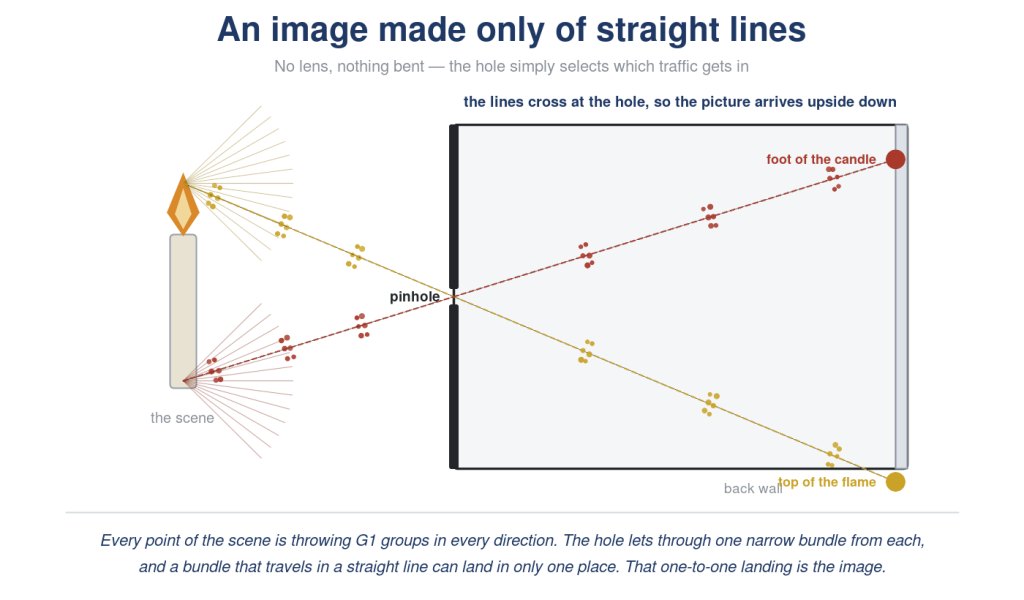
Once through, that bundle keeps going in a straight line, because nothing is acting on it. It lands in exactly one place on the back wall. Do the same for every point of the scene and every point gets its own landing place — a one-to-one map from the world onto the wall. That map is the image.
The inversion needs no explanation at all. Straight lines through a single point cross. Top goes to bottom, left goes to right. It is not an optical effect; it is geometry, and the only reason it ever looked like one is that a lens makes the same thing happen in a way that seems to require cleverness.
The pinhole does not form an image. It discards almost all of the traffic, and the image is what is left.
Why Nothing Is Ever Out of Focus
A pinhole camera has no focal length and no focus setting. A fingertip an inch from the hole and a mountain ten miles off are rendered with the same sharpness, at the same time, on the same wall. Photographers call this infinite depth of field and treat it as a quirk.
In this model it is not a quirk, it is the absence of a mechanism. Focusing is what you have to do when you have bent light and need all the bent paths from one object point to reconverge at one image point — which happens at exactly one distance, and that is the focal plane. The pinhole never bends anything. It selects a bundle and lets it fly straight. A straight line from a point lands in one place no matter how far away the point was.
Nothing needs to be brought together, so nothing can be out of focus. The lens, not the pinhole, is the special case.
Why a Million Bundles Cross Without a Tangle
Inside the box, the bundle from the top of the scene and the bundle from the bottom pass through each other on their way to opposite ends of the wall. They cross at the hole and again nowhere in particular, millions of times over, and the picture is not smeared.
For a field model this is an embarrassment. For a particle model it is the expected result, for the reason gravitic motion leans on throughout this site: matter is overwhelmingly empty, and these particles are overwhelmingly small. Two streams crossing are two sets of tiny bodies passing through a volume that is almost entirely vacant. Collisions happen — that is how the model does everything else — but they are rare enough that the formations survive the crossing intact.
The camera obscura is therefore a daily, visible demonstration that light is traffic rather than a filled field. If the room were full of interlocking planar waves, the hole could not sort them by direction so cleanly, and the crossings inside the box would not come out clean.
The Two Blurs
Now the detail everyone who has built one of these runs into. Make the hole smaller and the image gets sharper — up to a point. Past that point, smaller makes it worse, and also much dimmer. There is a sweet spot.
The model gives two separate blurs with two separate causes, pulling in opposite directions.
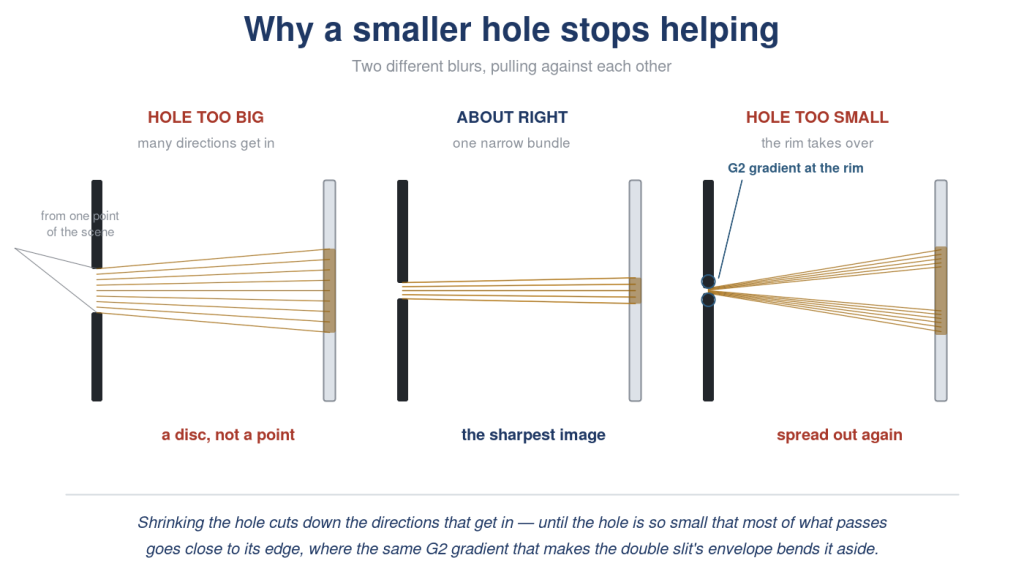
The first blur is bookkeeping. A hole of any real size admits not one direction from each scene point but a small cone of them. So each point paints a small disc rather than a point, and neighbouring discs overlap. Shrink the hole and the cone narrows and the discs tighten. This is the blur that gets better as the hole gets smaller.
The second blur is physical, and it is the heart of the matter. The rim of the hole is made of atoms, and a mass with a sharp boundary carries a strong G2 gravitic field whose gradient is steepest right at the edge. A G1 group passing close to that rim is deflected by it. This is David de Hilster’s conjecture from the first attempt on the double slit — that G1 particles passing near the edges of a slit are deflected by the strong G2 field there — and the pinhole is where it is easiest to see that he was right.
Two details decide everything. The pull is toward the mass, so a particle skimming the rim is drawn outward, into the material it just missed — the bundle spreads away from its centre line and never converges. And a G2 field is random, in the way all gravitic motion is random: it is particles travelling in random directions. So the rim does not bend each G1 particle along one calculated arc. It strikes them at random as they pass, and the kicks are random in direction. That is what turns a bundle into a spray.
In a large hole almost everything passes well clear of the rim and is never touched. In a tiny hole almost nothing does, so most of what gets through has been kicked, and the bundle arrives spread out instead of sharp.
A Round Rim Bends in Every Direction
A slit has two straight edges, so it throws its traffic into a flat fan. A pinhole’s edge is a ring, surrounding the opening on every side, so it throws its traffic into a cone — outward in all directions at once.
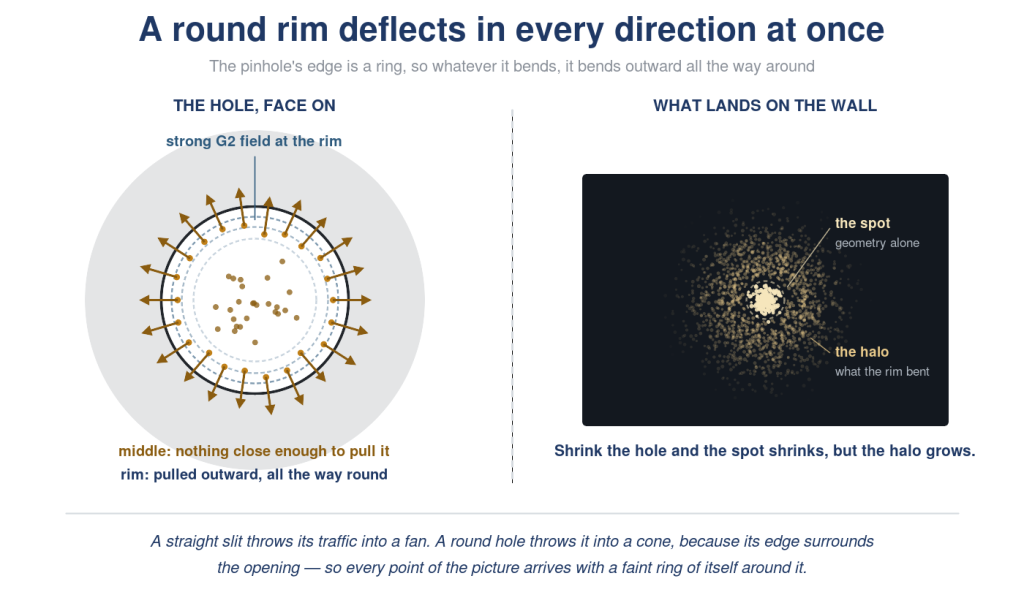
So each point of the scene lands as a sharp spot — the part of the bundle that went through the middle untouched — wrapped in a faint halo made of everything the rim got hold of. In a well-sized pinhole the halo is weak and the picture looks clean. Shrink the hole and the proportions invert: less and less traffic passes clear of the rim, the halo swallows the spot, and the image goes soft. That is the whole of the small-hole blur, and it is one physical cause rather than a wave invoked at the last moment.
One blur shrinks with the hole and the other grows with it. The sharpest image is at the crossover. That is the whole content of the optimum-diameter formula, now with a physical cause on both sides of it rather than a geometric cause on one side and a wave on the other.
The dimming comes free. Fewer admitted directions and a smaller opening mean fewer groups per second getting in. Nothing is lost or converted; less traffic is let through the door.
What the Pinhole Says About the Double Slit
Put the two experiments next to each other and they are the same apparatus counted differently.
- One hole: one admitted bundle per scene point, flying straight, landing in one place. An image. The only complication is the rim.
- Two holes: the same thing twice, except that two halves of one procession now arrive at the same spot having travelled different distances — and the rhythm of the procession starts to matter. Fringes.
The rim effect is present in both, and in both it does the same job: the broad spreading — the envelope under the fringes in the two-slit pattern, and the halo around every spot here. That is a genuine consistency, one mechanism doing the same thing in two experiments, and it is the part of Diffraction we have most confidence in.
There is one thing the pinhole cannot tell you, and it is worth knowing which experiment to ask. Here the rim’s kicks are random in direction, and that is all the pinhole ever needs — a spray is a spray. The double slit asks a harder question, because its fringes depend on the two halves keeping time with each other. The answer there is that the rim is random in direction but not in timing: it nudges a particle sideways while it is still travelling, rather than stopping it and letting it go again. The pinhole is blind to that distinction. The double slit is the experiment that tests it.
The part we have least confidence in is absent here, which is the honest reason the pinhole is easier. With one hole there is no second half-procession to arrive out of step, so the model is never asked the hard question — why a place that is receiving particles should record nothing at all.
What Is Still Open
- The rim deflection is qualitative. The model says the strong G2 field beside the edge kicks passing G1 particles outward at random. It does not yet say how hard, as a function of how close the particle passes — which is what would be needed to predict the optimum hole size rather than merely account for there being one.
- Colour dependence is unresolved. Real pinhole blur depends on wavelength. In this model that must mean the deflection depends on the spacing of the groups, and the mechanism for that is the same gap flagged in Diffraction: a prism and an edge sort the spacings in opposite senses, and we cannot yet say why.
- The configuration of the G2 fields is still unmodelled. Both blurs above lean on a strong G2 field at the rim whose structure has not been written down. See The Configuration of the Atom.
None of that touches the main claim, which is as simple as the box it happens in: the picture on the back wall is made of real particles that travelled in straight lines from the thing you are looking at, and the hole’s only job was to throw almost all of them away.
