

The Trick That Should Not Work
In 1831 Michael Faraday wound a coil of wire, connected it to a needle that could show a current, and pushed a bar magnet into it. Nothing was touching. Nothing was connected. The needle swung.
Then he stopped pushing and left the magnet sitting inside the coil, and the needle fell back to zero — with the magnet still right there, as magnetic as ever. He pulled it out, and the needle swung the other way.
Every power station on Earth runs on that trick. So does every transformer on every pole, the charger your phone sits on, and the cooktop that heats a pan without heating the air. And the explanation offered for all of it is a sentence: a changing magnetic field induces an electromotive force in the conductor.
That sentence names what happens with great precision and says nothing about what occurs. Three questions it will not answer:
- What crossed the gap? Something got from the magnet to the wire. What was it made of?
- Why must it be moving? A stationary magnet has a perfectly good field. Why is a field worth nothing unless it is changing?
- Why does the coil push back? Lenz’s law says the induced current always opposes the change. Why would it? What is doing the opposing?
What follows is a physical model for induction built only out of what the four universal motions already commit to elsewhere on this site — orbits, flows, gravity tubes, the Dinu effect, and the F2 force. It is offered as a proposal, with its weak points marked at the end.
First: a Magnet Is a River of Particles
Start with what is actually sitting in the room. As described in Magnetic Motion, a magnetic field is G1 particles caught in orbits — guided along the gravity tubes that lines of nuclei lay down, and around a magnet those orbits run far outside the metal itself. Out at one pole, around through the space beside it, back in at the other.
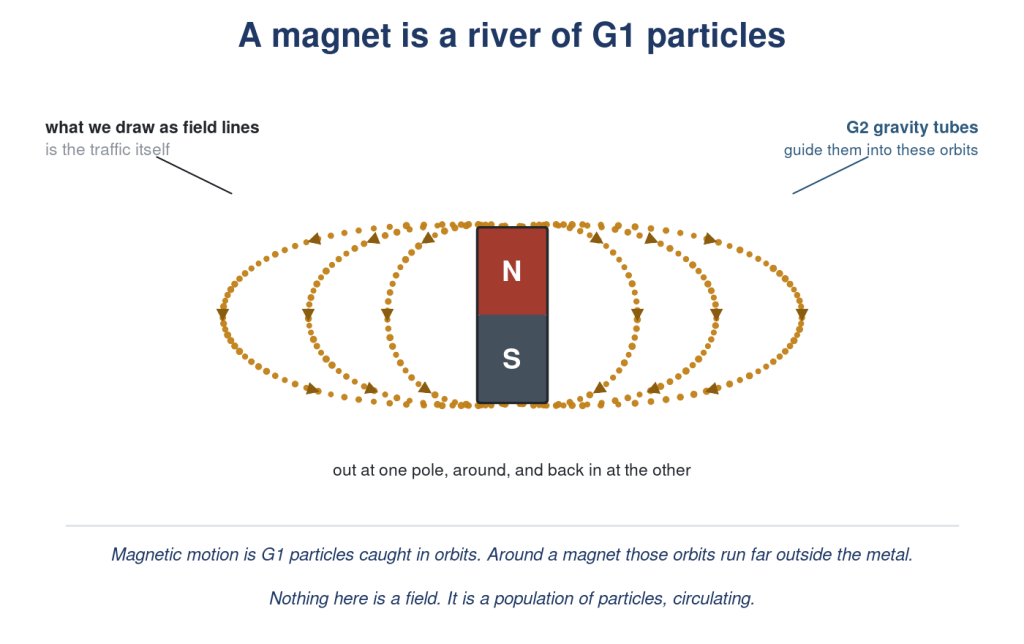
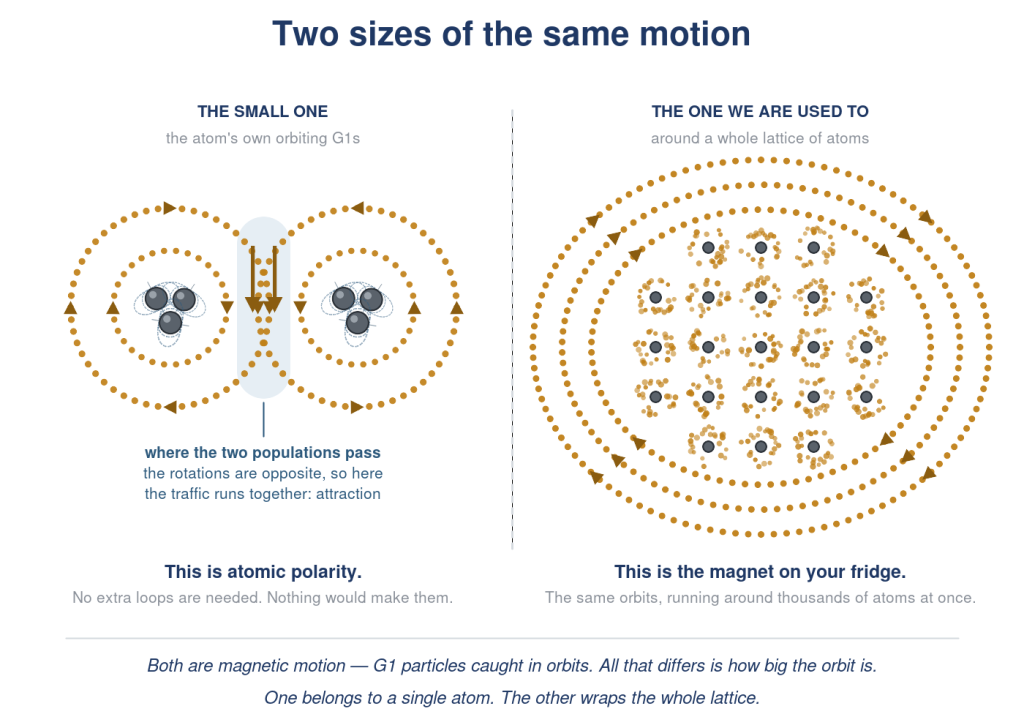
It is worth being exact about whose orbits these are. The small ones belong to the atoms themselves: the G1 particles already in orbit around the nucleons. Where two atoms sit side by side, those orbiting populations pass each other, and that passing is atomic polarity — what holds the atoms together, with no charge involved. The two rotations run opposite ways, so the streams travel together where they meet, and by the Dinu rule that is attraction. There are no additional loops strung across the gap between atoms; nothing would generate them, and nothing needs them. But the field you can feel through a fridge door is far bigger than one atom’s orbits. It is G1 particles looping around whole groups of atoms in the lattice, thousands at a time. A magnet is simply a piece of metal whose lattice holds those large loops lined up, instead of letting them point every which way.
This is the first thing the mainstream account cannot give you. A field, in that telling, is a condition of space with a number attached at every point. Here there is no condition of space. There is traffic. Something is physically going past.
Second: a Wire Is a Pipe That Is Already Full
The second half of the picture is the wire. Electric Motion describes a conductor as a lattice of nuclei whose gravity wells form tubes through the metal, and the live copper simulation on that page shows the rest: a bound cloud of G1 particles already drifting through those channels, threading between the atoms rather than orbiting any one of them.
So the wire does not need to be given particles. It is a pipe that is already full of them, and they are held loosely enough to be steered. Induction never has to create a current out of nothing — it only has to persuade a population that is already there to move.
Third: Current and Magnetic Field Are One Motion
Here is the piece that makes induction mechanical rather than magical. Electromagnetic Waves already states it: when G1 particles are driven through a conductor, some are guided along inside it and some spiral around the outside — and that circulation around the wire is what we have been calling the magnetic field.
Which means the traffic belonging to a wire is one helical motion with two parts. The part that advances along the wire is what we name current. The part that circles the wire is what we name the magnetic field. They were never two phenomena linked by a law. They are one screw.
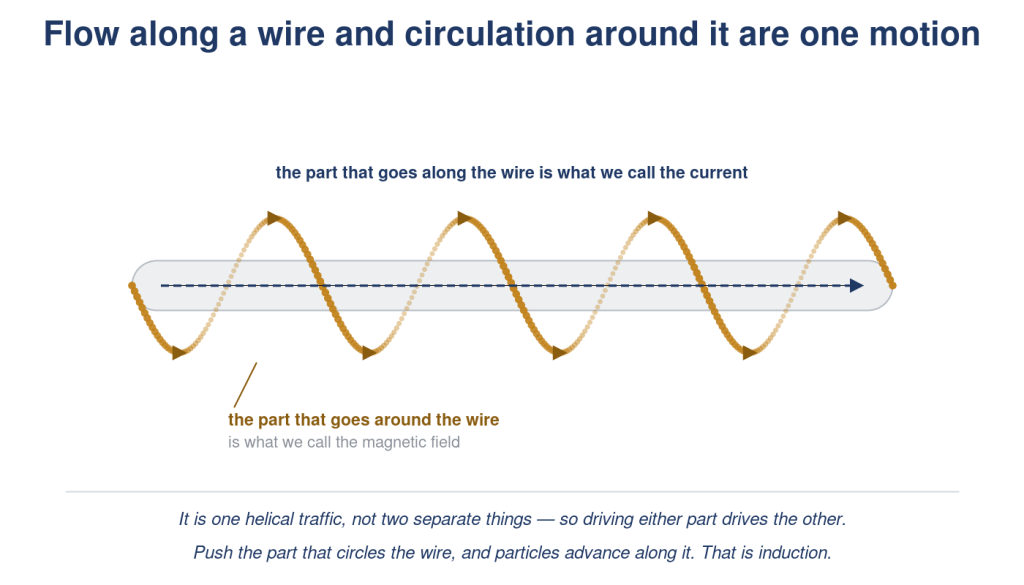
Physics has long known that these two go together — push current along a wire and a field wraps around it; that is Ampère’s law. The four motions say why: it is the same particles on the same helical path. And it hands you the converse for free. Push on the part that circles the wire, and particles advance along it. That converse is induction.
Why Nothing Happens Unless Something Moves
Now the question that defeats the field account. Why does a magnet sitting still in a coil do nothing at all?
Think about two tanks of water joined by a pipe at the bottom. While one side is higher than the other, water moves. Once the levels match, the water stops — and notice that nothing has gone away. All the water is still there, the pipe is still open, the connection is still perfect. What ended was not the water but the difference.
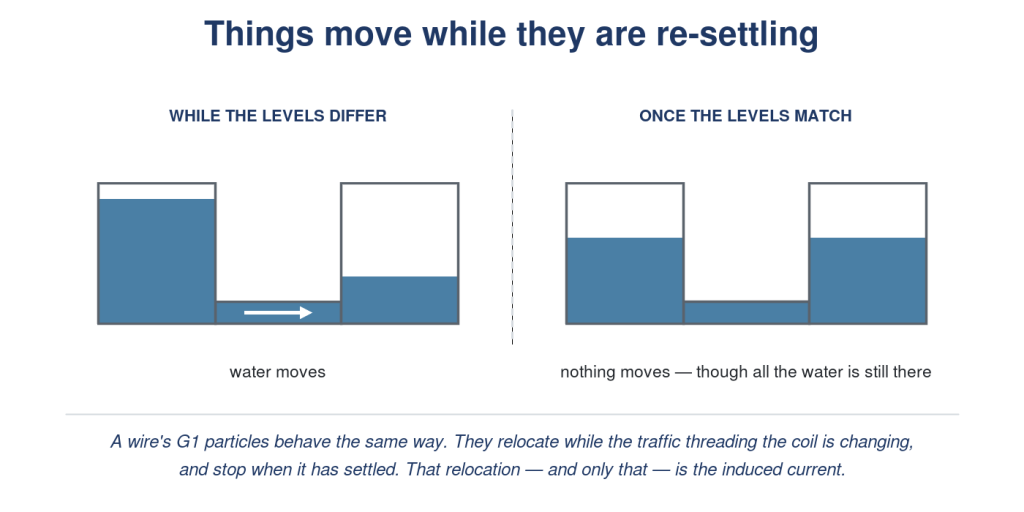
A wire’s G1 population behaves the same way. How its helical traffic sits — how many G1s are circling, how fast, how far out — has a settled arrangement, and that arrangement depends on how much outside traffic is threading through the coil. Bring a magnet near and you change what the settled arrangement is. While the coil’s particles are relocating toward the new arrangement, they are moving along the wire. That movement is the current.
Hold the magnet still and the coil reaches its new arrangement. Relocation finishes. The needle drops to zero with the magnet still sitting there — not because the magnet stopped doing anything, but because the levels matched.
A current is not a state. It is a population on its way somewhere.
The Whole Thing, Step by Step
Push a magnet into a coil and here is the sequence, with nothing in it but particles and motion:
- The magnet’s river of orbiting G1 particles threads through the loop of wire.
- Moving the magnet changes how much of that traffic is threading it, moment by moment.
- The coil’s own helical population is now sitting in the wrong arrangement for the traffic it finds itself in — an imbalance, the same kind of F2 imbalance that the battery and capacitor pages call voltage.
- The imbalance relieves itself the only way the lattice allows: G1 particles shift around the loop.
- Because circling and advancing are one helical motion, shifting around the loop is moving along the wire. The needle swings.
- Stop moving the magnet and the arrangement settles. The shifting ends. The needle returns to zero.
Nothing was induced into existence. Nothing acted at a distance. A population of particles that was already in the wire moved, because particles that were already around the magnet came through and changed what it would take for that population to sit still.
Which Way? Lenz’s Law Is the Dinu Effect
The induced current always runs the way that opposes what you are doing. Push the magnet in and the coil pushes back. Pull it out and the coil tries to hold on. In the standard account this is Lenz’s law, and it is usually justified by saying that otherwise you would get energy for nothing — a true statement that explains precisely nothing about the mechanism.
In the four motions it is not a separate law at all. The coil’s induced flow is a circulation. The magnet’s aligned atomic orbits are a circulation. Two circulations have met, and the rule for what two meeting circulations do was already written down by Ionel Dinu and sits on the Magnetic Motion page: same direction repels, opposite directions attract.
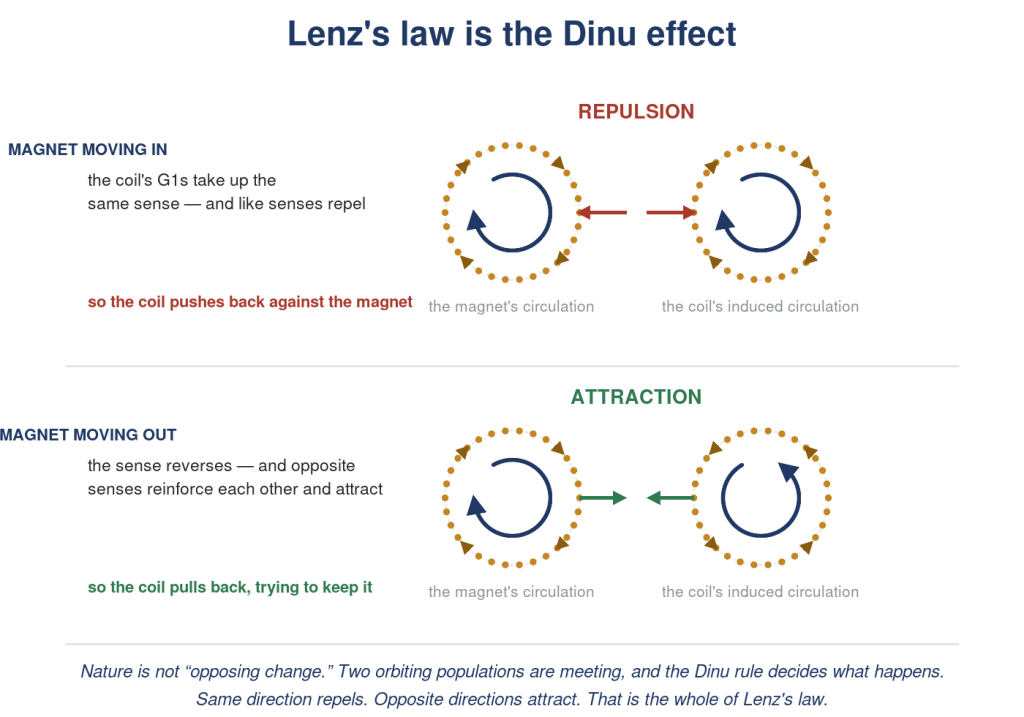
Approach, and the arrangement the coil relocates into is the one turning the same way as the magnet’s — so they repel, and you feel the resistance in your hand. Withdraw, and the relocation runs backwards, the coil’s sense reverses, the two are now opposite — so they attract, and you feel the tug. The famous “opposition” is just the Dinu rule, read off a diagram that was already on this site.
Why a Transformer Needs AC
Put two coils on one iron core and the model predicts the behavior of a transformer without a single equation.
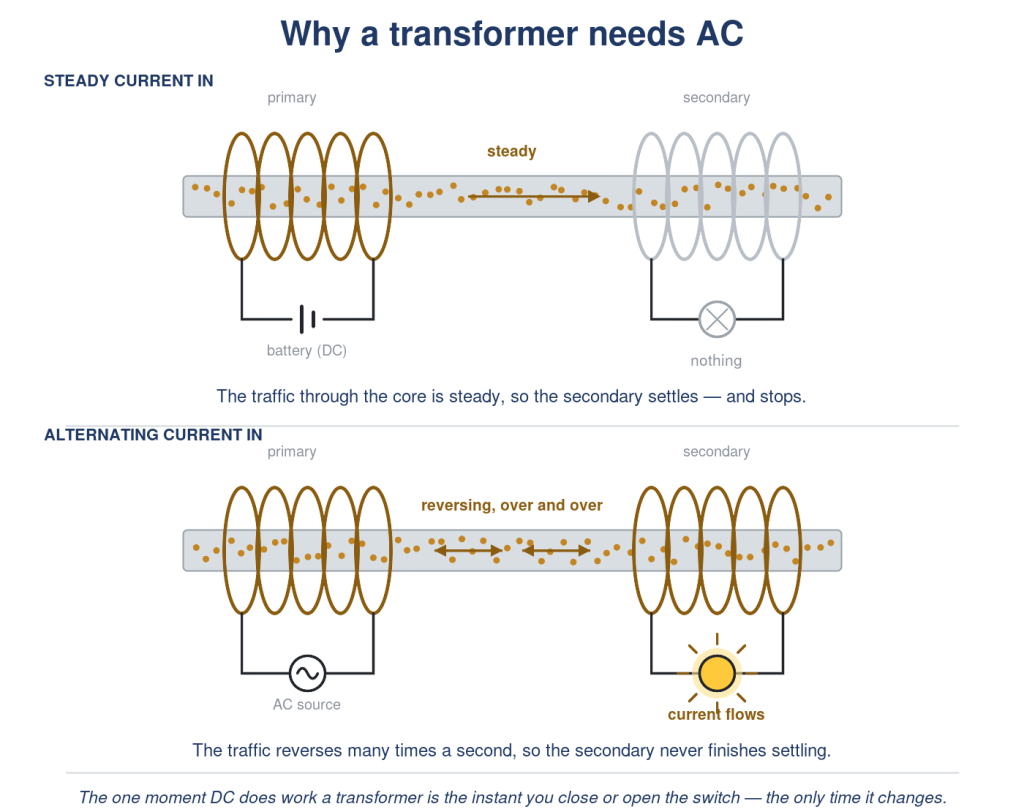
Connect a battery to the primary and you get a steady river through the core. The secondary settles into its new arrangement almost at once and then does nothing, forever, while the battery goes on supplying current. Hook a lamp to it and the lamp stays dark. The single exception is the instant you close or open the switch, because that is the only moment anything changes — which is exactly what a transformer connected to DC actually does.
Connect an alternating source and the river reverses dozens of times a second. The secondary is never given time to finish settling, so its particles are always relocating, so current flows the whole time. The lamp lights.
Two details come along for free. The turns ratio: the same sweeping traffic acts on however much wire you give it, so a secondary with ten times the turns is ten times as much population being relocated by the same change. The iron core: iron’s atoms carry G1 orbits that can be aligned, which means iron is a bundle of ready-made gravity tubes. It does not “concentrate a field” — it gives the traffic a good road, so more of it goes where you want instead of spilling into the room.
The Spark When You Break the Circuit
Switch a coil on and the current does not arrive all at once; it climbs. The model says why: the arriving G1s have to populate the coil’s own circulation before many of them get all the way through. The coil is filling its orbits, and what is left over is the current you measure. That slow climb is inductance.
Now switch it off, and you get the effect everyone who has built a relay circuit has been bitten by: a fat blue spark across the opening contacts, at a voltage far above anything the battery could supply.
Textbooks say the energy stored in the magnetic field has to go somewhere. In this model that is a literal statement about stuff. The circulation around the coil is a population of G1 particles in orbit, still moving, still being delivered into a wire that suddenly has no outlet. They pile up at the gap until the crowding is violent enough to cross it. The “energy stored in the field” is a quantity of particles, and the spark is that population cashing out.
What Else Falls Out
- A magnet falls slowly down a copper pipe. No circuit is needed — the lattice tubes let G1s drift in closed loops in the solid wall. Those loops are circulations, turning the same way as the approaching magnet’s, so they repel it. The drag you see is literally particles dragging on particles.
- An induction cooktop heats the pan and not the air. Same loops, driven hard, in a metal that resists their relocation.
- Magnetic shielding. A mu-metal box does not block a field. It offers better tubes, and the traffic takes the better road — around the box instead of through it.
- Wireless charging. This is the mechanism behind what the Smart Phone Example already claims: the pad’s coil drives a circulation that reaches past itself, the phone’s coil sits inside that traffic, and G1 particles physically arrive. Your grandmother was right.
- A generator. Spinning a coil in a magnet’s river keeps the threading traffic permanently changing, so the population never settles. The mechanical work you put in is spent against the Dinu repulsion — which is why a generator gets harder to turn the moment you switch the load on.
- Superconductors. A persistent current is a circulation that never has to re-settle, because nothing in the lattice is taking particles out of it. The Meissner effect is that surface circulation refusing the incoming river — same sense, repelled.
What We Have Not Done Yet
This model is a proposal, and three parts of it are not finished.
The direction has to be derived, not assumed. Everything above rests on the claim that when the threading traffic increases, the coil’s population relocates into the circulation that runs the same way as the magnet’s. That is what produces Lenz’s law — and it is asserted here, not shown. If the entrainment actually came out the other way round, the model would predict a world in which pushing a magnet into a coil pulls it in harder, which is not the world we live in. This is the hinge, and it has to be settled by working the collisions out, not by arguing.
There is no quantitative rule yet. Faraday’s law says the voltage tracks the rate of change of the threading traffic. This model says why a rate of change is the thing that matters — relocation only happens on the way to a settled arrangement — but it does not yet say how much current you get for how fast a change.
The configuration of the G2 fields is still unmodelled. The gravity tube that guides a G1 particle through copper is named on this page, not drawn. That gap — what is settled, what is not, and how to close it — is set out in full in The Configuration of the Atom.
The Experiment That Would Settle It
The good news is that most of the apparatus is already built. The live copper-lattice simulation on the Electric Motion page already models G1 particles as bodies moving under the pull of 1,200 real copper nuclei in a real face-centred cubic lattice. It is a physical model simulation, which is exactly the right kind of tool.
Add one thing to it: an external population of orbiting G1 particles, and the ability to move it. Then watch for four results.
- When the external population is swept past the lattice, does a net drift appear along the wire?
- Does that drift reverse when the sweep reverses?
- Does it stop when the sweep stops, while the external population is still sitting there?
- Does the circulation the drift creates run the same way as the approaching one — or the opposite way?
Those four checks are Faraday’s induction, the reversal, the requirement for change, and Lenz’s law. No equations have to be fitted and nothing has to be assumed; the particles either do this or they do not. If they do not, this model is wrong and should be thrown out, which is the strongest thing that can be said in its favor.
What Changes
- Nothing acts at a distance. Particles that were around the magnet come through the coil and collide with particles that were already in the wire.
- Nothing is induced into existence. The current is a population that was already present, relocating.
- “Change is required” stops being a strange rule and becomes the most ordinary fact there is: things move while they are settling and stop when they have settled.
- Lenz’s law stops being a separate principle and becomes the Dinu effect.
- Current and magnetic field stop being two things that mysteriously accompany each other, and become one helical motion named twice.
- The energy stored in an inductor becomes a quantity of particles rather than a quantity in an equation.
Faraday had no theory when he pushed that magnet into that coil. He had a thing he could do with his hands and a needle that moved. Nearly two centuries later the mathematics is immaculate and the question he actually asked — what is going across? — has still not been answered in physical terms.
Particles are going across. They were in orbit around the magnet, and when you moved it they changed what the wire’s own particles would have to do to sit still. The needle swings while they are sorting that out, and stops when they have.
