

The Parking Lot
A row of cars, parked bumper to bumper, with one empty space in the middle. The car to the left of the space pulls forward into it. Now the empty space is where that car used to be.
One car moved, to the right. The gap moved, to the left.
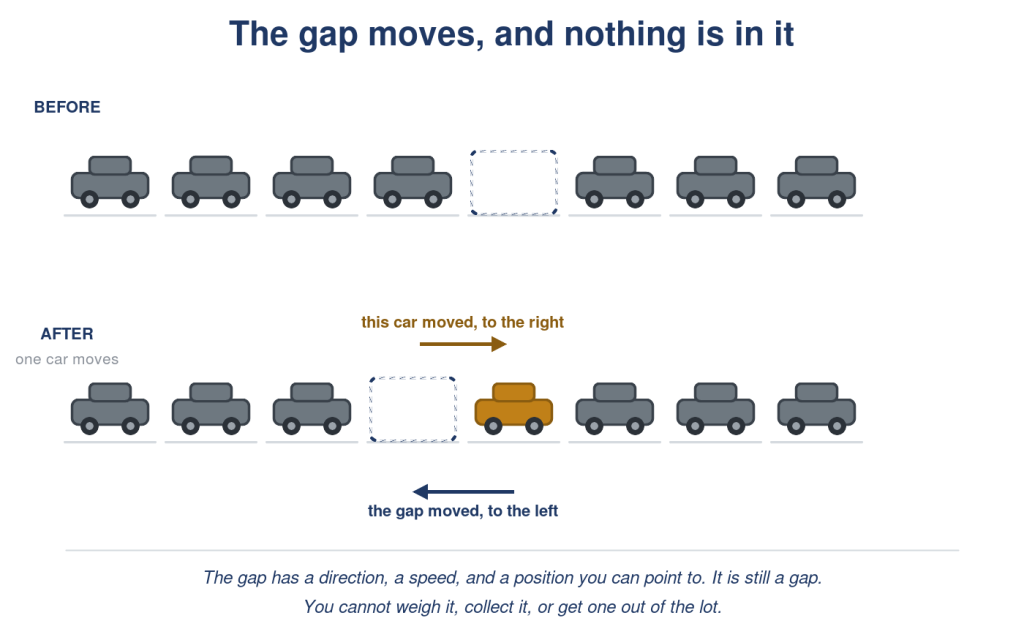
Keep it going — each car in turn pulling forward — and the gap travels the length of the row at a perfectly respectable speed. You could time it. You could write an equation for it. You could say, correctly, that the gap is moving west at four miles an hour.
What you could not do is weigh it, photograph it, collect a bucket of gaps, or drive one home. There is nothing in it. The gap is not a thing that moves; it is the name we give to where the things are not.
Physics did exactly this with electricity. And then it kept going.
What a Hole Is Supposed to Be
In a semiconductor, a hole is defined as a missing electron — a vacancy in a band that is otherwise full. As bookkeeping, it is a reasonable move. Tracking one absence is easier than tracking the billions of electrons shuffling around it, in exactly the way that watching the gap is easier than watching every car.
But look at what the hole is then handed.
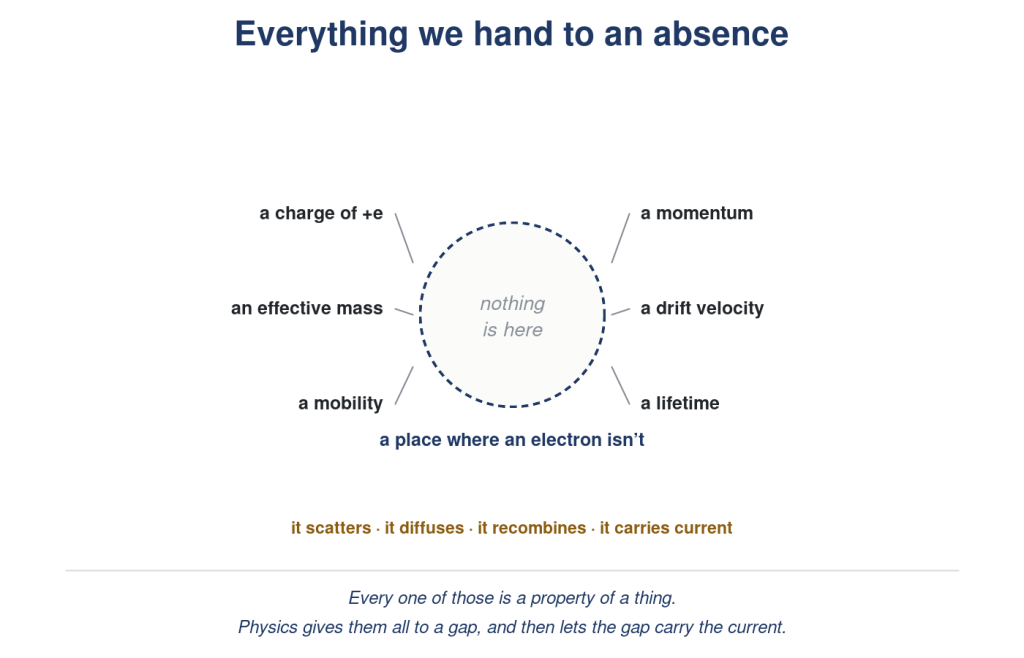
A hole is assigned a charge of +e. It is given an effective mass, and the number is not a placeholder — it is tabulated per material, and it differs from the electron’s. It is given a mobility, a drift velocity, a momentum. It scatters. It diffuses. It has a lifetime, and it recombines. It is called, without qualification, a charge carrier, and it carries current.
That is not bookkeeping any more. You do not give a parking gap a mass and a lifetime. Somewhere between “a convenient way to count” and “a positively charged particle with its own mass that carries the current,” a line was crossed, and nobody announced it.
Physicists will tell you, if asked directly, that a hole is a quasiparticle — an emergent description, not a thing. That is an honest answer, and it is also an admission that the physical account is a placeholder. The formalism is not in question here. What is in question is the picture underneath it, and the picture has an absence doing the work of an object.
Why the Hole Had to Be Invented
The hole did not come from the circuit diagram. It came from a measurement. In 1879 Edwin Hall put a strip of metal carrying a current into a magnetic field and found a small voltage building up across its width. Which side goes positive tells you whether the things moving along the strip behave as positive or negative. In most metals the answer was negative, as expected. But in some metals, and later in most semiconductors, the reading came out positive.
Nothing in the electron picture could explain a positive carrier moving through a solid. Around 1929–31, Rudolf Peierls and Werner Heisenberg showed that band theory could account for it if a nearly full band was described by its vacancies instead of its electrons, each vacancy behaving as if it were a positive particle. The hole began as a calculating device for a reading nobody could otherwise explain. And because a vacancy drifts the opposite way to the electrons, it drifts the way Franklin’s arrow points, so it was handed the job of being the current.
Robert de Hilster puts it bluntly in his circuit papers: current is the flow of holes, and a hole is a nothing. We have been drawing arrows for the movement of an absence.
The Four Motions Do Not Need One
In the four universal motions, the thing that physically moves through a wire is G1 particles, and they go from the negative terminal to the positive (Current follows them round the circuit): from the end holding more G1s to the end holding fewer. That is the same direction mainstream physics gives its electrons. The direction is not where the two accounts part.
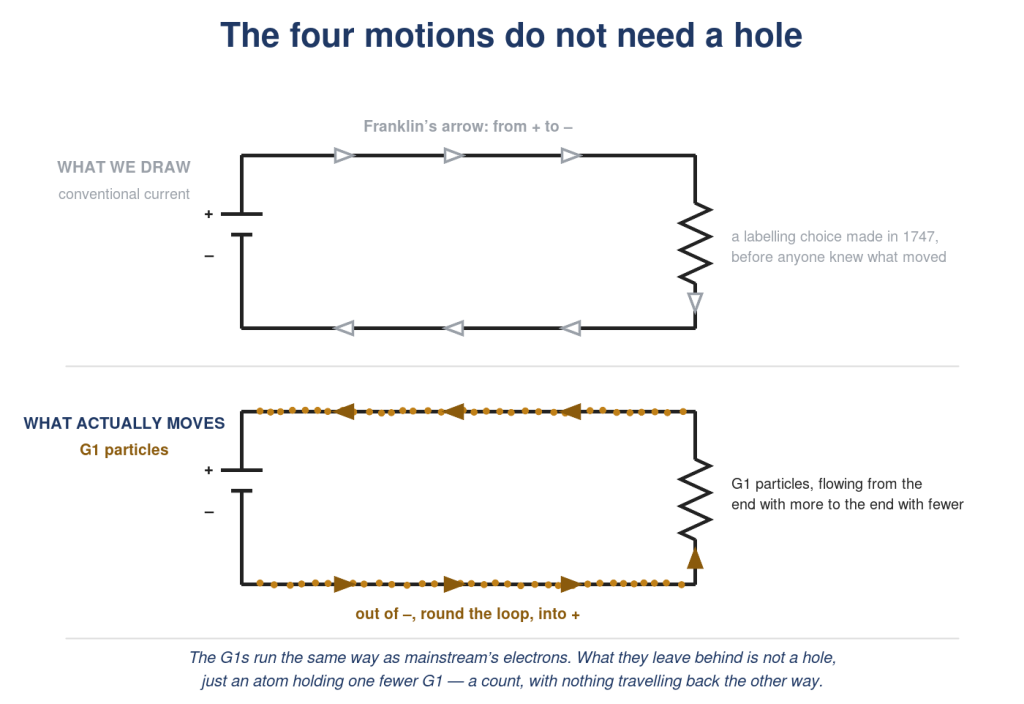
Where they part is what gets left behind. When a G1 particle leaves an atom, it does not leave a hole. It leaves an atom holding one fewer G1, with a slightly different cloud. That is a count, not an object, and the G1 particles themselves carry no charge at all. Charge sets out why a count is all charge ever was. Nothing travels back the other way. Each atom’s number dips and recovers as the particles pass through.
Like the gap in the parking lot, the place where the count has dipped seems to drift backwards, from + to –, which is exactly the way Franklin’s arrow points. The arrow has been following the gap all along. That is fine as a label. It is not a reason to give the gap a mass.
A word of care here, because the direction question is easy to overstate. Which end of a circuit you call the start, and which way you choose to label the current, is a convention. It is not the interesting part, and it is not what is wrong with the hole.
The circuit papers on this site follow the G1 flow out of the negative terminal — the direction an electrical engineer tracks, and Robert de Hilster spent forty years as one, designing digital switching systems in telecommunications before turning to the particle model. He is also one of the two authors of the four universal motions: luminic motion, the particle model of light that the rest of this site is built on, is his. At a bench, electron flow is the direction that makes sense, and the diode and transistor analyses come out the same either way — because the particles do the same thing whichever end you start counting from.
What is not a convention is whether something is there. A label can point either way along a wire and still be a label for a real population of particles. It cannot point at an absence and have the absence carry a charge, a mass and a lifetime. That is the distinction this page is about.
A hole is the name we gave to an atom that is one G1 short — and then we gave the name a mass.
The Other Thing the Hole Was Hiding
There is a second oddity in the standard account, and it is usually passed over quickly. Work out how fast the charge carriers actually move along a copper wire and you get a startling number: a fraction of a millimetre per second. Slower than a snail. Slow enough that an individual carrier leaving the battery would take hours to reach the lamp.
And yet the lamp comes on the instant you close the switch.
The standard resolution is to say that the carriers crawl but the field propagates at nearly the speed of light, so every carrier along the wire starts moving at once. Which hands the explanation to the field — and the field, as Electromagnetic Fields sets out, has never been given a physical description either. One unexplained thing is being covered by another.
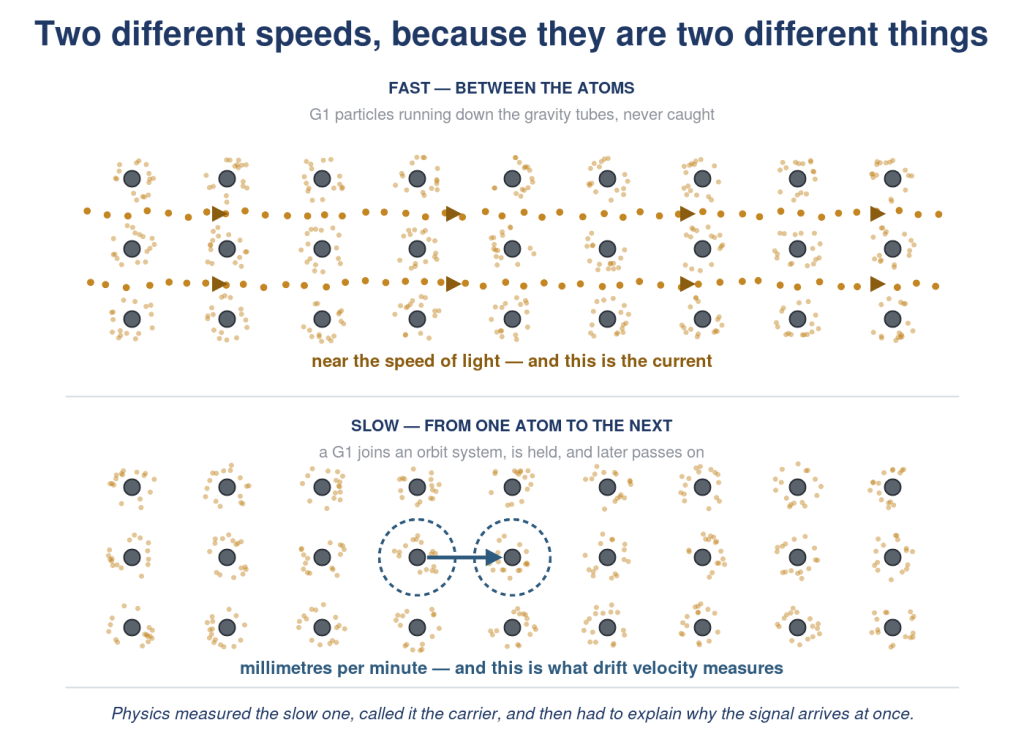
In the four motions there is no paradox, because there are two different processes going on in the same piece of copper and physics has been averaging them together.
- Fast: G1 particles running down the gravity tubes between the atoms. They thread the channels in the lattice without ever being captured, and they move at near light speed. This is the current, and this is why the lamp lights at once.
- Slow: G1 particles entering one atom’s orbit system and later passing to another. Being taken into an orbital arrangement, held, and released again is a slow business. This is a real process, and it is the one the drift velocity number is measuring.
The famous slow number is not a strange fact about electricity. It is a measurement of the wrong process. Physics measured the hopping, called it the carrier, and then had to invent a fast field to explain why anything happens quickly. The four motions keep both — because both are really happening — and simply decline to confuse them.
Why This Is Not Pedantry
It would be fair to say: the hole formalism works, so who cares what we call it? The answer is that counting absences makes certain questions impossible to ask, and those questions have answers.
- The capacitor at balance. When a capacitor has finished charging, the meter reads zero. Counting holes, nothing is happening. Counting particles, G1s are still being pushed out of both sides at equal rates — there is flow, it is simply undetectable. Those are very different statements about the same instant.
- The transistor‘s “gain.” Gain is defined as a ratio of hole currents. Count the particles instead and you see an emitter stream dividing into base and collector — and the ratio of the two parts of a split is not a gain. That conclusion is invisible while you are counting absences.
- The diode. The hole account needs a depletion layer built out of charge. The particle account needs a difference in how many G1s each region holds and a push from the F2 force. One of those you can picture.
In every case, naming the absence let the mechanism go unexamined. That is the cost.
The Same Move, Three Times
Step back and this stops looking like a quirk of semiconductor physics and starts looking like a habit.
A photon is a single structureless point, and it is given a frequency — a property only a repeating series can have. That is The Impossible Photon. A field is a number assigned to each point in space, and it is given energy, momentum and the power to push things. That is Electromagnetic Fields. A hole is a place where an electron isn’t, and it is given charge, mass and the job of carrying the current.
Three times, a bookkeeping device was promoted to an object, because the mathematics kept working and nobody needed to look underneath. The four motions are an attempt to look underneath each time, and the answer keeps coming back the same: there are particles, and they are moving.
What We Have Not Done Yet
The hole formalism is quantitative and this is not. Band theory predicts carrier concentrations, junction voltages and device behaviour to real precision, and it does it with holes in the equations. Nothing here reproduces those numbers. What is offered is a physical account of what is moving; the arithmetic that would replace effective mass and mobility with counts of G1 particles has not been done.
The two speeds need to be pinned down. Saying that one process is fast and the other slow is the beginning of a model, not the end of one. What fraction of the G1s thread the tubes without being caught? What decides whether an arriving particle is captured into an orbit system or passes straight through? Those are the numbers that would turn this into a prediction.
The configuration of the G2 fields is still unmodelled. The F2 force is what pushes the G1s along the wire; we can say what it does without yet saying how it is arranged. That gap — what is settled, what is not, and how to close it — is set out in full in The Configuration of the Atom.
The positive Hall readings are not yet explained. Some metals and most semiconductors give a Hall voltage of the sign a positive carrier would produce. That measurement is what the hole was invented for, and a four-motions account has to explain it with G1 particles alone. We do not have that account yet.
All of these are jobs for the same tool: physical model simulations on a real lattice, counting what goes in and what comes out — the copper simulation on the Electric Motion page, pointed at these questions. A simulation that tracks particles can report both speeds separately, which is exactly what is needed here.
What Changes
- The arrow on the schematic can stay as a label. The G1 particles go the other way, from – to +, and the arrow follows the dip in the count.
- The hole becomes unnecessary rather than wrong. What it tracks is an atom one G1 short: a count, not a thing.
- The drift velocity paradox dissolves into two processes that were being averaged together.
- Current stops being a flow of nothing and becomes a count of particles passing a point.
The gap in the parking lot really does move. It has a direction and a speed, and you can write it down. But if you want to know what is actually happening in that lot, you have to stop watching the gap and start watching the cars.
