

The Lamp That Should Take Hours
Flip a switch and the lamp across the room comes on. Not soon after: at once.
Now work out how fast the carriers of the current are said to move along the copper. The answer, from any textbook, is a fraction of a millimetre per second. Slower than a snail. A carrier leaving the switch would need hours to reach the lamp.
Both facts are true, and physics reconciles them by saying the carriers crawl while something else, the field, races ahead and sets them all moving at once. That moves the question rather than answering it. And underneath it sit two older questions that are rarely put side by side: which way does the current really go, and what is it that goes?
The four universal motions answer all three with one picture. Something real moves through the wire, it moves the way the experiments say, and it moves at two speeds because two different things are happening.
Franklin’s Arrow
Every circuit diagram draws current leaving the positive terminal, running round the loop and returning to the negative. That arrow was fixed by Benjamin Franklin in 1747, and it was a guess.
Franklin pictured a single electric fluid. A body holding more of it than usual he called plus, one holding less he called minus, and the fluid, he supposed, ran from plus to minus. He had no way to know which body really held the extra. He made a choice and labelled it, and in doing so made two guesses at once:
- which body holds the extra: the plus one;
- which way the fluid flows: from plus to minus.
Both turned out to be wrong. But the arrow was on every diagram long before anyone could check, and it is still there.
What the Experiments Found
The check took sixty years and a vacuum pump.
In 1858 Julius Plücker, and in 1869 Johann Hittorf, pumped the air out of glass tubes and put a voltage across two metal plates. A glow streamed off the negative plate, the cathode, and travelled in straight lines; an object in its path cast a shadow at the far end. Eugen Goldstein named them cathode rays in 1876. In 1895 Jean Perrin caught them in a metal cup and found they carried negative charge, and in 1897 J. J. Thomson bent them with magnets and electric fields and showed they were something far lighter than any atom.
Inside solid wires the evidence came from two other directions. In 1879 Edwin Hall put a strip of metal carrying a current into a magnetic field and found a small voltage building up across its width, whose sign tells you whether the moving things behave as positive or negative. In most metals they behaved as negative. And in 1916 Richard Tolman and Thomas Stewart spun a coil of wire and stopped it dead; the carriers sloshed on for an instant, like water in a pipe, and the pulse they made matched Thomson’s particles.
Whatever moves leaves the negative side. That much is not a matter of interpretation.
Why Physics Ended Up With Holes
Hall’s test did not always agree. In some metals, and later in most semiconductors, it read positive, as if the carriers were positive things moving the other way. Nothing in the electron picture could explain that, and around 1929–31 Rudolf Peierls and Werner Heisenberg found a way to make band theory account for it: describe a nearly full band by its vacancies, and treat each vacancy as a positive particle.
That vacancy is the hole. It drifts opposite to the electrons, which happens to be the way Franklin’s arrow points, so it ended up carrying the arrow. The Moving Hole follows what happened next: the vacancy was given a charge, a mass and a lifetime, and became a carrier in its own right, though there is nothing in it.
What Moves, in the Four Motions
In the four universal motions, what moves through a wire is G1 particles. They carry no charge. They are the same particles that make up light and that every atom holds in orbit around its nucleons, and in a wire they run from the negative terminal to the positive.
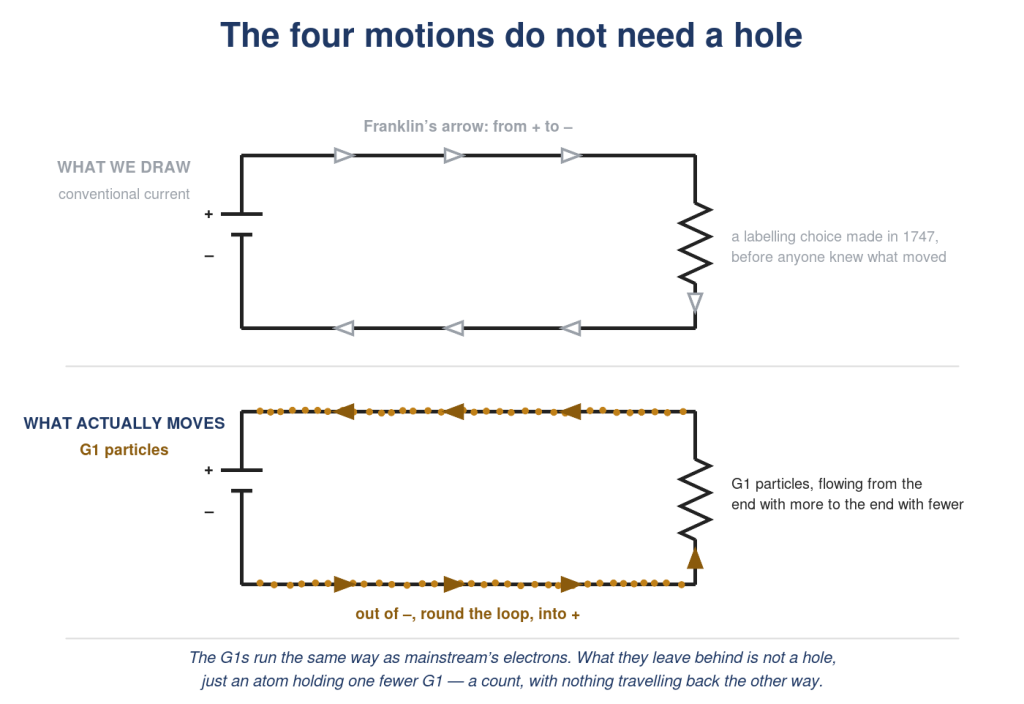
That is the same direction mainstream physics gives its electrons, and it is worth being clear that the direction is not where the four motions part company with the textbook. It follows directly from what charge is. Charge is a count of the G1 particles a body holds, and the end we call negative is the end holding more. The particles run from where there are more to where there are fewer, which is all a battery ever arranges: it keeps one end fuller than the other.
The difference is in what moves and what it leaves behind. The movers are real particles, not a charge with nothing underneath it. And when a G1 particle leaves an atom it does not leave a hole. It leaves an atom holding one fewer G1, which is a count, not an object. Nothing travels back the other way.
The path the particles take is a gravity tube. The nuclei of a metal sit in a regular lattice, and their combined gravity wells lay down channels running the length of the wire; G2 gravity is the means by which the nuclei guide, but the tube belongs to the lattice. The G1 particles thread those channels the way a comet threads the pull of the planets it passes.
Two Speeds, Because Two Things Are Happening
Here the lamp puzzle comes apart. There are two different processes going on in the same piece of copper, and physics has been averaging them together.
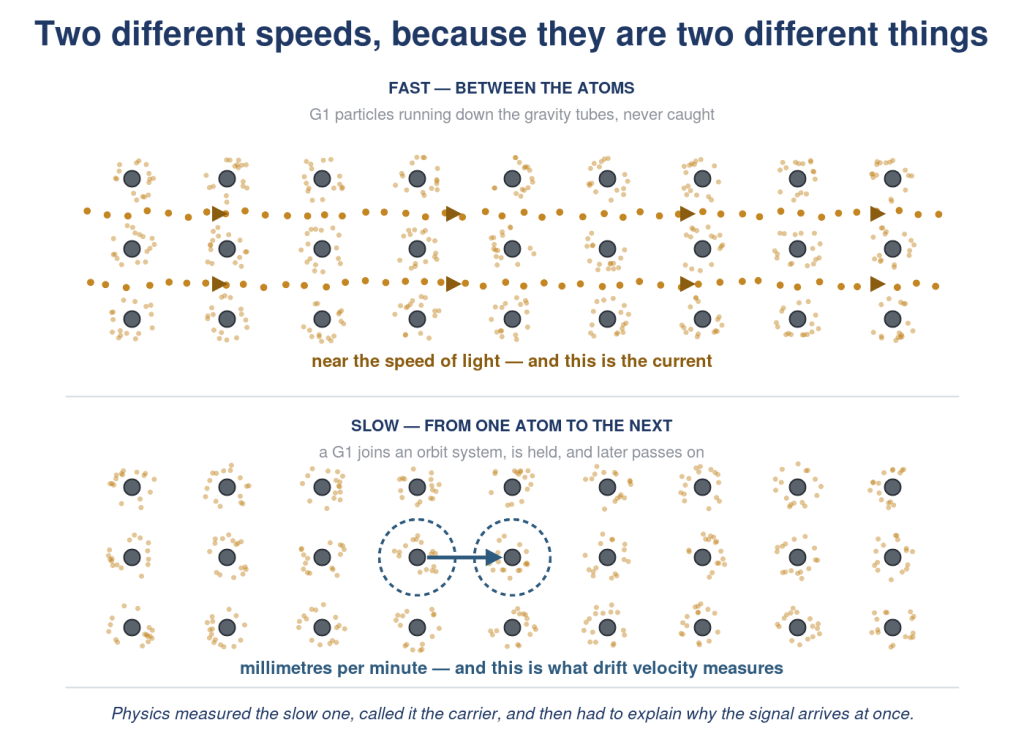
Fast. G1 particles running down the gravity tubes between the atoms, never captured, near the speed of light. This is the current, and it is why the lamp lights at once.
Slow. G1 particles entering one atom’s orbit system, being held there, and later passing to the next. Being taken in, held and let go is a slow business. This is a real process too, and it is what the drift velocity number measures.
The snail-speed figure is not a strange fact about electricity. It is a careful measurement of the slower of the two processes. No field needs to be invented to explain why the lamp lights at once, because the thing that lights it was always moving fast.
What Stays the Same
Nothing in the arithmetic changes. Ohm’s law, Kirchhoff’s laws and every circuit equation work exactly as before, and every meter on every bench keeps reading what it read yesterday. Those relationships do not care which way you label the current; reverse the label and every current simply flips its sign.
So the arrow on the schematic can stay, as a label. Electrical engineers who track the flow out of the negative terminal, as Robert de Hilster did through forty years of designing telecommunications switching systems, and as the diode and capacitor pages here do, are following what the particles actually do. Engineers who keep Franklin’s arrow are not wrong either; they are counting from the other end. What changes is not the circuit diagram. It is the answer to the question underneath it: what is moving, and how fast.
What We Have Not Done Yet
The positive Hall readings are not explained. Some metals and most semiconductors give a Hall voltage of the sign a positive carrier would produce. That is what the hole was invented for, and a four-motions account has to explain it with G1 particles alone. We do not have that account yet.
The two speeds need numbers. What fraction of the G1 particles thread the tubes without being caught? What decides whether an arriving particle is captured or passes through? Those are the figures that would turn this into a prediction.
The push is described, not modelled. The difference in count is what drives the flow, and the steady G2 stream behind it is what we measure as voltage. How the G2 fields are arranged to do that is still open; The Configuration of the Atom sets out what is settled and what is not.
None of it is quantitative yet. Resistance, conductivity and the speed of a signal along a cable should all eventually come out of a count of particles moving through a lattice. At present this is a physical account of what moves, not a calculation.
The way to close all four is the copper simulation on the Electric Motion page, pointed at these questions: a real lattice, G1 particles under nothing but gravity, and a count of what goes in, what comes out, and how fast.
What Changes
- Current is a count of real particles passing a point: G1 particles, carrying no charge, running from the end holding more to the end holding fewer.
- The direction agrees with the experiments, from negative to positive. Franklin’s arrow stays as a label.
- The hole becomes unnecessary. What it tracks is an atom one G1 short.
- The drift-velocity paradox comes apart into two real processes, one fast and one slow.
- The equations stay exactly as they are.
Flip the switch again. The lamp lights at once because something is already racing down the wire, and it was never the snail.