

The Drop Is Not the Water
A kitchen tap, not quite closed. Drip. Drip. Drip.
Every drop is very nearly the same size as the last one. Catch a hundred of them and you will find they vary hardly at all. Now suppose drops were the only way you ever encountered water — no rivers, no glasses, no rain, just this tap. You would measure drop after drop, find the same amount every time, and conclude something reasonable and completely wrong: that water comes in indivisible units, and that you had just measured one.
The size of a drop is a fact about the faucet. It is set by the width of the lip and by the surface tension that holds the bead until its own weight wins. It says nothing whatever about what water is made of. Water leaves that tap in equal drops because that is how the tap lets go.
Hold onto the faucet. It is about to explain the electron.
Everything We Know About the Electron Is a Total
In 1897 J. J. Thomson sent a cathode ray through electric and magnetic fields and measured how far the beam bent. From the bending he got a number: the ratio of charge to mass. Of the beam.
In 1909 Robert Millikan suspended oil droplets between charged plates and found that the charge on a droplet was always a multiple of one smallest amount. Every droplet, the same smallest amount.
Everything since has been of the same kind. Currents in wires. Beams in tubes. Spots on phosphor. Clicks in a detector. Tracks curling through a cloud chamber. These are superb experiments and the numbers they produced are solid. But look at what each one does: it measures how much. How much the beam bends. How much charge the droplet carries. How much current flows.
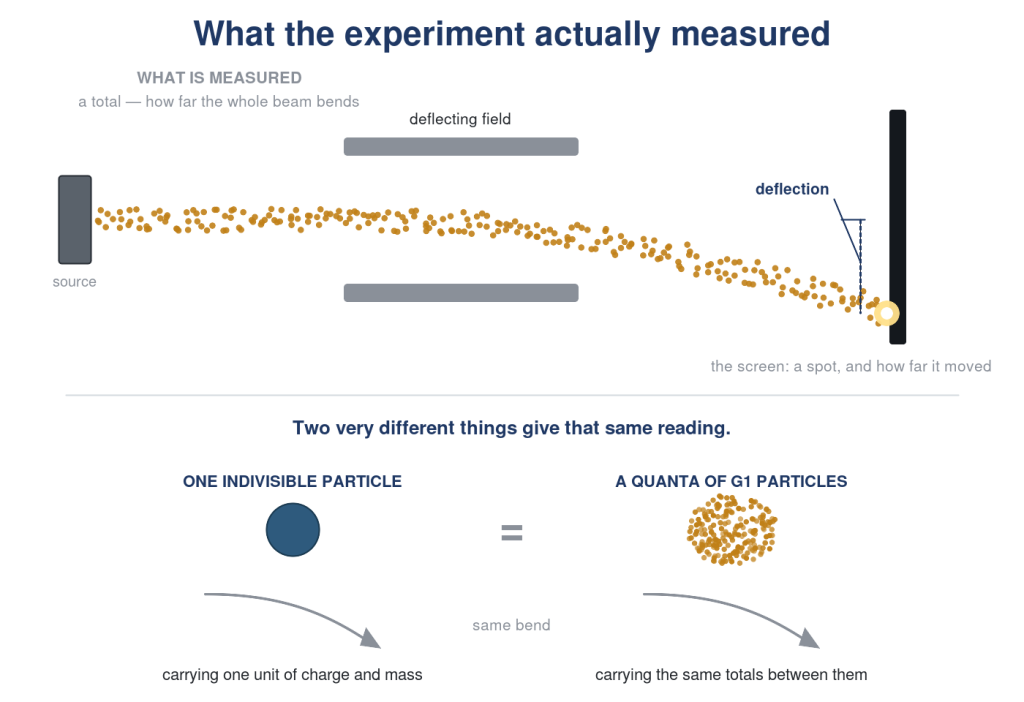
Not one of these experiments ever isolated a single object and looked at it. They could not; nobody has ever seen an electron. What they found was the smallest bundle their apparatus could separate out — and then a step was taken that no instrument took for them: the smallest amount we can isolate must be one indivisible thing.
That step is not a measurement. It is an interpretation, and it is precisely the step from drops to water.
A Quanta, Not a Particle
In the four universal motions, the electron is not a particle. It is a quanta — a large population of far smaller particles, called G1 particles, that an atom holds around its nucleus. Not one of something. Very many of something much smaller.
And they carry no charge. No particle in this model carries a charge of any kind. What physics calls charge is simply a count: how many G1 particles a body is holding against the number it settles at, as Charge sets out. Everything else charge was invented to describe is handled by motion.
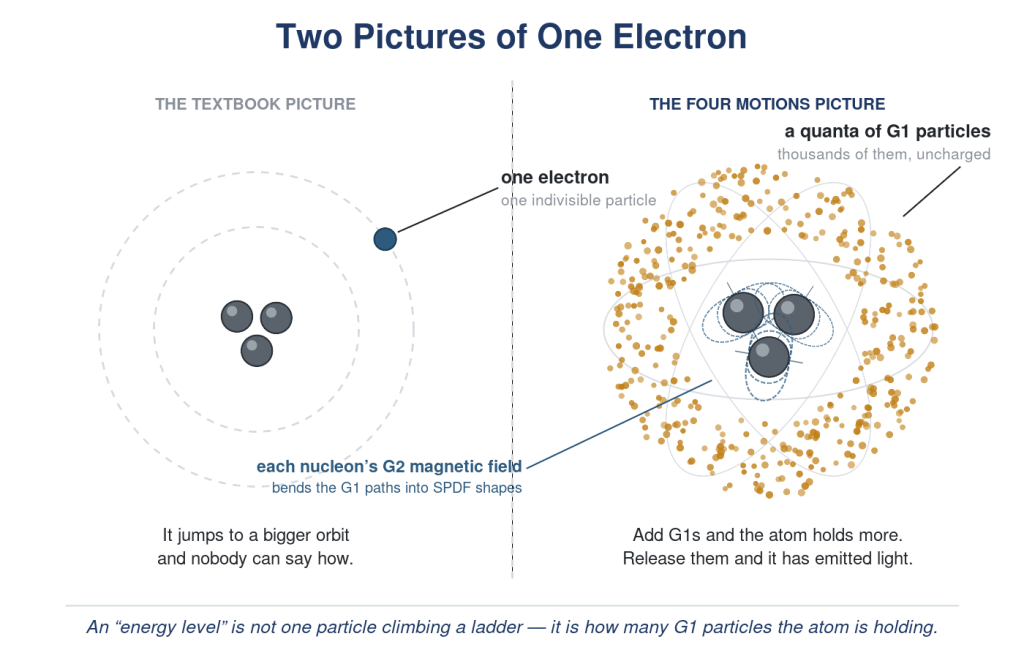
Every awkwardness attached to the electron comes from insisting it is one thing. One thing cannot be spread across an orbital. One thing cannot have parts to release when an atom gives off light. One thing cannot have a frequency. A population has no trouble with any of this, because a population can be spread out, can grow, can shrink, and can travel in a rhythm.
What Holds Them There
Two motions do the work, both operating one level down from the gravity and magnetism we see in the sky.
G2 gravitic motion keeps the G1 particles in orbit. What Coulomb wrote as an attraction between charges is gravitation at the atomic level, carried by particles far smaller and faster than the ones that hold planets to stars — which is why Coulomb’s equation and Newton’s have exactly the same form. The nucleus holds its G1 cloud the way a star holds its planets, and no charge is required for it.
G2 magnetic motion decides the shape. Every nucleon in the nucleus has its own magnetic field, in exactly the way the Earth has one — one field per nucleon, each with its own poles, each tilted its own way. Those overlapping fields bend the G1 particles off of simple orbits and into the lobed, dumbbell and clover-shaped paths that chemistry calls the S, P, D and F orbitals.
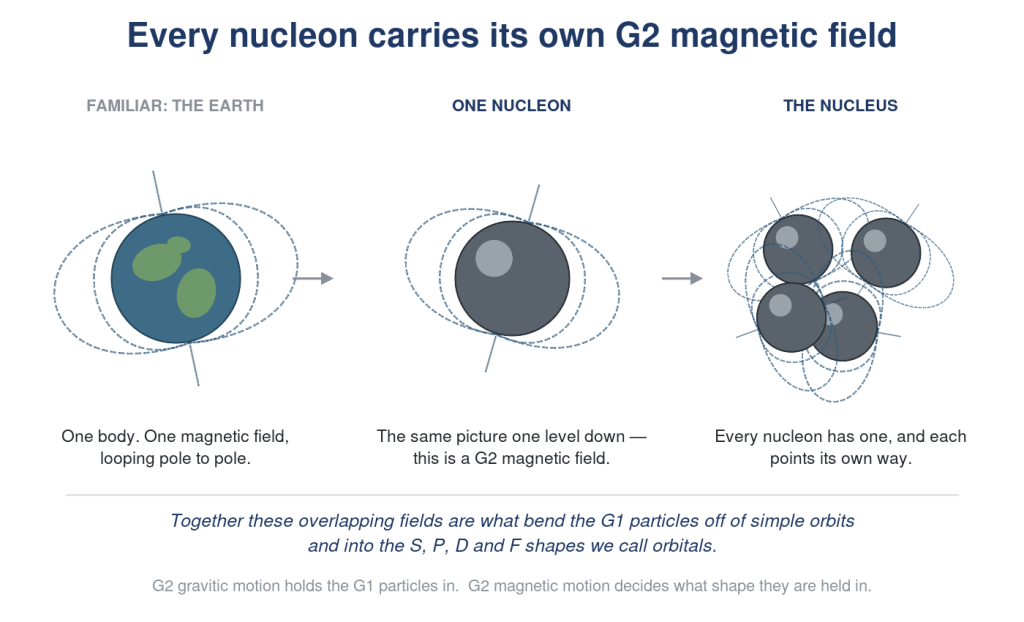
So “an electron in the 2p orbital” is not a particle on a rung. It is a population of G1 particles held in a particular shape by a particular arrangement of G2 fields.
Physics Already Draws It as a Cloud
Here is something worth noticing. Mainstream physics already refuses to put the electron at a point inside an atom. Open any chemistry book and the electron is a cloud — smeared across an orbital, present everywhere in it at once, with no position until something measures it.
And in the same breath, the same book will tell you the electron is a point particle with no measurable size and no internal structure.
Both statements are maintained at once, and the strain between them is managed with a qualifier: the cloud is a cloud of probability, not of stuff. Which is to say — the thing is drawn as spread out, described as spread out, and calculated as spread out, while being insisted upon as a point.
The four motions take the picture at face value. The cloud is a cloud. It is spread out for the most ordinary reason anything is spread out: it is made of many things, and many things take up room.
Why It Always Comes in the Same Amount
The strongest argument for an indivisible electron has always been Millikan’s: the charge never comes in halves. If it is a population, why is the bundle always the same size?
Go back to the tap. The drops are all the same size, and water is still continuous. The regularity belongs to the faucet.
An atom is a faucet with very precise plumbing. Its G2 gravitic and magnetic fields form a specific geometry, and that geometry can only hold G1 particles in certain stable arrangements — so it can only let go of certain amounts. The same structural fact is what makes spectral lines sharp, as described in How an Atom Emits Light. Constancy of the bundle is evidence about the container. It was never evidence that the bundle has no parts.
Every drop from the tap is the same size. That tells you about the tap, not about the water.
Why the Numbers on the Periodic Table Are Not Whole
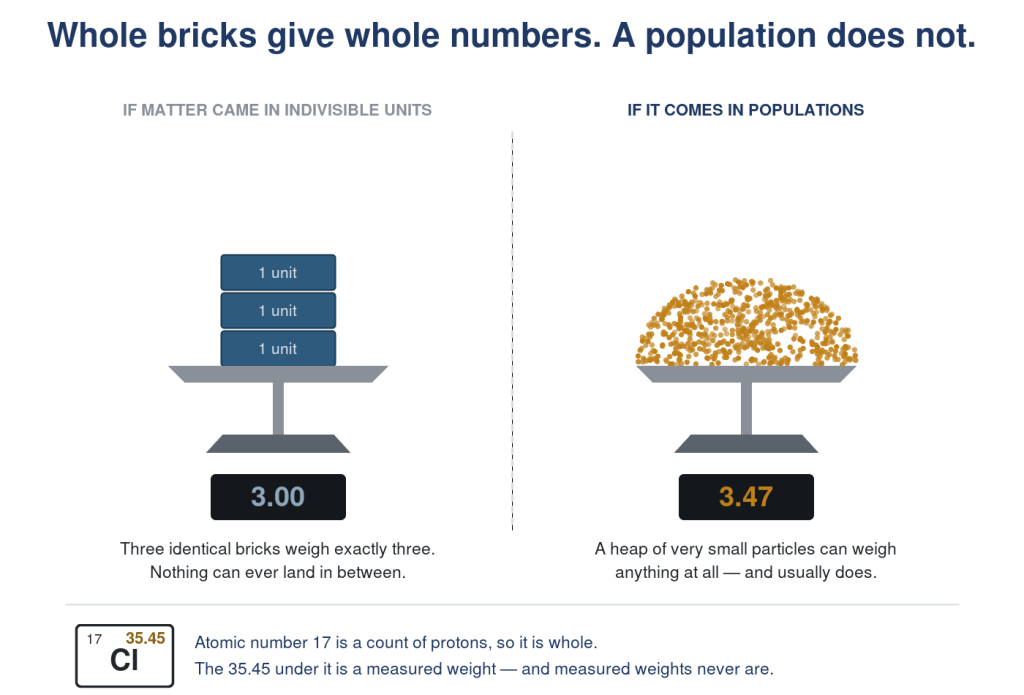
Look at a periodic table. The atomic number is a count of protons, so of course it is a whole number — 17 for chlorine, and there is no such thing as 17.4 protons. But the other number in the box, the one underneath, is a measured weight. For chlorine it is 35.45.
Almost nothing in atomic measurement comes out whole. Oxygen-16, a single isotope with no averaging involved, weighs 15.9949 atomic mass units rather than 16. The proton is 1836.15 times the mass of the electron — not 1836, and not any other tidy figure. Wherever we weigh matter precisely, we land between the integers.
Mainstream physics has an account of each case. Chlorine’s 35.45 is an average over isotopes. Oxygen-16’s shortfall is mass defect — binding energy carried away. These explanations are not wrong, and nothing here asks you to throw them out.
But notice what they have in common. In every instance, the amount of stuff in an atom refuses to arrive in whole units, and a separate reason has to be supplied each time for why. That is exactly what you would expect if matter is built from populations of very small particles. It is exactly what you would not expect if the universe is assembled from a fixed number of three identical indivisible bricks.
To be clear about the claim: this model does not yet predict 35.45, or 15.9949, or 1836.15. What it does is make them the ordinary sort of number to find — the kind you always get when you weigh a heap — instead of a run of fractions each needing its own patch.
The Same Particles, Three Motions
Once the electron is a population of G1 particles, something quietly enormous follows. G1 particles are also what light is made of, and what flows in a wire.
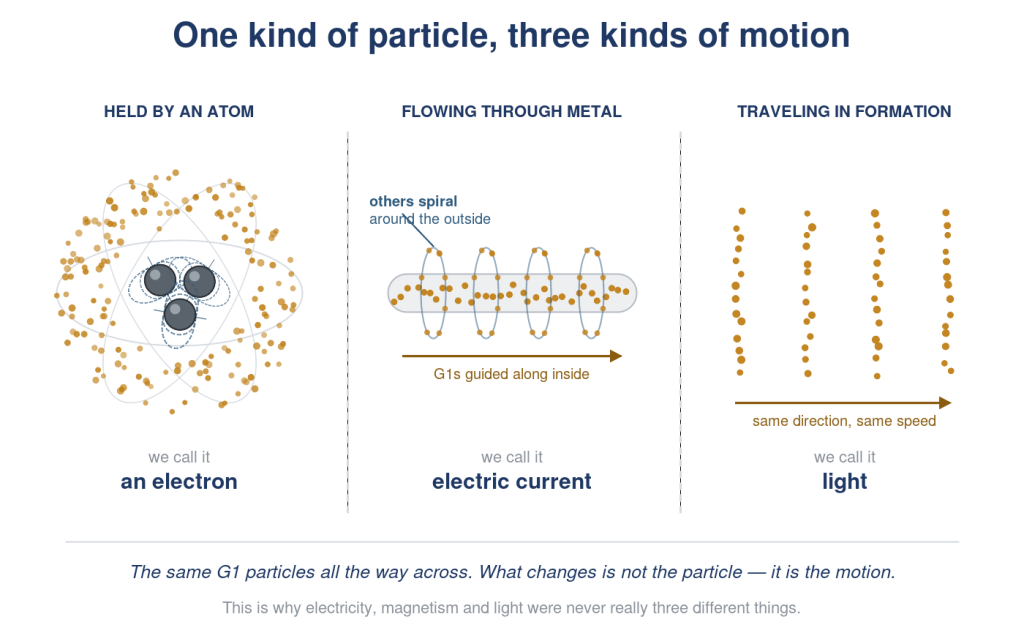
Held by an atom, we call the population an electron. Driven along a wire, we call it electric current — and the G1s that spiral around the outside of the conductor instead of passing through it are what we call the magnetic field, as described in Electromagnetic Waves. Released in groups traveling together at the same speed, we call it light.
This is why an atom can swallow light and later give light back, and why the current you push into a filament comes out as a glow. Nothing is being converted into anything. It is one stock of particles, moving in different ways, and we gave each way of moving a different name and then spent a century wondering how they were related.
It also dissolves the duality. A single particle cannot have a frequency, as The Impossible Photon works through in detail. A population traveling in formation has one automatically — the spacing between its groups. Fire that population through a pair of slits and you should expect a pattern, because patterns are what formations make.
What We Have Not Done Yet
Honesty is worth more than a tidy ending, so here is the open edge of this work.
The configuration of the G2 fields is still unmodelled. The shape of the 2p population, and of every other orbital named here, is set by an arrangement of G2 fields we cannot yet write down. That gap — what is settled, what is not, and how to close it — is set out in full in The Configuration of the Atom.
What Changes
- The electron stops being an indivisible mystery and becomes a population you can count.
- Charge is not needed. G2 gravitic motion holds the particles; G2 magnetic motion shapes their paths.
- The probability cloud becomes an actual cloud, spread out because it is made of many things.
- Fixed bundle sizes become a fact about the atom’s structure rather than proof of indivisibility.
- Fractional masses become the expected result of weighing a population.
- Electricity, magnetism and light stop being three mysteries and become three motions of one particle.
Nothing in this asks you to discard a single measurement. Thomson’s ratio stands. Millikan’s quantum stands. The spectra stand. What is being replaced is the sentence that was quietly appended to all of them — and therefore it is one indivisible particle — which was never measured by anybody.
The tap drips. Every drop the same. And the water was never made of drops.
