

This article is an attempt, not a result. The double slit is one of the places where the four universal motions have not been worked out — Robert and David de Hilster have both taken runs at it and neither is satisfied. What follows is a first pass, built only out of what the model already commits to elsewhere on this site, with its weak points listed at the end rather than buried.
The Experiment That Is Supposed to Be Impossible
Cut two narrow slits in a card. Send light through them at a wall. You do not get two bright lines. You get a row of bright and dark bands, spread far wider than the slits, in a rhythm you can measure with a ruler.
Thomas Young did this in 1803 and it was taken as proof that light is a wave. The twentieth century then made it strange in three steps.
- Turn the source down until it is supposed to be releasing one photon at a time. The bands still appear — built up dot by dot, each dot landing at one spot, the pattern emerging only after thousands of them.
- Do it with electrons instead of light. Exactly the same thing happens.
- Put a detector at one slit to see which one each particle went through. The bands vanish. You get two blobs. Remove the detector and the bands come back.
The standard account is that each particle goes through both slits as a wave of probability, interferes with itself, and is collapsed to a single location by the act of measurement. Every word there is doing hard work and not one of them names a material. What went through? What was waving? What is a probability made of, such that it can be bent by a card?
Physics is quite open about this. It says the mathematics predicts the fringes to many decimal places and that asking what physically happened is a category error. That is a defensible position for a working physicist and a terrible one for anyone who wants to know what the world is made of.
The Question Nobody Asks First
Before asking what happened at the slits, ask something earlier and much more boring.
What, physically, was sent?
The whole paradox is loaded into the answer that is normally assumed without comment: one indivisible particle. If one indivisible thing is travelling toward two gaps, then of course the experiment is impossible, because one thing cannot be in two places. Every strange device in the standard story — superposition, self-interference, collapse — exists to rescue that opening assumption.
The four universal motions never make that assumption, and did not make it in order to solve this problem. It was ruled out years earlier, on entirely separate grounds, in The Impossible Photon: a single particle cannot have a frequency, for the same reason a single bus passing your house cannot have a timetable. Frequency is a property of a series. So light was never one particle. Luminic motion is groups of G1 particles travelling together, one group after another, and the spacing between the groups is what we read as colour.
The electron got the same treatment in The Electron. It is not a point. It is a quanta — a population of G1 particles that an atom holds, and that can be released.
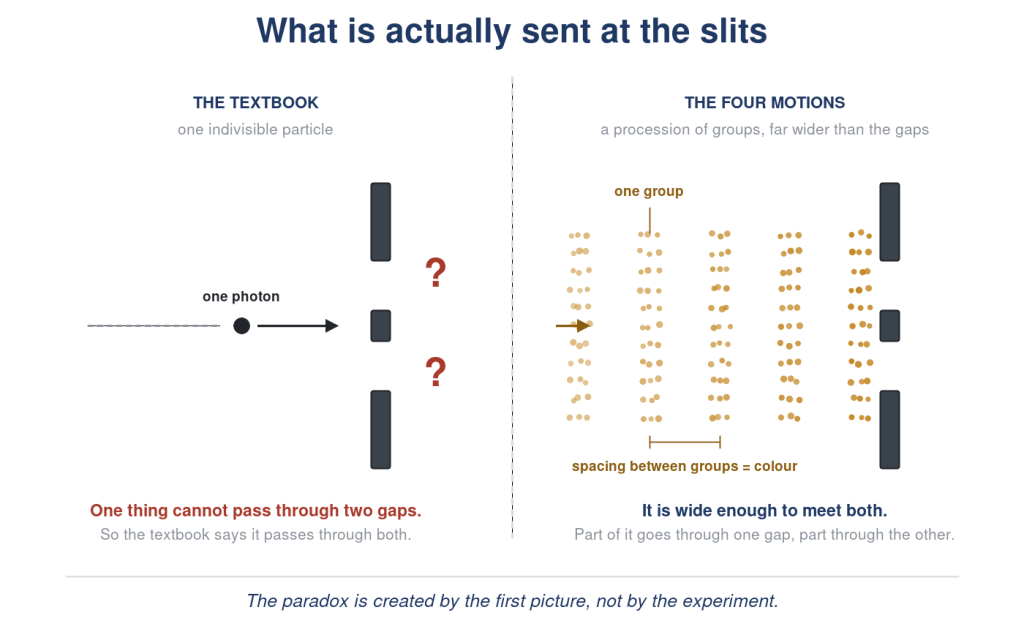
So the first move is not clever. It is just refusing to start with the thing that causes the trouble. What approaches the card is a procession of groups of particles, spread across a region far wider than the gap between two slits. Part of it goes through one slit. Part of it goes through the other. Nothing was in two places, because nothing was ever one place to begin with.
That disposes of the headline mystery and almost nothing else. The hard work is still ahead.
Why Anything Changes Direction at All
Before the fringes, a more basic question — and the model owes an answer to it before it is allowed to go any further. The procession travels in a straight line. If nothing acts on it, each half carries straight on through its own slit, the two halves never meet, and there is nothing to interfere. Something has to spread them.
In this model only one thing can turn a G1 particle: mass. A slit edge is made of atoms, and beside a sharp boundary of mass the G2 gravity field is strong and its gradient is steep. That is not a device invented for this article. It is the same gradient Dispersion uses to explain why a wedge of glass throws a rainbow and a flat pane of the same glass does not — and it is what David de Hilster conjectured at the very beginning of the first attempt on this problem: that the G1 particles passing near the edges of the slit are deflected by the strong G2 gravitic field there. Working through the rest of this article, that conjecture turns out to have been right, and to be carrying more of the load than anything else in the account.
It is not only the source of the broad spreading. It is the precondition for the experiment having a pattern at all, and — as the next section shows — it is also what makes a single faint release land anywhere other than straight ahead.
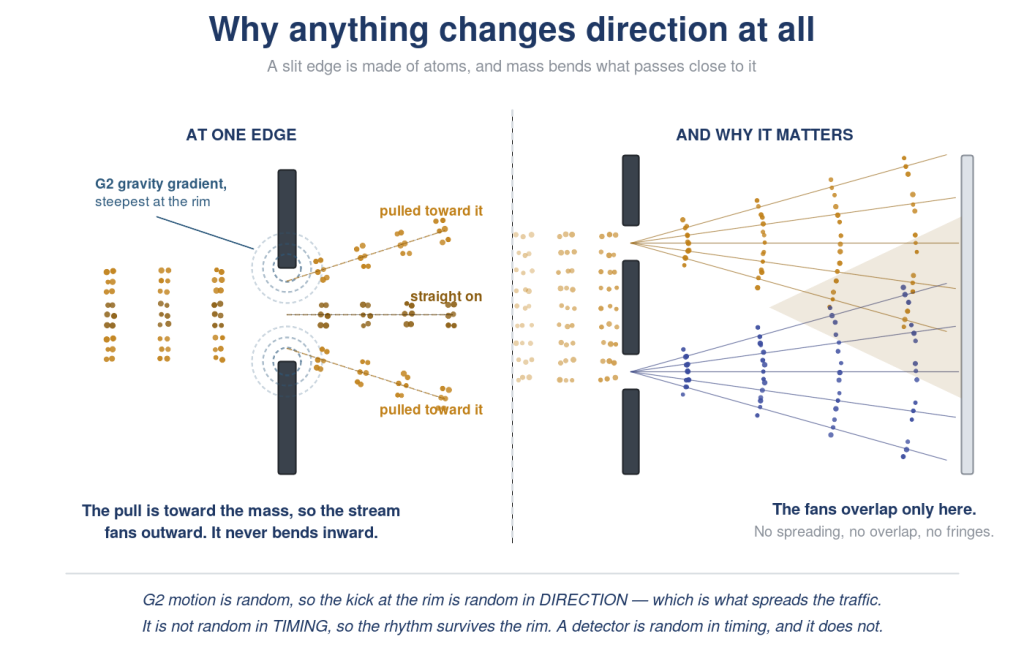
The deflection is toward the mass. A particle skimming the upper rim is pulled up, into the material it just missed. One skimming the lower rim is pulled down. So a slit does not steer its traffic in some chosen direction — it fans it out, both ways, around straight ahead. Particles passing down the middle, far from both rims, are barely touched and carry on dead straight, which is why a single slit still gives a strong beam straight ahead with weaker spreading to either side. That shape is the envelope, now arrived at as a cause rather than measured as a curve.
That fan is load-bearing. Without it the two halves never overlap and there is no pattern at all. It is also why the experiment is done with slits that are narrow: narrow slits mean most of what gets through passed close to a rim, so the fans are wide, so they overlap over a wide region, and the fringes are easy to see. Widen the slits and the pattern degrades, which is exactly what happens on a bench.
Now the part that looks at first like a problem and turns out to be the mechanism. A G2 gravitic field is random — that is what gravitic motion is, by the definition on the Gravitic Motion page: bodies travelling in random directions, whose net effect is a force. So a G1 particle skimming the rim is not steered along a single calculated arc. It is struck, repeatedly and randomly, by the G2 particles swarming there.
The distinction that matters is this one:
- The rim is random in direction. It changes where a particle goes. That is what spreads the traffic into a fan in the first place, and it is why the fan is a fan and not three tidy rays.
- The rim is not random in timing. Nothing stops a particle and holds it. It is nudged sideways while still travelling, so it still arrives when a particle on that path would arrive.
The fringe condition, as the next section sets out, is a condition on path difference — on timing. So randomness in direction scatters the traffic across the fan without touching the rhythm, and the two halves of the procession still meet nose to nose or nose to tail according to where on the wall they land. A detector at a slit is the other kind of randomness entirely: it stops a group dead and lets it go again at a moment of its own choosing. That is randomness in timing, and that is why it destroys the pattern when the rim does not.
Why Stripes and Not a Smear
Here is the real problem. Two half-processions now travel to the wall, and they arrive at any given spot having covered slightly different distances. Why should that produce a rhythm of bright and dark, rather than a single bright smudge?
Because a procession has a rhythm already. That is what it is. The groups are spaced, and the spacing is a real length — in this model you could in principle measure it with a ruler if you could freeze the stream in flight. Call it s.
Now take one spot on the wall. The two halves reach it by paths of different length. Only two things can happen.
- The path difference is a whole number of spacings. Groups from slit A land on top of groups from slit B. Nose to nose. What arrives is a procession with the original spacing s, at full strength.
- The path difference is half a spacing. Groups from A land in the gaps between groups from B. Nose to tail. What arrives is a procession of half-strength groups at spacing s/2 — the wrong rhythm and half the density.
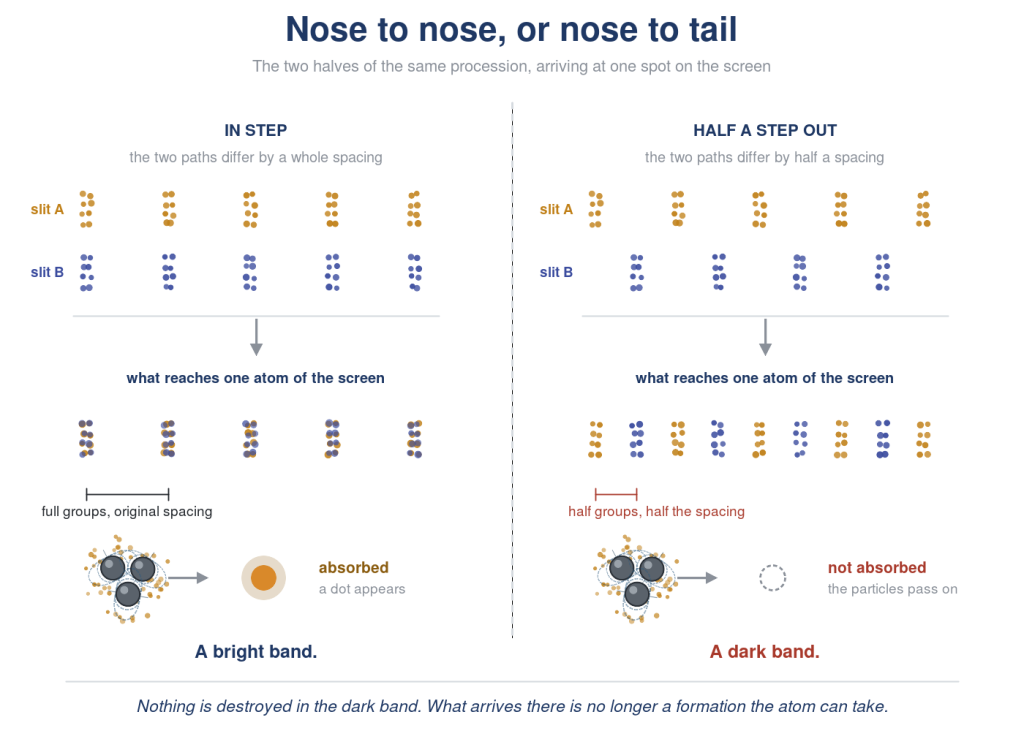
Notice what the condition for the first case is: path difference equal to a whole number of spacings. That is the standard fringe formula, the one that predicts the band positions correctly, arrived at without a wave. The arithmetic is the same arithmetic. What has changed is that wavelength is no longer the period of an abstract oscillation in nothing. It is the gap between two real clumps of real particles.
Why the Dark Bands Are Dark
This is where a particle model has to earn its keep, and where this one is at its most exposed. Particles are things. They cannot cancel. Whatever went into the apparatus is still in it. So why is a dark band dark?
The answer the model already has in hand is that a wall does not detect particles. It absorbs formations. That is not invented here; it is the absorption mechanism from How an Atom Emits Light, and it was put there to explain something else entirely — the dark lines in a stellar spectrum. Shine white light through a cool gas and the atoms take up the formations that match what they can hold, and the colours they carried go missing from the beam. Absorption is selective by spacing.
Apply that here and the two cases come apart:
- At a bright band, what arrives is a full-strength procession at spacing s — exactly the formation the atoms of the screen were built to take. It is absorbed. A dot appears.
- At a dark band, what arrives is half-strength groups at spacing s/2. Wrong rhythm, wrong density. The screen atoms cannot take it, so nothing registers as light.
Nothing was destroyed. The particles still went to the dark band; they simply arrived in a formation the detector has no way of accepting. Dark, in this model, is a fact about the receiver, not about the traveller.
That is a real claim and it can be killed. It says the dark bands are still being hit by particles, and that the energy has to go somewhere — into heat, into some other channel, or back out. A careful measurement showing that a dark fringe receives nothing whatsoever would take this account apart. We think that is the right kind of claim to make.
Two Effects, Two Causes
Look closely at a real double-slit pattern and it is not a uniform row of equal bands. It is a set of sharp fringes sitting underneath a broad hump: bright in the middle, dying away at the edges. Standard optics calls this the single-slit envelope and gets it from a second calculation.
The model needs two causes for that, and it has two.
- The fringes come from the spacing of the procession, as above. They are about timing.
- The envelope comes from the slit edges. An edge is made of atoms, and a mass with a sharp boundary has a steep G2 gravity gradient beside it. A gradient like that bends passing G1 particles — which is not a new idea introduced for this article either. It is the mechanism Dispersion already uses to explain why a wedge of glass throws a rainbow and a flat pane does not. Particles passing close to an edge are deflected; particles passing well clear of it are not. That spreads each half-procession into a fan, and the fan is the envelope.
Two phenomena, two separate physical causes, matching the two separate terms that optics has always needed. That is worth something.
One at a Time
Now the experiment that is supposed to end all argument. Turn the source down so far that only one thing is in the apparatus at a time. Each arrival is a single dot. Leave it running and the fringes build up anyway. The standard reading is that each particle must have interfered with itself, which is said to be impossible to picture and is therefore not pictured.
In this model there is nothing to picture, because the premise is false. You cannot send one particle. The smallest thing a source can release is a release — a quanta, a population of G1 particles leaving in formation. That is what an atom does when it sheds the surplus it was holding. Turning the source down does not make the released object smaller; it makes the releases rarer.
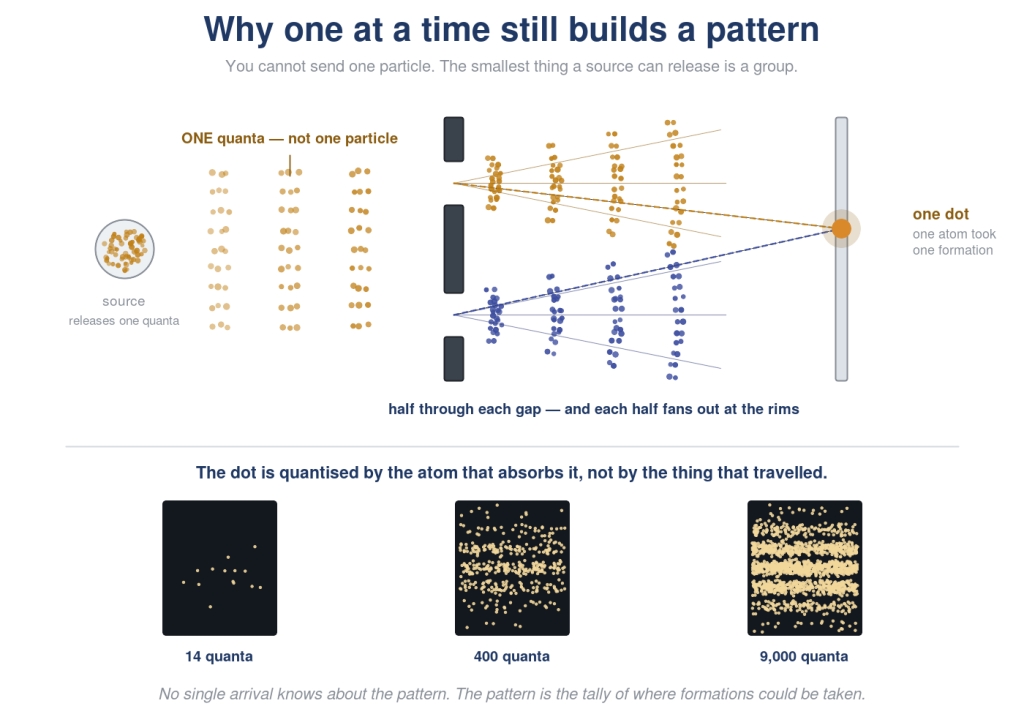
So one quanta goes through, spread across both slits, and lands as one dot. Why one dot, if a whole population arrived?
Because the dot is quantised by the atom that absorbs it, not by the thing that travelled. An atom takes up a formation or it does not — there is no half-absorption, for the same structural reason that spectral lines are sharp. One absorption event, one dot. The arriving quanta was extended; the record it leaves is a point, because the recording medium is made of atoms and an atom is a yes-or-no device.
That relocation — from a quantised traveller to a quantised receiver — is the single most useful thing this model does with the experiment. The dots were never evidence that something point-like flew across the room. They were evidence that something atom-sized caught it.
And this is where the rim comes back. A faint source releases a small population — not many G1 particles, spread thin. Passing the slits, those few are struck at random by the G2 particles crowding the edge, and the random kicks scatter them across the fan. A single faint release therefore does not march straight ahead to one place. Its handful of particles fan out over the whole region where the pattern will eventually appear, and wherever enough of them arrive together in a formation the detector can take, that spot fires.
It is worth being blunt about what a photo detector is in this model. It is a device that registers when it takes up a quanta of G1 particles. That quanta is exactly what is being called a photon. The instrument was never detecting an indivisible particle of light. It was detecting the smallest bundle it is able to absorb — and then the bundle was named after the threshold of the instrument.
So the famous build-up has two causes working together, and neither of them is mysterious. The random G2 kicks at the rim decide where a release can land. The nose-to-nose condition decides where a landing can be recorded. Scatter, then select. Run it ten thousand times and the fringes appear, without any single arrival ever having known about them.
Why Watching Breaks It
Put a detector at one slit and the fringes die. In the standard telling this is where physics becomes philosophy: observation collapses the wave function, and a century of argument follows about what counts as an observer.
Here it is dull, which is the point. A detector cannot register a formation without taking it. There is no reading without absorbing, and absorbing is the end of that formation’s flight. Whatever continues onward is a fresh release from the detector, timed by the detector, with no inherited relationship to the half that went through the other slit.
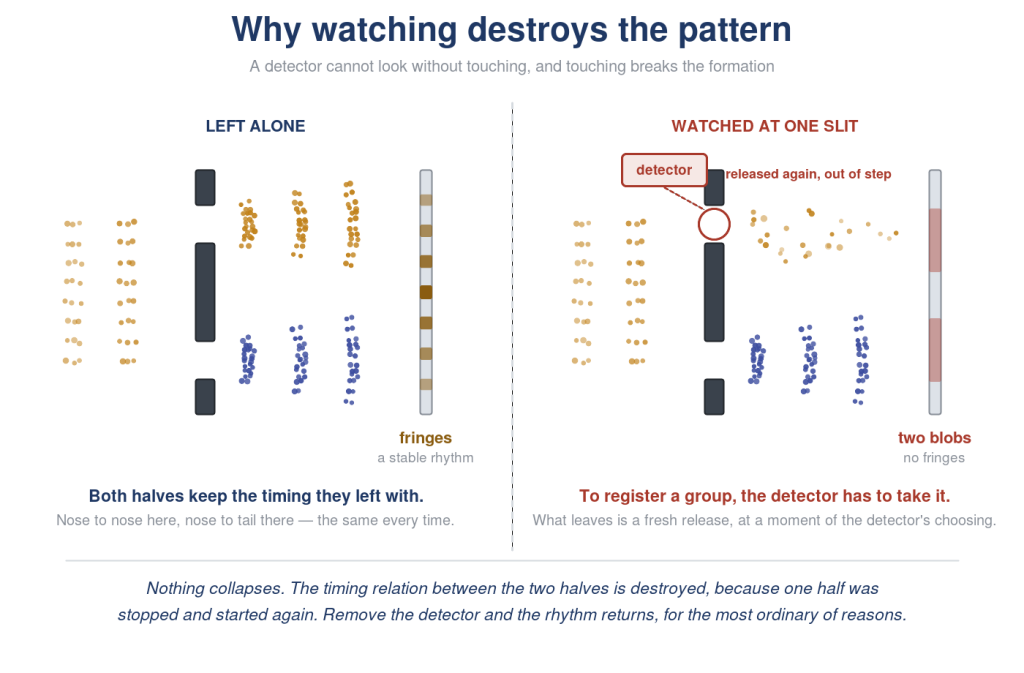
Nose to nose and nose to tail both require the two halves to keep time. Destroy the timing and you destroy the alternation, and what reaches the wall is simply the sum of two sprays: two blobs. Take the detector away and the timing returns, because it was never anything more exotic than two halves of one procession that left together.
And there is a second reason, harder still to get around. A detector is made of the same four motions as the experiment. It is matter, so it is nucleons, so it carries G2 fields of its own — and putting it at a slit places those fields exactly where the slit’s own G2 landscape does its work. The edge that was deflecting G1 particles now has another edge beside it. You have not inspected the apparatus. You have rebuilt it.
And a detector registers light by taking up G1 particles. The thing it uses to detect is the thing it is detecting. There is no neutral probe available anywhere in this model, because there is nothing to make one out of except the particles that are already in the experiment.
So “measurement disturbs the system” is not a principle discovered in the 1920s, and it is not a statement about knowledge or about observers. It is a statement about construction. A camera left running in an empty room does the same damage, and so does a dust mote. There is no such thing as a detector that does not affect the experiment — not because nature forbids it, but because there is nothing to build one out of that is not already part of the experiment.
Electrons Do It for the Same Reason
Fire electrons at the slits and the fringes come back. For mainstream physics this is the moment the problem becomes universal, because now matter itself has to be a wave, and every particle gets a wavelength from its momentum.
In the four motions the electron was already a population rather than a point, so nothing new is required. An electron beam is a stream of released quanta of G1 particles. The quanta is wide, it meets both slits, and the halves arrive in step or out of step exactly as before. The electron’s so-called wavelength is the spacing of the groups within the release — the same physical length, measured along the same stream.
It even runs the right way qualitatively. Accelerate the electrons harder and the fringes tighten, which in this picture says that a harder-driven release packs its groups more closely. That is the same statement as the spacing-is-colour rule in How an Atom Emits Light, where a bigger release packs the groups tighter and the light goes blue.
What This Buys
- No superposition. Nothing is in two places; a wide thing covers two gaps.
- No self-interference. Two halves of one procession meet, which is an ordinary thing for traffic to do.
- No collapse and no observer. Measuring means taking, and taking ends a formation.
- Wavelength becomes a length. The fringe formula survives intact with a physical referent underneath it.
- The fringes and the envelope get two different causes, as the mathematics has always quietly required.
- Light and electrons need one explanation instead of two, because in this model they were never different in kind.
What It Does Not Buy — the Open Problems
This is a hack in progress. The places it is thin should be stated as plainly as the places it is strong.
- The dark band is the weakest joint. Everything turns on a screen atom refusing a formation at the wrong spacing and half the density. The model needs a real account of what an atom will and will not take, and it does not have one yet. Until it does, this is a promissory note.
- Half spacing ought to mean a different colour. If spacing is colour, then the formation arriving at a dark band is light of half the wavelength. That is a strange and strong prediction. Either something stops it being absorbed as such, or the prediction is wrong and the account needs repair.
- The spread is not calculated. The model says a G2 gradient at the rim pulls passing G1 groups toward the mass, which gives the fan and therefore the envelope. It does not say by how much, as a function of how close the particle passes. It also requires that bending to be smooth rather than random, or the fringes would not survive it — and that has not been shown, only required.
- We do not derive Planck’s constant. Saying a harder-driven release packs its groups tighter is the right shape for the de Broglie relation but it is not that relation. Where the actual number comes from is not answered here.
- Refraction and edge deflection bend colours opposite ways. In a prism, violet deviates more than red. At an edge, red spreads more than violet. If a G2 gradient is doing both jobs, the model owes an account of why passing through mass and passing by mass sort the spacings in opposite senses. We do not have it.
- The configuration of the G2 fields is still unmodelled. The edge deflection this whole account turns on is a G2 field whose structure has not been written down. See The Configuration of the Atom.
The companion piece to this one is The Pinhole Camera, which is the same apparatus with the interference taken out — one hole instead of two — and which the model handles far more comfortably. It is worth reading as the control experiment for everything above.
The experiment never showed that one thing went through two slits. It showed that whatever went through was wider than the card.
