


Discovered
It was never our intention to reverse engineer the entire universe. We simply wanted to give physicality to things like light, gravity, magnetism and electricity. Between David de Hilster’s collecting ideas and models from others through numerous decades, to his dad Robert’s physical model for light 10 years ago, the two came to realize that if all of these phenomena traveled at the speed of light, and that they all had to be the same particle. Once more, they came to realize that the four phenomena had very distinct movements and that when combined, they could describe the universe from the infinitely large to the infinitely small.
It sounded crazy at first. But after working with one particle and its four fundamental movements, it works surprising well and explains a myriad of phenomena that today’s physics simply cannot explain.
On These Shoulders We Stand
Our work stands on the shoulders of these five scientists:
| Dr. Glenn Borchardt | Infinite Universe Theory |
| Dr. Ionel Dinu | Underwater experiments for simulating magnetism |
| Jeff Yee | He work on mechanical models at the subatomic level |
| Robert de Hilster | Luminic wave model for light |
| David de Hilster | 4 Universal Motions in physics |
Standing on a shoulder is not the same as agreeing about everything, and one disagreement is worth naming here rather than leaving a reader to find it. From Glenn Borchardt we take the architecture: an infinite universe, and the principle that there are no partless parts, so that every particle is built of smaller ones without end. That idea runs through everything on this site. Where we part company is light. Borchardt holds that light needs an aether; we hold that an aether has nothing to contain it and would disperse, and that light is better explained as groups of particles travelling together. That argument is set out in Why Aether is a Poor Model for Light. The four motions are not an aether theory: there is no medium in them anywhere, only bodies moving through empty space.
Four Universal Motions
We present the Four Universal Motions (4UM) in physics which we claim gives physicality to everything in the universe, from the infinitely large, to the infinitely small. Given that gravity, light, magnetism, and electricity all travel at the speed of light, we claim they are all the same particle — the G1 — differing only in how it moves. This simplification gives rise to physical explanations for many aspects of physics that are “magical” including charge, induction, and photons appearing out of nowhere, to name a few. This model also gives a physical solution to the wave / particle duality. The 4UMs differ from every other model of the universe in that every part of them can be pictured. Nothing in the model is a quantity with no owner. The mathematics comes after the picture rather than standing in for it.
Two of the names physics already uses need care here, because they were never the names of single particles at all. What is called a photon is a group of G1 particles travelling together — which is how it can carry a frequency, when no lone body can have one. What is called an electron is a quanta: a population of G1 particles that an atom holds, which is why atomic weights are not whole numbers. A graviton is a G1 in random motion, and what we have called a magniton is a G1 caught in an orbit. One particle and four motions — the old names were never names for four different particles.
Equations are Not Physical
Modern physics is dominated by equations. Equations for gravity, equations for light, equations for electricity, and equations for magnetism to name a few. These equations have helped create today’s modern world. Despite their success, the equations themselves tell us nothing of the physical nature of these forces. We are very good at describing the resultant movements of objects in “fields” or the behavior of a physical phenomenon, but we still have no agreed upon physical explanation for these fields or phenomena including those for gravity, light, electricity, and magnetism.
An extreme example of an empirical force equation comes from a colleague of David and Bob: Dr. Bill Lucas. Here is his equation for a universal force equation in physics as described by Dr. Bill Lucas.

Because of the tremendous success of modern-day equations, the pursuit of physical models for the basic forces in the universe have been sorely neglected. Over the years, gravitons have been proposed for gravity, photons and aether have been proposed for light, and electrons have been proposed for electricity. Even though many of us are familiar with the concepts of photons, electrons, gravitons and the like, the way in which they move is a mystery. Light acts both as a particle and a wave, gravitons are hypothesized to be the carrier of the gravitational force but their movement is not mentioned, while electrons seem to travel too slowly to account for the near light-speed movement of current in electrical circuits. We still use arbitrary terms such as charge that magically cause attraction or repulsion without ever saying how this magic happens.
The four universal motions try to answer the question of physicality for everything in the universe not by inventing a fresh equation or a fresh particle for every force — a graviton for gravity, a photon for light, a carrier for each new effect — but by describing all forces as one or more of four motions of a single particle. Their discovery is the result of decades of work by the authors of this book and other critical thinkers around the world.
It is worth being exact about this, because it is easy to misread as hostility to mathematics. We are not against equations. We are against an equation standing in for a thing nobody will name. The order is what matters: first say what is physically there and how it moves, then let the mathematics describe what follows from it. Done in that order the equations are earned rather than assumed.
Newton’s inverse square is the clearest example. It does not have to be put into the shadowing model by hand. A body blocks a share of the random rain, that share falls off as the solid angle it covers, and the solid angle falls off as the square of the distance. The equation drops out of the picture on its own. That is the relationship we want with mathematics everywhere — not to avoid it, but to arrive at it.
The Four Universal Motions
There are four universal motions in physics. These motions and their combinations give physicality to all forces in the universe. These motions are intended to be visualized. That is the requirement we place on physics, and it is the one modern physics quietly dropped.
The names of the four motions are as follows:
| MOTION TYPE | DESCRIPTION |
| gravitic | relating to gravity (this is the foundational movement from which all other movements can be derived) |
| luminic | relating to light (this word is invented by one of the authors) |
| magnetic | relating to magnetism |
| electric | relating to electricity |
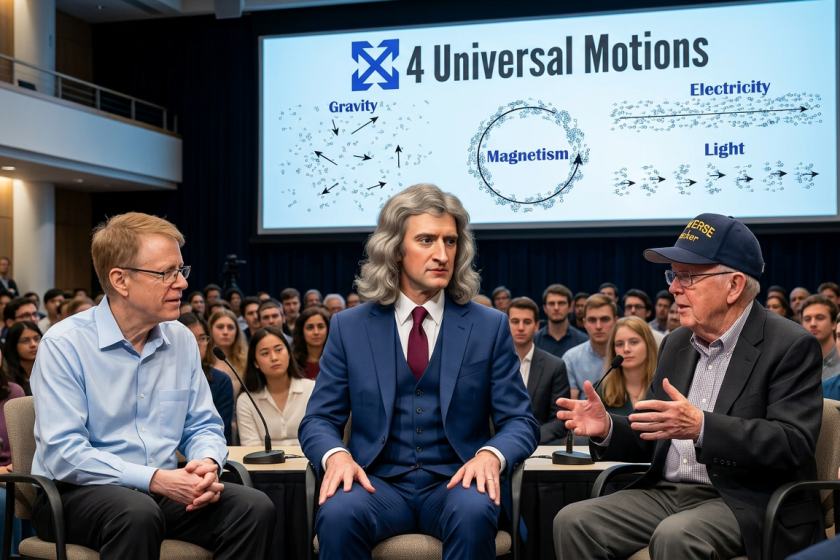
Gravitic motion is random, magnetic motion is orbits, electric motion is flows, and luminic motion is waves of bodies moving together. As shown in our first book\cite{Principia-Mathematica}, it is possible to ‘hack’ or visualize the universe by using and combining these four motions. It is the claim of we authors that all fundamental forces in the universe can be described in a combination of these four forces.
For historical reference, gravitic motion has been around hundreds of years in the form of gravitons. It is not known to the public because it is not considered an accepted model of gravity in modern physics. Magnetic motion was described in 2006 by Ionel Dinu of Romania and is known to hundreds or at most by thousands of people around the world. Luminic motion and electric motion was described in 2015 by our authors, Robert and David de Hilster, respectively, and is currently known only by a small number of people..
For the most part, these four motions \textbf{based on the same particle} are new to the world of physics. Fundamental motions are commonly described in physics as being linear, circular, rotational, periodic, random, harmonic, etc. The origin of these classifications are rooted in empirical observation and are not what we consider to be universal. These commonly mentioned motions come from how engineers describe the motions that they use in machines or observe in nature. The 4UMs on the other hand, come from the observation of fundamental forces in the universe, none of which are not man-made.
The four universal motions are simplistic in nature, yet their combinations allow for the creation of all the complexities of the universe from the infinitely small to the infinitely large. All modern equations in physics can be derived from how objects are affected by these motions of bodies at all levels of the universe. All forces in the universe are reduced to physical collisions, and at any one level of the universe, there is a principal body or particle that organizes that level.
-
An Evening with Newton
A Dialogue on the Four Universal Motions A staged conversation. ROBERT DE HILSTER and DAVID DE HILSTER sit on a centered stage along with SIR ISAAC NEWTON, a man pulled three centuries out of his own time and visibly delighted to be here. The house lights are turned up. The audience is full and surrounds…
-

Electric Motion
Electric motion is the flow of bodies along a gravitic path that is not an orbit.
-

Gravitic Motion
Gravitic motion is random, magnetic motion is orbits, electric motion is flows, and luminic motion is waves of bodies moving together.
-
Luminic Motion
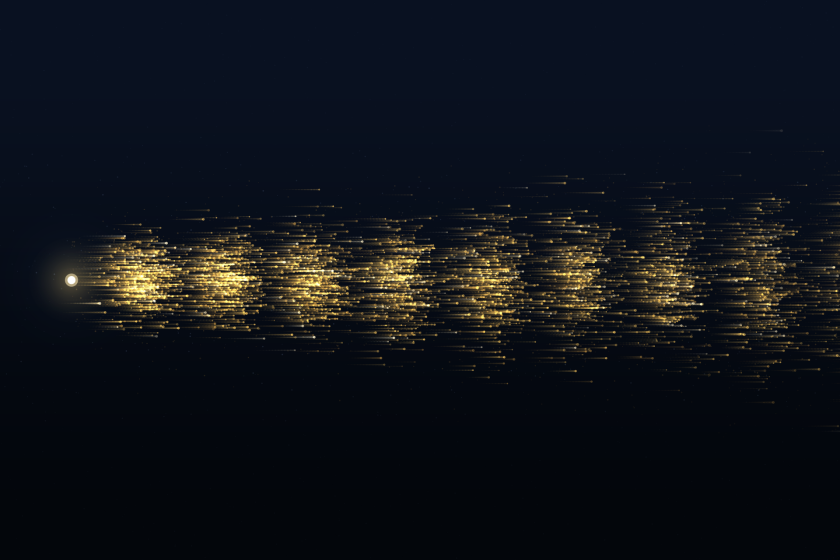
Luminic motion is the movement of groups of bodies traveling in the same direction at the same speed.
