
Coming soon.
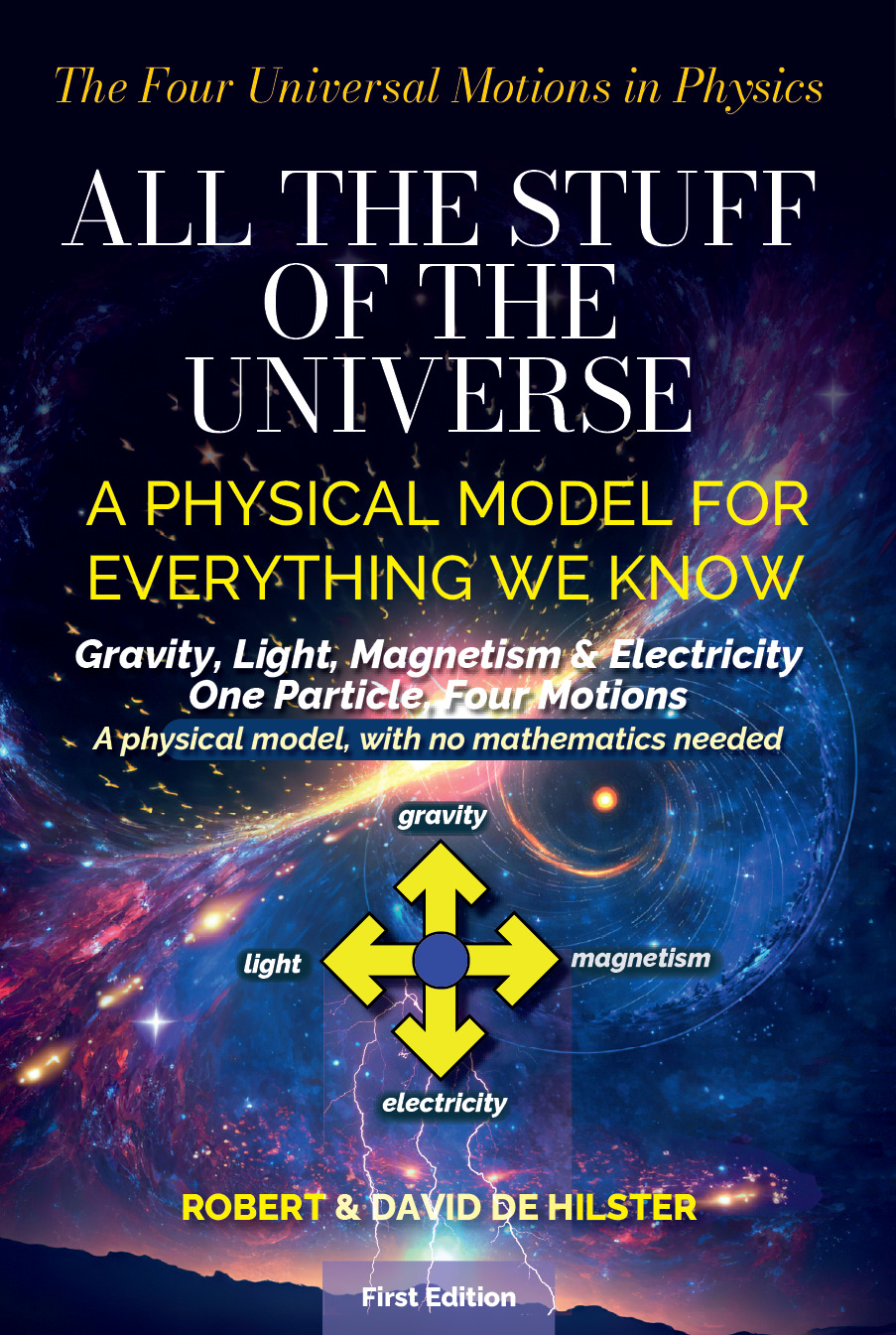
All the Stuff of the Universe: A Physical Model for Everything We Know, by Robert and David de Hilster, sets out the four universal motions in physics in one book. Gravity, light, magnetism and electricity, as one particle moving four ways.
No mathematics is needed to follow it.
It will be published by publish.naturalphilosophy.org.
Be Told When It Is Out
Leave your email and we will tell you when the book is out. We will use it for that and nothing else.
What Is Actually in the Room?
Physics has equations that predict what light, gravity, magnetism and electricity do. It has never said what they are made of. Flip a switch and a lamp comes on at once. What came out of the wire, and what reached your eye? Ask what a field is made of and you are likely to be told the question is not well posed.
Maxwell once drew gears to stand for magnetism and electric current, and within a few years set them aside and kept the equations. This book puts the gears back, and says what they are made of.
One Particle, Four Motions
The idea is simple to state. Gravity, light, magnetism and electricity travel at the same speed, and the authors propose they are the same particle, the G1, which differs only in how it moves:
- Gravitic motion: particles moving at random, in every direction. Two bodies each shadow part of the rain, so they are pushed together. Nothing pulls.
- Magnetic motion: particles in orbit.
- Electric motion: particles streaming along a path, which is what a current is.
- Luminic motion: particles in groups, travelling together, with the spacing of the groups as the colour of the light.
From those four motions come a physical account of why gravity only attracts, why light is a procession of particles and not a wave in something, what a current is, and how a circuit works.
What Is Inside
- The question and the method: why a description is not a model, and what a physical model owes the reader.
- Gravity: why things fall together, why gravity only attracts, why it is so weak, and what Newton’s constant is made of.
- Light: the impossible photon, white light and the prism, and how an atom emits and absorbs.
- Magnetism, electricity, charge and current: particles in orbit, a wire as a pipe already full, charge as a count and not a kind, and what actually moves in a wire.
- The atom and the electron: the atom without charge, and why one electron is better understood as a quanta of billions of G1s.
- Fields, induction, the double slit and the pinhole camera: what is in the room, again.
- Circuits and a phone: capacitors, diodes and transistors, and all four motions at once.
- Testing the model: what would count against it, a ledger of predictions, results and explanations, and the experiments that would measure the particle itself.
Three Things You Will Find
Newton’s constant, taken apart. In this model the constant G comes apart into three pieces: a solid angle, a property of matter and a property of space. That explains why it is the same for every pair of bodies, and the same factor of 4π turns up in Coulomb’s constant one level down. The book says plainly that it does not derive the value of G.
A test the authors have run. The model says the current around a series circuit should not be exactly the same at every point, and should vary in a particular V-shaped way. Robert and David measured it. In 13 of 18 measured curves the predicted shape appears. The book is careful about what that does and does not show, and says it has not yet been repeated independently.
A pinhole that depends on colour. A simple argument about timing across the hole says the best pinhole should go as the square root of the depth of the box times the spacing of the groups of light, so a blue pinhole should be smaller than a red one.
What the Book Does Not Claim
The model is not finished, and the book says so. The arrangement of the finer G2 fields inside the atom is not yet found, and the values of the constants are not derived. The double slit is a proposal with its weak joints named. A chapter lists what the model predicts, what has been tested and what it cannot yet explain. Where the model fails a test, the mechanism is rebuilt, not defended.
From the Back Cover
About the Authors
Robert de Hilster is an engineer who for more than forty years designed and researched digital switching systems for telecommunications. After ten years of work on a particle model of gravity, in May 2015 he proposed a motion for light. His son David de Hilster, a software engineer and documentary filmmaker, added the rest. The story of how they found it is told in the book’s second chapter.
Read More Now
The ideas in the book are developed in articles on this site: Gravitic Motion, Luminic Motion, The Impossible Photon, Electromagnetic Fields, The Electron, Diffraction and The Pinhole Camera.
