

Minus Five Marbles
You can owe a friend five marbles. You cannot hold minus five of them. Empty your pockets and the smallest number you can end up with is none.
Now open any physics textbook. The electron, it says, carries a charge of −1.602 × 10⁻¹⁹ coulombs. Not a debt, not a shortfall against some other amount: a negative quantity, built into the particle itself, as much a part of it as its mass.
Ask what that minus sign is attached to. What is there in an electron that is less than nothing? The question is never answered, because it is never asked. Charge is introduced as a property that comes in two kinds, the kinds are labelled plus and minus, and the lesson moves on.
The four universal motions give a plainer answer. Charge is a count. And a count is never negative.
Where Plus and Minus Came From
The labels are older than the particles. In 1733 Charles du Fay found that rubbed glass and rubbed amber behaved as if they held two different kinds of electricity, which he called vitreous and resinous. Two substances, two names.
In 1747 Benjamin Franklin replaced the two substances with one. There was a single electric fluid, he proposed, and every body held some amount of it. A body with more than its usual share he called plus; a body with less he called minus. Plus and minus were not two kinds of anything. They were two comparisons with one amount, exactly as a bank balance is above or below where it started.
That was the clearer idea, and it did not survive. Over the following century the signs drifted from the bodies onto the stuff itself, and when J. J. Thomson found the electron in 1897 it was handed the minus sign outright. What had started as “more” and “less” had become two opposite substances again: du Fay’s two kinds, wearing Franklin’s labels.
Franklin guessed wrong about which body had the extra, as Current sets out. But his structure was right. One kind of thing, and a number above or below the usual.
What Charge Is Said to Be
Ask a physicist what charge is and you will be given a list of what it does. It comes in two signs. Like signs repel and unlike signs attract. It is conserved. It comes in fixed steps. It is the source of the electric field and the thing the field acts on.
Every item is true as a description of behaviour, and none of it is a description of a thing. Charge is defined entirely by its effects, and then the effects are explained by the charge. It is the same move Electromagnetic Fields follows for the field itself: a map, made so good that nobody asks what it is a map of.
Charge Is a Count
In the four universal motions, the particles that move in a wire, that make up light and that orbit every atom are G1 particles, and a G1 particle has no charge at all. It is not slightly charged or charged in some hidden way. There is nothing on it to carry a sign.
What does exist is the number of them a body holds. Every atom holds a population of G1 particles in orbit around its nucleons, and at rest each kind of atom settles at its own number. Push more in and it holds a surplus. Take some away and it is short.
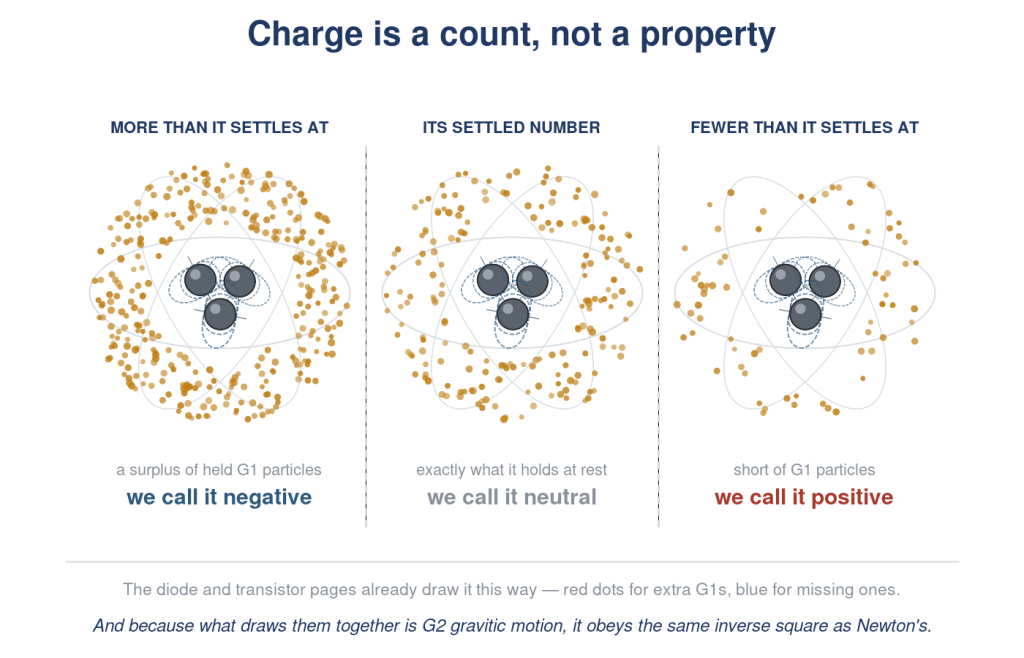
That number is the charge. It is a count of particles, and like every count it starts at zero and goes up. “Negative” and “positive” are not two kinds of it. They are comparisons:
- An atom holding more than its settled number is what we have been calling negative.
- An atom holding fewer is what we have been calling positive.
- An atom at its number is neutral.
- Between any two bodies, the one holding more G1s is the one we call negative.
This is Franklin’s structure put back, with the labels the way history fixed them. One kind of particle. A number above or below the usual. And it is not a new convention invented here: the diode and transistor pages have always drawn doping this way, with red dots for atoms carrying extra G1s and blue for atoms short of them.
A Battery, Counted
The plainest example is one most people have in a drawer. Robert de Hilster describes a battery this way: the difference between its two ends is the number of electrons each side holds. In the four motions that is a number of G1 particles, since an electron is a bundle of them.
Take a rechargeable nickel cell, the kind in cordless phones and power tools. One electrode is built around nickel; the other around cadmium or a metal hydride. The nickel side holds fewer G1 particles, so it is the end we call positive. The other side holds more, so it is the end we call negative. Neither side carries a different kind of anything. Both are made of atoms holding G1 particles, and one side simply holds more of them than the other.
That difference is the battery’s charge. Connect the two ends with a wire and G1 particles run out of the side holding more, through the wire and whatever it powers, and into the nickel side. As they go, the difference shrinks, and when it has been used up the battery is flat. Recharging pushes G1 particles back the other way, out of the nickel side and into the other, and restores the difference.
“Charged,” “discharged” and “recharged” turn out to mean exactly what they sound like: a count of particles moved from one side to the other, and back again.
Why Charge Comes in Steps
The step is real. Robert Millikan’s oil drops in 1909 always carried a whole multiple of one smallest amount, and nobody has ever measured less.
But as The Electron sets out, a smallest amount you can separate is not the same thing as an indivisible particle. Water leaves a dripping tap in equal drops because of how the tap lets go, not because water comes in drops. An atom gives up and takes on G1 particles in bundles of a characteristic size, and that bundle is what the experiments have been weighing. The step is a fact about how atoms trade, not about a smallest piece of charge.
What the Count Does
A count on its own does nothing. What matters is what happens when two bodies with different counts sit near each other. Three things follow.
The particles flow. Connect the two bodies and G1 particles run from the one holding more to the one holding fewer, which is to say from negative to positive, until the counts settle. That flow is current, and it is the whole of what a battery does: it keeps one end holding more than the other. Current follows the particles round the circuit.
Unlike counts pull together. The pull between a body with a surplus and a body with a shortfall is G2 gravitic motion, the random flow of the far smaller G2 particles, and it pulls by shadowing in exactly the way Newtonian gravity does one level up. That is why Coulomb’s law has the same shape as Newton’s, two quantities over the square of the distance. Electromagnetic Fields works this through.
Like counts push apart. Two bodies that both hold a surplus each carry a large orbiting population of G1 particles. Where those populations meet, they meet in the same sense, and by the Dinu rule set out on Magnetic Motion, orbits that meet that way repel.
Charge Is Not Polarity
One distinction is worth keeping sharp, because chemistry blurs it. When two atoms bond, chemistry describes the result by handing each atom a “partial charge,” a fraction of a plus or a minus.
In the four motions that is a different thing altogether. A bond is made by the G1 particles already orbiting each atom’s nucleons passing each other in the gap between the atoms. That is atomic polarity, and it is a matter of direction: which way the two orbiting populations run where they meet. Charge is a matter of number: how many particles a body holds.
The two are connected. The count is the cause, and the direction is what the count does. But a sentence that gives only the direction, with no count behind it, has described the effect and left out the thing.
What Changes
- The minus sign stops being a substance. Nothing is less than nothing, and nothing carries a negative amount of anything.
- Plus and minus go back to what Franklin meant by them: more, and fewer.
- The electron stops being the owner of the minus sign. It is a bundle of G1 particles, and a body holding extra bundles is holding extra particles.
- Conservation of charge becomes a statement about particles. If G1 particles are moved from one body to another and never made or destroyed, the total count cannot change, and that is all conservation has ever measured.
- Charge and polarity separate cleanly: one is how many, the other is which way.
What We Have Not Done Yet
The settled number is not calculated. Each kind of atom settles at its own count of G1 particles, and that is what neutral means. Nothing here yet says what sets that number for a given element, or how large it is.
The size of the step is not derived. The bundle an atom trades is the charge Millikan measured. Why it is that size, and how many G1 particles are in it, is open.
Like repelling like needs to be shown. Orbiting populations meeting in the same sense is a consistent account of why two surpluses push apart. It is still an account until a simulation shows it happen.
None of this is quantitative yet. Coulomb’s constant should eventually fall out of a count of particles and the geometry of their flow. At present this picture explains the form of the law, not its numbers.
All four are jobs for the same tool as everywhere else on this site: physical model simulations in which particles are the model, put in a box with nothing but motion and collisions, and counted.
The marbles were right all along. You can have more, you can have fewer, and you can have none. What you can’t have is minus five.