
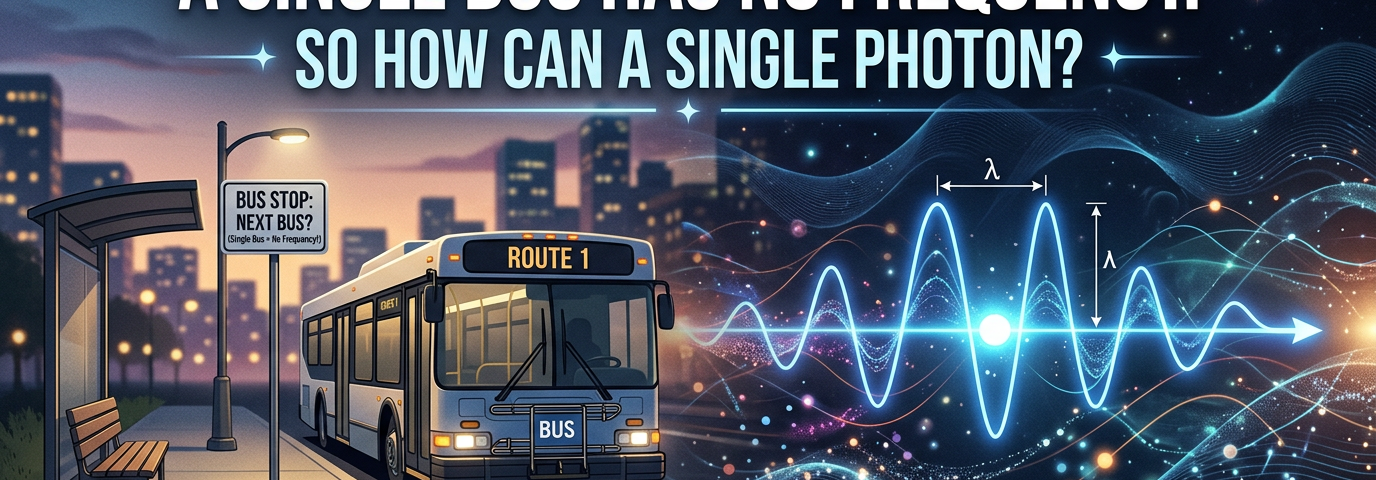
Watch the Bus Go By
A bus passes your house at eight in the morning. Just once. It rolls by, turns the corner, and is gone.
What is its frequency?

The question has no answer, because frequency is not a thing a single passing object can possess. Frequency means how often — how many times something happens in a given stretch of time. One bus, passing one time, has no “how often.” It just went by. To even ask about its frequency, you would need a second bus, and a third, and a rhythm between them: one bus every ten minutes, six buses an hour. Frequency lives in the spacing between repeated things. Take away the repetition and the frequency vanishes — not because we failed to measure it, but because there is nothing there to measure.
Hold onto that bus. It is about to dismantle one of the strangest claims in modern physics.
The Claim That Doesn’t Survive the Question
Modern physics says light is made of photons — individual, indivisible particles. And in the same breath, it says each photon has a frequency. A red photon has a lower frequency; a violet photon has a higher one. The energy of the photon is even calculated directly from that frequency.
Now put those two statements side by side and ask the bus question.
If a photon is a single particle — one thing — what is doing the repeating? Frequency requires more than one event, spaced in time. It is a property of a series, not of an individual. A lone particle, like a lone bus, has no “how often.” So when physics attaches a frequency to a single photon, it is attaching a property of repetition to a thing that, by its own definition, never repeats. It is describing the spacing of a series while insisting there is only one member in it.
This is not a small wrinkle. It is a logical impossibility hiding inside the foundational object of quantum optics. A single particle being “photonic” — carrying a frequency all by itself — is not a difficult idea or a counterintuitive one. It is simply incoherent, the way a one-bus bus schedule is incoherent. One of anything can never carry a frequency, because frequency is the name we give to the rhythm between things.
Physics has lived with this contradiction for over a century by not looking directly at it. The mathematics works beautifully — you can predict every angle, every energy, every spectral line. But the physical claim underneath, that a single structureless point somehow is a frequency, was never coherent, and no amount of mathematical success makes it so.
Newton Saw the Problem — and Reached for Size
This is not a new struggle. Three hundred years ago, Isaac Newton looked at light and concluded it was made of particles — corpuscles, he called them, tiny bodies streaming from luminous sources in straight lines. On this much, Newton’s instinct ran in the same direction as the model we will come to: light is made of real things, moving.
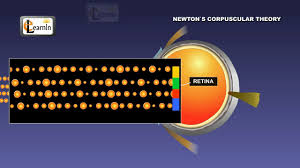
But then Newton hit the same wall, and he had to answer the same question: if light is particles, what makes one color different from another? Newton believed that different colors corresponded to particles of different sizes — larger, slower particles for red, smaller, faster ones for violet. Each color was a different size of corpuscle, and the prism sorted them by how much each size was bent.
It was a reasonable guess for its time. But it does not work, and it does not make sense.
Size is a property a single particle can have — and that is exactly why it fails. If color were size, then a single corpuscle would carry its color all on its own, and we would be right back to a lone bus claiming a schedule. Worse, size explains nothing about why color behaves the way it does. Why should a slightly larger particle look red rather than loud, or heavy, or sharp? The link between a diameter and a color is pure assertion — there is no mechanism in it, only a label swapped for another label. The idea that color comes from the size of the particle has no justification behind it; it was never more than a guess. Newton’s wider scheme ran into trouble on other grounds too — to make refraction come out right, he had to assume light travels faster in a denser medium than in a thinner one, which was later shown to be false — but the color-by-size idea was hollow from the start.
Newton had the right raw material — particles — and the wrong property. He looked for color in the size of one thing, when color was never going to live inside a single thing at all. He was one step away and facing the wrong direction.
Robert de Hilster’s Model Resolves It
This is exactly why Robert de Hilster’s model is so revealing. It keeps Newton’s correct instinct — that light is real particles in motion — and abandons his mistake. It does not locate color in the size of a particle. It locates color where frequency actually lives: in the spacing between many particles.

In the Four Universal Motions, light is never a single particle. Light is many similar particles traveling together — moving in the same direction, at the same speed, in formation. Picture a long stream of identical particles flowing forward as a groups of particles traveling together like waves of bombers. The particles are real. The group is real. And the frequency is real too, because now there is finally something to count: the peaks of the formation, one after another, spaced out along the line of travel.
The frequency is the spacing between those groups of particles. Tightly spaced groups are what we see as blue and violet; widely spaced groups are what we see as red. That is what color is — not a magic number stamped onto a lonely particle, and not the diameter of a single corpuscle, but the literal rhythm of a procession of particles streaming past. The buses are back, and now there are many of them, in a steady cadence. Now you can ask how often, because now there is a how-often to ask about.
What we call a luminic wave is simply this: any group of similar particles, traveling together at the same speed, moving in coordinated formation. Notice that the particles themselves can be identical — same size, same kind. The color does not come from what each one is; it comes from how they are spaced as they travel. Give Robert’s model a single particle and it makes no claim of frequency at all — correctly, because one particle has none. Give it a stream, and the frequency appears naturally, for the only reason frequency ever appears anywhere: because something is happening over and over, with spacing in between.
Why This Matters
The mainstream photon asks you to believe that a single, partless, sizeless point carries a property that, everywhere else in nature, only a series can carry. It asks you to accept the bus schedule of a single bus. Newton, to his credit, at least reached for something physical — but he hung color on the size of one particle, and a property of one particle can never become a frequency either.
Robert’s model asks for nothing of the kind. It says light is what it looks like when you slow it down in your mind: a multitude of particles, moving together, their groups marching past in rhythm. The wave is the formation. The frequency is the spacing. The color is the cadence. There is no impossible single thing that must somehow be a wave all by itself — there is only the natural, countable rhythm of many things in motion.
One bus has no frequency. One particle has no frequency, and no size will give it one. But a stream of particles, traveling past in groups, has a rhythm you can count — and that rhythm is what we have always called light.
