
The Picture That Replaced Understanding
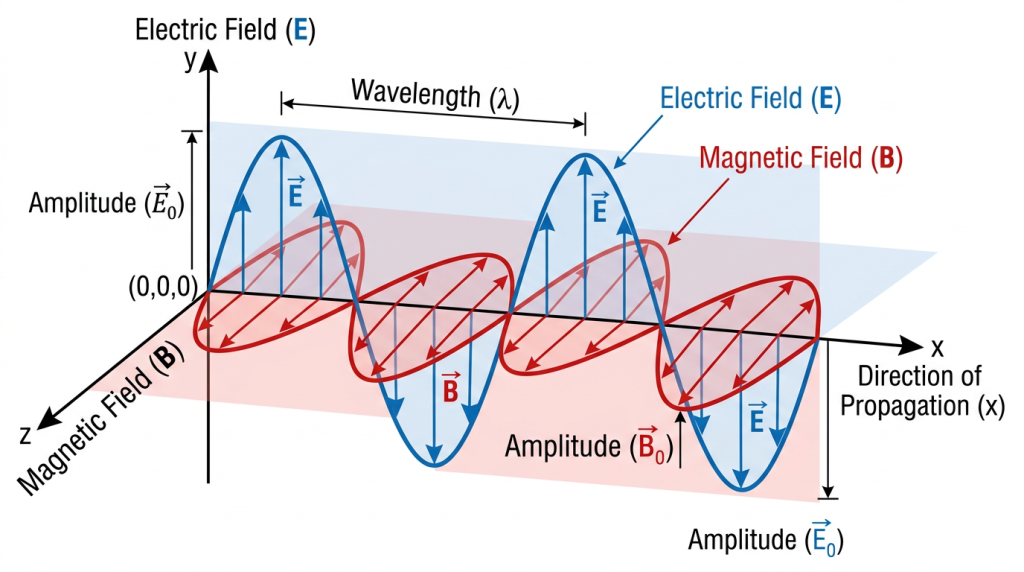
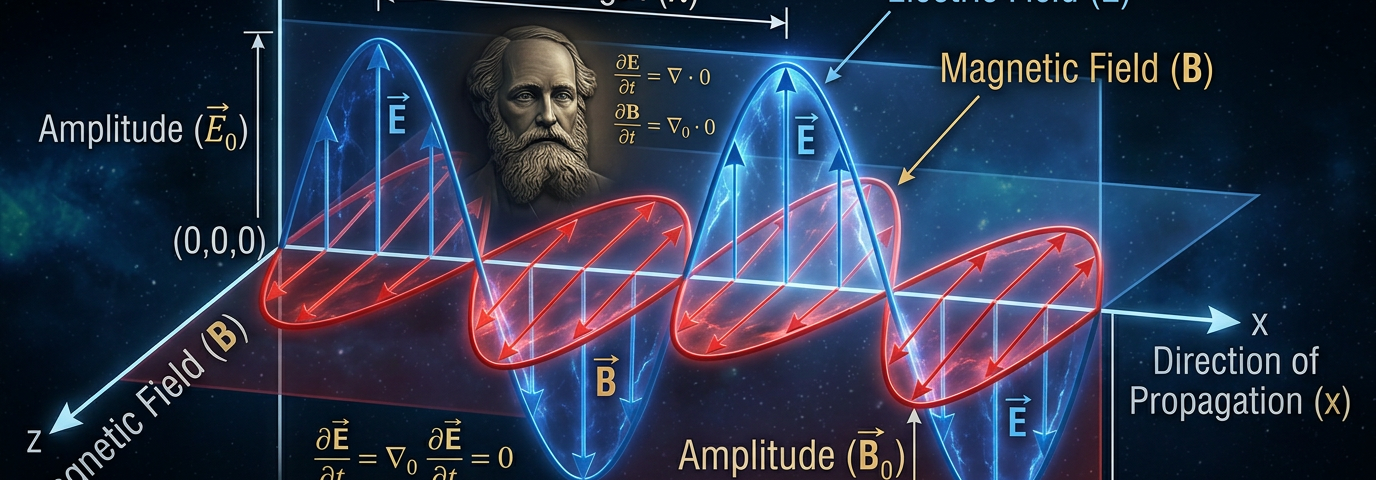
Every textbook shows it. Two sine waves threading down an axis — one blue, one red — riding perpendicular to each other through empty space. The electric field oscillates up and down, the magnetic field side to side, and together they march off toward the horizon at the speed of light. It is one of the most reproduced images in all of physics, and it is sold to us as a picture of what light is.
It is nothing of the kind. It is a graph of a mathematical relationship dressed up as a physical object, and once you ask the questions the picture is designed to keep you from asking, it falls apart.
What Maxwell Actually Did
Maxwell’s achievement was real, but it was not the one he is usually credited with. He took the experimental relationships that Faraday, Ampère, and others had uncovered — a changing magnetic field induces an electric one, a current produces a magnetic field around it — and he wrote them down as a tightly connected set of equations. That much is solid. It describes, with great precision, how these forces relate to one another in specific situations.
Then he noticed something. The constants buried in those equations, when combined, produced a velocity. And that velocity was the speed of light.
From this coincidence of numbers, Maxwell made a leap. If the math churned out the speed of light, then light itself must be an electromagnetic disturbance — an oscillation propagating with an electric component and a magnetic component, the two locked perpendicular to each other, regenerating one another as they travel.
That leap is the whole problem. He did not unify electricity, magnetism, and light by explaining what they are. He unified the force equations and then extrapolated a physical wave out of a numerical match. The famous picture is what you get when you plot the variables of that extrapolation onto a 3D coordinate system. The coordinate axes give the illusion of a thing sitting in space. But axes are bookkeeping, not substance.
The Questions the Picture Cannot Answer
Treat the diagram as a literal claim about reality and the cracks appear immediately.
What is each field made of? The electric field oscillates “up.” In what medium? Out of what material? The magnetic field oscillates “sideways.” Sideways through what? The picture labels two planes and colors them, but it never says what physical stuff is being displaced. A wave is a disturbance in something. Name the something.
How do the two travel together? We are told the electric and magnetic oscillations are perpendicular and inseparable, each sustaining the other. But this is asserted by the geometry of the drawing, not explained by any mechanism. Two different “fields,” made of unspecified material, somehow bolted at right angles and moving in perfect lockstep forever. As a physical arrangement this is a mystery wearing the costume of an answer.
How do countless rays share the same space? Look up from the page. Light from every star, every lamp, every reflecting surface is crossing the room you are in right now, from all directions, all at once, without colliding, blocking, or scrambling. If light were literally these two oscillating planar fields, the space around you would be a hopeless tangle of intersecting, mutually interfering planes. The diagram shows one tidy ray on a clean axis. Reality has uncountably many, overlapping in every orientation. The picture has no account of this whatsoever.
These are not advanced objections. They are the first things a curious person asks — and the mathematical formalism is structured so that they never get asked, because “it’s just how the equations work” is treated as a sufficient stopping point.
From Force Equations to Physical Models
This is where the Four Universal Motions takes a different road. The goal is not to write a more elegant set of force relationships. It is to say what each thing physically is — to give light, magnetism, electricity, and gravity actual mechanical models instead of equations standing in for understanding.
Light is not a wave in a medium. It is a wave of particles. The oscillation is not an abstract field value rising and falling; it is real particles in motion. That single shift dissolves the “what is the medium” problem, because there is no mysterious substance being displaced — there are particles, and the wave is their pattern of movement.

Magnetism has a physical origin in the wire. When a G1 particle is forced to move through a conductor, it does not only travel along the wire — it also moves around it, outside the wire. That circulation outside the conductor is what we have been labeling the magnetic field. It is not a separate ethereal field sitting perpendicular to an electric one; it is the geometry of how the particles actually move when driven through metal.
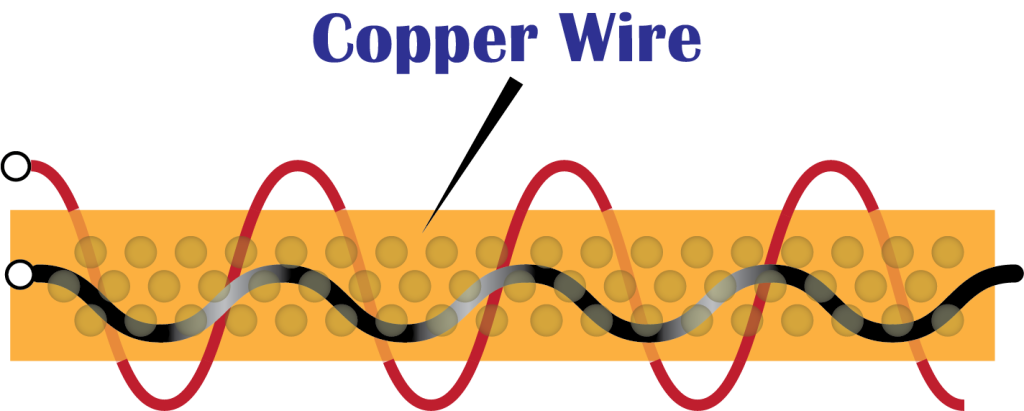
The electric and magnetic fields are replaced by motion, not mysticism. What the textbook calls the electric field is a second gravitic motion — very small, very fast particles operating one level down. What it calls the magnetic field is those particles in orbit. Both “fields” become descriptions of where particles are and how they move, rather than invisible planes of force whose composition no one will specify.
Once you make that move, the unanswerable questions stop being unanswerable. There is a medium, because there are particles. There is a reason magnetism wraps a wire, because that is the path the particles take. And many beams can cross the same space at once for the same reason many streams of particles can — they are things in motion, not rigid planar fields nailed together at right angles.
The Real Lesson
Maxwell was a brilliant physicist and his equations remain a superb description of how electromagnetic forces relate. But describing a relationship is not the same as explaining a thing. The mistake was to take a numerical coincidence — light and electricity share a speed — and promote it into a physical picture, then plot that picture onto coordinate axes until it looked solid enough to put in every textbook.
Shifting from force equations to actual physical models for light, magnetism, electricity, and gravity does not throw away what Maxwell got right. It finishes the job he left undone: saying what is really there.
